Niacin
| vitamin B3 | |
|---|---|
 |
| Salts [] | |
|---|---|
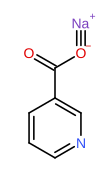
| Sodium niacin | |
 | |
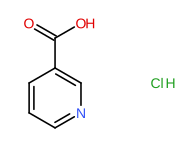
| Niacin hydrochloride | |
 |
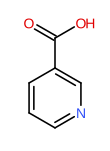
| Molecular structure drawn from PubChem coordinates |
| Physical properties [] | |
|---|---|
| Molecular mass | 123.11 g/mol [1] |
| Appearance | Needles from alcohol or water [1] |
| Odor | Odorless [1] |
| Taste | Sour taste [1] |
| Density | 1.473 (NTP, 1992) - Denser than water; will sink [1] |
| Melting point | 457 °F (NTP, 1992) [1] |
| Boiling point | Sublimes (NTP, 1992) [1] |
| Decomposition | Hazardous decomposition products formed under fire conditions - Carbon oxides, nitrogen oxides (NOx). [1] |
| Solubility | 10 to 50 mg/mL at 63 °F (NTP, 1992) [1] |
| Predicted LogP | 0.4 [1] |
| Structural Identifiers [] | |
|---|---|
| Molecular formula | C6H5NO2 |
| IUPAC name | pyridine-3-carboxylic acid |
| SMILES | C1=CC(=CN=C1)C(=O)O |
| InChI | InChI=1S/C6H5NO2/c8-6(9)5-2-1-3-7-4-5/h1-4H,(H,8,9) |
| InChIKey | PVNIIMVLHYAWGP-UHFFFAOYSA-N |
| CAS number | 59-67-6 |
| UNII | 2679MF687A |
| PubChem CID | 938 |
| Pharmacokinetics[] | |
|---|---|
| Routes of administration | Intramuscular, by mouth |
| Toxicity [] | |
|---|---|
| LD50 | Mouse: - oral: 3720 mg/kg Rat: - sc: 5 g/kg - oral: 7000 mg/kg - ip: 730 mg/kg - Oral: 7000 mg/kg [1] |
Niacin (also known as 3-pyridinecarboxylic acid, 3-Carboxypyridine, Akotin, wampocap, Apelagrin, Pellagrin, Daskil, Efacin, Niaspan or Pelonin) is a vitamin substance of the carboxylic acid class.
Chemistry
Salts []
Stereochemistry []
Niacin is achiral.
Druglikeness
Lipinski's rule of five
Niacin matches Lipinski's rule of five.Pharmacology
ATC Classification
- cardiovascular system (C)
- peripheral vasodilators (C04)
- peripheral vasodilators (C04A)
- nicotinic acid and derivatives (C04AC)
- nicotinic acid (C04AC01)
- lipid modifying agents (C10)
- lipid modifying agents, plain (C10A)
- nicotinic acid and derivatives (C10AD)
- nicotinic acid (C10AD02)
MeSH Classification
Mechanism of action []
Niacin performs a number of functions in the body and so has many mechanisms, not all of which have been fully described. Niacin can decrease lipids and apolipoprotein B (apo B)-containing lipoproteins by modulating triglyceride synthesis in the liver, which degrades apo B, or by modulating lipolysis in adipose tissue. Niacin inhibits hepatocyte diacylglycerol acyltransferase-2. This action prevents the final step of triglyceride synthesis in hepatocytes, limiting available triglycerides for very low density lipoproteins (VLDL). This activity also leads to intracellular degradation of apo B and decreased production of low density lipoproteins, the catabolic product of VLDL. Niacin also inhibits a high density lipoprotein (HDL) catabolism receptor, which increases the levels and half life of HDL. [1]
Prodrugs of niacin: Picamilon.
Medical side effects []
164 side effects listed on drug labels in SIDER 4.1 (niacin).
- Diarrhoea
- Nausea
- Dermatitis
- Rash
- Vomiting
- Cough
- Cough increased
- Anaphylactic shock
- Angioedema
- Arrhythmia
- Asthenia
- Atrial fibrillation
- Dizziness
- Syncope
- Dyspnoea
- Eructation
- Flatulence
- Flushing
- Generalized flushing
- Gout
- Hepatitis
- Hypersensitivity
- Hypotension
- Orthostatic hypotension
- Jaundice
- Laryngeal oedema
- Laryngospasm
- Myopathy
- Nervousness
- Tension
- Palpitations
- Paraesthesia
- Tingling sensation
- Peptic ulcer
- Hyperhidrosis
- Shock
- Loss of consciousness
- Tachycardia
- Urticaria
- Burning sensation
- Oedema peripheral
- Migraine
- Tongue disorder
- Tongue oedema
- Glucose tolerance decreased
- Rash pustular
- Dermatitis bullous
- Skin discolouration
- Dry skin
- Myalgia
- Musculoskeletal discomfort
- Arthralgia
- Skin burning sensation
- Macular oedema
- Vision blurred
- Rash maculo-papular
- Face oedema
- Insomnia
- Abdominal pain
- Gastrointestinal pain
- Acanthosis nigricans
- Alopecia
- Amblyopia
- Angina pectoris
- Decreased appetite
- Arthritis
- Ascites
- Bone disorder
- Bronchitis
- Bursitis
- Cholelithiasis
- Cholestasis
- Dysphagia
- Dermatitis contact
- Fungal skin infection
- Diabetes mellitus
- Dyspepsia
- Heartburn
- Eczema
- Oedema
- Oesophagitis
- Eye disorder
- Faecal incontinence
- Body temperature increased
- Fibrosis
- Furuncle
- Gastrointestinal disorder
- Gastrointestinal symptom NOS
- Gastrointestinal haemorrhage
- Glaucoma
- Headache
- Haemoptysis
- Haemorrhage
- Haemoglobin
- Hepatomegaly
- Hernia
- Herpes zoster
- Hyperbilirubinaemia
- Hyperinsulinism
- Blood insulin increased
- Hyperventilation
- Hypoaesthesia
- Hypothyroidism
- Libido increased
- Disturbance in sexual arousal
- Influenza
- Jaundice cholestatic
- Hyperkeratosis
- Laryngitis
- Muscle spasms
- Leukopenia
- Lung disorder
- Cystoid macular oedema
- Breast pain
- Hypertonia
- Necrosis
- Pain
- Polyuria
- Urine output increased
- Prostatic disorder
- Pruritus
- Rhabdomyolysis
- Rhinitis
- Neoplasm skin
- Skin ulcer
- Stomatitis
- Tinnitus
- Vaginal inflammation
- Vaginal infection
- Angiopathy
- Vertigo
- Dry mouth
- Urinary retention
- Chills
- Hypokinesia
- Hepatic function abnormal
- Application site reaction
- Generalised oedema
- Fluid retention
- High density lipoprotein decreased
- Liver function test abnormal
- Raised liver function tests
- Mucous membrane disorder
- Malnutrition
- Skin hyperpigmentation
- Skin disorder
- Muscle twitching
- Feeling hot
- Warmth
- Sensation of warmth
- Hepatotoxicity
- Skin exfoliation
- Erectile dysfunction
- Xanthoma
- Erythema
- Abdominal distension
- Metabolic syndrome
- Blood glucose increased
- Blood uric acid increased
- Hyperuricaemia
- Muscular weakness
- Arterial thrombosis
- Somnolence
- Visual impairment
Indications
- Abdominal pain
- Cardiovascular disorder
- Coronary artery disease
- Coronary heart disease
- Diabetic
- Dyslipidaemia
- Flushing
- Gout
- High density lipoprotein increased
- Hypercholesterolaemia
- Hyperlipidaemia
- Hyperlipoproteinemia
- Hypertriglyceridaemia
- Myocardial infarction
- Nicotinic acid deficiency
- Pancreatitis
- Peptic ulcer
- Type 2 diabetes mellitus
- Type V hyperlipidaemia
- Vasodilation
Legal status []
- United States: Niacin is a OTC / Prescription only.
See also []
External links []
References []
National Center for Biotechnology Information. PubChem Compound Summary for CID 938, Niacin. Accessed November 22, 2026. https://pubchem.ncbi.nlm.nih.gov/compound/938
U.S. Food and Drug Administration; National Center for Advancing Translational Sciences. Niacin. UNII: 2679MF687A. Global Substance Registration System. Accessed November 22, 2026. https://gsrs.ncats.nih.gov/ginas/app/beta/substances/2679MF687A
Data sources []
| Source | Status | Updated (UTC) |
|---|---|---|
| dosing | missing (no dosing statistics) | 2026-11-20 21:00:46 |
| drugspro | missing (no DrugsPRO reagent data) | 2026-11-20 21:00:42 |
| erowid | missing (no Erowid substance of that name) | 2026-11-20 21:00:42 |
| gsrs | ok | 2026-11-20 21:00:45 |
| hmdb | missing (hmdb.ca refused automated access to HMDB0001488) | 2026-11-20 21:00:42 |
| kegg | ok | 2026-11-20 21:00:44 |
| pubchem | ok | 2026-11-20 21:00:42 |
| missing (no r/tripreports posts mention it) | 2026-11-20 21:00:42 | |
| sider | ok | 2026-11-20 21:00:43 |
| structure | ok | 2026-11-20 21:00:42 |
| wikipedia | ok | 2026-11-20 21:00:43 |