Nicotine
| Nicotine | |
|---|---|
 |
| Salts [] | |
|---|---|
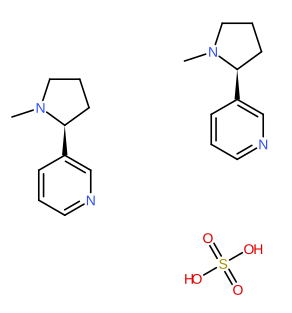
| Nicotine hemisulfate | |
 | |
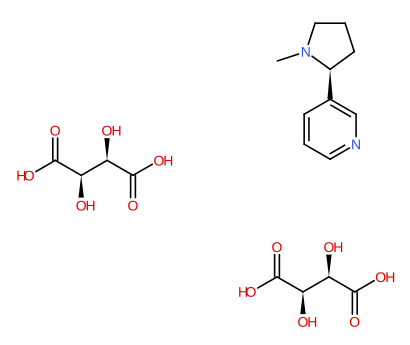
| Nicotine dibitartrate | |
 | |
| Nicotine salicylate | |
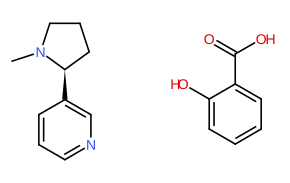 |
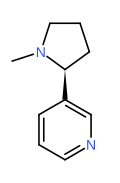
| Molecular structure drawn from PubChem coordinates |
| Physical properties [] | |
|---|---|
| Molecular mass | 162.23 g/mol [1] |
| Appearance | Colorless to pale yellow, oily liquid [1] |
| Odor | Fish-like odor when warm [1] |
| Taste | Acrid, burning [1] |
| Density | 1.0097 at 68 °F (EPA, 1998) - Denser than water; will sink [1] |
| Melting point | -110 °F (EPA, 1998) [1] |
| Boiling point | 476.1 °F at 745 mmHg (EPA, 1998) [1] |
| Decomposition | When heated to decomp it emits /nitrogen oxides, carbon monoxide/ and other highly toxic fumes. ... [1] |
| Solubility | Miscible (NTP, 1992) [1] |
| Predicted LogP | 1.2 [1] |
| Structural Identifiers [] | |
|---|---|
| Molecular formula | C10H14N2 |
| IUPAC name | 3-[(2S)-1-methylpyrrolidin-2-yl]pyridine |
| SMILES | CN1CCC[C@H]1C2=CN=CC=C2 |
| InChI | InChI=1S/C10H14N2/c1-12-7-3-5-10(12)9-4-2-6-11-8-9/h2,4,6,8,10H,3,5,7H2,1H3/t10-/m0/s1 |
| InChIKey | SNICXCGAKADSCV-JTQLQIEISA-N |
| CAS number | 54-11-5 |
| UNII | 6M3C89ZY6R |
| PubChem CID | 89594 |
| Pharmacokinetics[] | |
|---|---|
| Elimination half-life | 1–2 hours; 16–19 hours cotinine (range is 10–27 hours)[3] |
| Metabolism | Primarily hepatic: CYP2A6, CYP2B6, FMO3, others |
| Excretion | Renal, urine pH-dependent;, 10-20% (gum), 30% (inhaled); 10-30% (intranasal)[4] |
| Routes of administration | Inhalation, insufflation, oral, buccal, sublingual, rectal, transdermal, ophthmalmic |
| Dependence liability | Physical: Low–moderate Psychological: High[5][6] |
| Addiction liability | Very high[7] |
| Toxicity [] | |
|---|---|
| LD50 | Rat: - oral: 188 mg/kg - ip: 30 mg/kg - dermal: 140 mg/kg - sc: 33.5 mg/kg - Dermal: 140 mg/kg [1] |
Nicotine (also known as L-Nicotine, (-)-Nicotine, (S)-Nicotine, (S)-3-(1-methylpyrrolidin-2-yl)pyridine, Habitrol, (S)-(-)-Nicotine, Nicotrol, Nicoderm, Nicoderm Cq or Fumetobac) is a substance of the pyrrolidine class.
It is a constituent of tobacco.
Chemistry
Salts []
Stereochemistry []
Nicotine is a single defined stereoisomer (optical activity ( - )).
Druglikeness
Lipinski's rule of five
Nicotine matches Lipinski's rule of five.Pharmacology
ATC Classification
- nervous system (N)
- other nervous system drugs (N07)
- drugs used in addictive disorders (N07B)
- drugs used in nicotine dependence (N07BA)
- (N07BA01)
- nicotine (N07BA01)
MeSH Classification
- smoking cessation agents (M000640785)
- ganglionic stimulants (M0008986)
- nicotinic agonists (M0028051)
Mechanism of action []
Nicotine is a stimulant drug that acts as an agonist at nicotinic acetylcholine receptors. These are ionotropic receptors composed up of five homomeric or heteromeric subunits. In the brain, nicotine binds to nicotinic acetylcholine receptors on dopaminergic neurons in the cortico-limbic pathways. This causes the channel to open and allow conductance of multiple cations including sodium, calcium, and potassium. This leads to depolarization, which activates voltage-gated calcium channels and allows more calcium to enter the axon terminal. Calcium stimulates vesicle trafficking towards the plasma membrane and the release of dopamine into the synapse. Dopamine binding to its receptors is responsible the euphoric and addictive properties of nicotine. Nicotine also binds to nicotinic acetylcholine receptors on the chromaffin cells in the adrenal medulla. Binding opens the ion channel allowing influx of sodium, causing depolarization of the cell, which activates voltage-gated calcium channels. Calcium triggers the release of epinephrine from intracellular vesicles into the bloodstream, which causes vasoconstriction, increased blood pressure, increased heart rate, and increased blood sugar. [1]
Interactions []
Medical side effects []
163 side effects listed on drug labels in SIDER 4.1 (nicotine).
- Back pain
- Headache
- Arthralgia
- Musculoskeletal discomfort
- Myalgia
- Dyspnoea
- Menstrual disorder
- Palpitations
- Tooth disorder
- Nausea
- Vertigo
- Abdominal pain
- Gastrointestinal pain
- Confusional state
- Feeling abnormal
- Malaise
- Dysmenorrhoea
- Flatulence
- Pain
- Diarrhoea
- Dysgeusia
- Oedema
- Dermatitis
- Rash
- Pruritus
- Paraesthesia
- Stomatitis
- Mouth ulceration
- Ulcerative stomatitis
- Dyspepsia
- Heartburn
- Tongue disorder
- Acne
- Amnesia
- Anaphylactic shock
- Angioedema
- Anxiety
- Aphasia
- Arrhythmia
- Arthritis
- Asthenia
- Fatigue
- Atrial fibrillation
- Mental disorder
- Blister
- Dermatitis bullous
- Bronchospasm
- Bronchitis
- Chest pain
- Chest discomfort
- Constipation
- Cough
- Cystitis
- Bladder pain
- Cystitis noninfective
- Dysphagia
- Dizziness
- Syncope
- Drug abuse
- Ear pain
- Epistaxis
- Eructation
- Prostration
- Body temperature increased
- Flushing
- Gastrointestinal disorder
- Gingivitis
- Cardiac disorder
- Cardiac failure
- Oral herpes
- Hiccups
- Dysphonia
- Hypersensitivity
- Hypertension
- Hypotension
- Immune system disorder
- Influenza
- Irritability
- Muscle spasms
- Mediastinal disorder
- Nasal congestion
- Nervous system disorder
- Nervousness
- Tension
- Nicotine dependence
- Hypoaesthesia
- Sensory loss
- Pallor
- Pharyngitis
- Respiratory paralysis
- Rhinitis
- Salivary hypersecretion
- Convulsion
- Shock
- Sinusitis
- Sleep disorder
- Sneezing
- Gastric ulcer
- Aphthous stomatitis
- Withdrawal syndrome
- Completed suicide
- Loss of consciousness
- Tachycardia
- Thyroid disorder
- Toothache
- Tremor
- Erythema
- Redness
- Urticaria
- Vomiting
- Weight increased
- Dry mouth
- Burning sensation
- Agitation
- Apathy
- Flat affect
- Mood swings
- Affect lability
- Oedema peripheral
- Migraine
- Application site reaction
- Abnormal faeces
- Discomfort
- Ill-defined disorder
- Muscle twitching
- Cold sweat
- Increased appetite
- Abdominal pain upper
- Memory impairment
- Motor dysfunction
- Tenderness
- Disturbance in attention
- Mental disability
- Eye irritation
- Abnormal dreams
- Pain in jaw
- Tobacco poisoning
- Nasal discomfort
- Nasal ulcer
- Extrasystoles
- Influenza like illness
- Oral discomfort
- Dependence
- Blood pressure increased
- Coordination abnormal
- Fluid retention
- Menopausal symptoms
- Hot flush
- Throat irritation
- Hyperhidrosis
- Local swelling
- Local reaction
- Laryngeal pain
- Insomnia
- Abdominal discomfort
- Respiratory failure
- Tobacco withdrawal symptoms
- Nasopharyngitis
- Rhinorrhoea
- Blood pressure fluctuation
- Somnolence
- Lacrimation increased
- Visual impairment
Indications
- Angina pectoris
- Arrhythmia
- Coronary heart disease
- Eczema
- Endocrine disorder
- Hepatic impairment
- Hepatic insufficiency
- Hypersensitivity
- Local reaction
- Malignant hypertension
- Myocardial infarction
- Nicotine dependence
- Non-smoker
- Palpitations
- Peptic ulcer
- Peripheral vascular disorder
- Pregnancy
- Prinzmetal angina
- Rash generalised
- Renal impairment
- Sensitisation
- Skin disorder
- Sleep disturbance
- Thromboangiitis obliterans
- Urticaria
- Vasodilation
- Withdrawal symptom
Subjective effects []
| 0xea / Nicotine [] | |
|---|---|
Routes:
| |
| a1ko / Nicotine [] | |
|---|---|
Routes:
| |
| alina / Nicotine [] | |
|---|---|
Routes:
| |
| bonzi / Nicotine [] | |
|---|---|
| emily / Nicotine [] | |
|---|---|
Routes:
| |
| magnus / Nicotine [] | |
|---|---|
Routes:
| |
| Mere / Nicotine [] | |
|---|---|
| nervewing / Nicotine [] | |
|---|---|
| Pilz / Nicotine [] | |
|---|---|
Routes:
| |
Experience reports
Erowid
There are currently 30 experience reports involving nicotine on Erowid: []- "New Person" by expers
- "Withdrawal Gnawing With My Mental Health" by user9298405
- "The Night of Restoration of My Sanity" by CD
- "Technicolor Dreams" by Angryferret
- "For Anxiety and Smoking Cessation" by I am nemo.
- "Patch Dreaming for a Non-Smoker" by MonkeyBoy
- "Stimulated All Day" by drizzy
- "I Had Been Tipped Into Hypomania" by expsme
- "Empathy for the Addicts" by Bishop Roberts
- "Subtle Relaxation With a Touch of Psychedelia" by Sykah Delik
- "I Have Been Using It for Two Weeks" by Finula
- "How to Keep Getting That High" by Mishkin
- "It Looked Like It Was Snowing" by Jdizzle
- "Enveloping Bliss" by Blinky
- "Reducing My Nicotine Cravings" by melli
- "A New Way to Smoke" by plutonic
- "The Best High Ever!" by Lotusmountain2
- "And Weed is Legal?" by Paddos
- "A Big Disappointment" by Pulsewidth
- "How to OD on Nicotine" by Kaoz the Assasin
- "Strange, Intense, Somewhat Uncomfortable Focus" by dexarian
- "Confusing And Not Really Worth it" by lthompson
- "They Have Helped Me Lucid Dream" by parallelograndma
- "A Potent Alternative To Vaping Or Chewing" by PJ
- "Shooting Up Dilute Solution" by Smalapander
- "Railing on Thin Ice" by LOL
- "Dopamine Dysfunction" by BeachesNSneeches
- "SRNI Effects on Psychoactives" by EuphoricMarine
- "Lucid" by mistabishi
- "Noticeable Symptomatic Juxtaposition" by THe Abbr.
- "Cigarette trip report" by awmolina03 (146 upvotes)
- "Friend tried to kill me while on LSD..twice" by canderson99 (79 upvotes)
- "I Have Tried Every Single Drug and Steroid" by Hangeth_Thy_Dong (51 upvotes)
- "The Soup: 250ug LSD, 22mg 2C-B, Nitrous Oxide, Cannabis, and Nicotine." by postcooked_2 (49 upvotes)
- "Doing Every Drug For The Last Time" by stjakey (39 upvotes)
- "Salvia, DXM, Nitrous and Tobacco: Became a salvia god" by [deleted] (35 upvotes)
- "How 6 Grams of Shrooms “Released” Me From Nicotine For Good." by PsychedelicWalnuts (31 upvotes)
- "Tripping 350 ug LSD at Kalahari (Waterpark Resort in Pennsylvania) Craziest Trip of my Life" by ollie_tripz (31 upvotes)
- "Weed became my nicotine" by stjakey (30 upvotes)
- "Ego death on 6 grams of shrooms or what I thought to be shrooms (4 aco dmt) AMA" by zachisbofa- (27 upvotes)
- "Visualising addiction using mushrooms" by ingoodspirit (26 upvotes)
- "Pretty Wild LSD Trip" by MoneyshotMonday (25 upvotes)
- "LSD, LSA, weed, alcohol, nicotine and nitrous trip report" by 420gayspacecommunist (24 upvotes)
- "The first time I dropped acid (overwhelming & scary)" by strangegeneration94 (22 upvotes)
- "Two Tabs with an ex-girlfriend" by ollie_tripz (20 upvotes)
- "Bad shrooms trip left me packed with anxiety, paranoia, panic attacks, and the meaning to life?" by poopityscoopity12345 (19 upvotes)
- "Ketamine/MDMA/nicotine/weed/nitrous/kratom" by vandyape (16 upvotes)
- "Nicotine Trip" by 23u32 (15 upvotes)
- "Friend on 500ug LSD accidentally took 600 mg of DXM and had a crazy ego death." by soupkid5 (15 upvotes)
- "MDMA peak + MXE + DMT & MDMA comedown + Ketamine + DMT (weed & nicotine used throughout)" by OOglyshmOOglywOOgly (15 upvotes)
- "Almost left my body" by HerbRat (14 upvotes)
- "My amazing first experience with Magic Truffles" by xoxloudy (14 upvotes)
- "17 yo insane shroom trip, Blue Magnolia Shrooms" by simppslayerr (13 upvotes)
- "First time trying drugs, 1g edibles and 46ug lsd (bad trip)" by CrazyCampPRO (12 upvotes)
- "Nutmeg Trip ~ 1 tbsp" by juicedog010 (12 upvotes)
- "Accidental Trip Turned Out Great & Allegedly Helped Me Recover from a "Psychic Collision"" by Didymos_Black (12 upvotes)
- "some DMT & lots of pot in Fresno" by beezeezy412 (12 upvotes)
- "Running up the dose with 4-ACO-DMT." by WandaLovingLegend (12 upvotes)
- "My horrible experience with Alpha GPC" by strangegeneration94 (11 upvotes)
- "5.5 grams, PE (revised)" by smokmajana (11 upvotes)
- "600ug trip report- reminding myself what's important" by lowkey_add1ct (11 upvotes)
- "Weed Trip Report/Story" by MikkelLoekke (10 upvotes)
- "3.2-3.7 lemon tekked golden teachers trip report" by PsychologicalLeave19 (10 upvotes)
- "Derealization while high - Weed + snus (nicotine)" by eldense (10 upvotes)
- "My terrifying and confusing drug experience." by PomegranateIcy6520 (9 upvotes)
- "3rd Time Tripping Shrooms - 2.5g + 1.0g + 0.5g Booster Dose" by ChemistryNegative51 (9 upvotes)
- "Description, comparison and rating of 14 opioids " by PsychedStrawberry (9 upvotes)
- "Caffeine, Nicotine, Diazepam - A day of opposites" by [deleted] (9 upvotes)
- "a 3.5g Psilocybin, THC, and Nicotine experience" by bloodblade58 (8 upvotes)
- "Lsdxm 450mg hbr + 75ug." by lowkey_add1ct (8 upvotes)
- "My first time with DPH" by Claimedred (8 upvotes)
- "LSD+3-HO-PCP trip report" by lowkey_add1ct (7 upvotes)
- "Eighth of penis envy mushrooms = seizure and love" by Ollietrips4505 (7 upvotes)
- "Test your tabs" by Neverunknown9 (7 upvotes)
- "first time meeting an online friend u already know we got high as hell" by HistoricalNebula5050 (6 upvotes)
- "First trip 4g [shroom] chocolate bar" by jakethelizard99 (6 upvotes)
- "First and only time taking LSD" by Particular-Let-2485 (6 upvotes)
- "The meaning of life is to create meaning. " by unemployedthug (6 upvotes)
- "The infinite loop" by zaafiel8 (6 upvotes)
- "4 grams of Psilocybe Cubensis and Salvia 10x alone in the woods for guidance and healing" by postcooked_2 (6 upvotes)
Legal status []
- Australia: Nicotine is a Schedule 7.
- Canada: Nicotine is Unscheduled.
- Brazil: Nicotine is Unscheduled.
- Germany: Nicotine is Unscheduled.
- New Zealand: Nicotine is Unscheduled.
- United Kingdom: Nicotine is a GSL.[8]
- United States: Nicotine is a OTC and prescription.[9]
- United Nations: Nicotine is Unscheduled.
- European Union: Nicotine is Unscheduled / OTC.
- Other: Nicotine is a SE: Unscheduled / OTC MX: Unscheduled / OTC.[10][11][12][13][14][15]
See also []
External links []
References []
National Center for Biotechnology Information. PubChem Compound Summary for CID 89594, Nicotine. Accessed November 21, 2026. https://pubchem.ncbi.nlm.nih.gov/compound/89594
U.S. Food and Drug Administration; National Center for Advancing Translational Sciences. Nicotine. UNII: 6M3C89ZY6R. Global Substance Registration System. Accessed November 21, 2026. https://gsrs.ncats.nih.gov/ginas/app/beta/substances/6M3C89ZY6R
Jarvis MJ, Russell MA, Benowitz NL, Feyerabend C. Elimination of cotinine from body fluids: Implications for noninvasive measurement of tobacco smoke exposure. American Journal of Public Health. 1988; 78(6):696–698. PMID 3369603. https://doi.org/10.2105/ajph.78.6.696
Landoni JH. Nicotine (PIM). INCHEM. http://www.inchem.org/documents/pims/chemical/nicotine.htm
McLaughlin I, Dani JA, De Biasi M. The Neuropharmacology of Nicotine Dependence. 2015. https://doi.org/10.1007/978-3-319-13482-6_4
Cosci F, Pistelli F, Lazzarini N, Carrozzi L. Nicotine dependence and psychological distress: outcomes and clinical implications in smoking cessation. Psychology Research and Behavior Management. 2011; 4:119–128. PMID 22114542. https://doi.org/10.2147/prbm.s14243
Hollinger MA. Introduction to Pharmacology. CRC Press. 19 October 2007. https://books.google.com/books?id=qfrLBQAAQBAJ&pg=PA222
The Medicines (Products Other Than Veterinary Drugs) (General Sale List) Amendment Order 2001. legislation.gov.uk. https://www.legislation.gov.uk/uksi/2001/2068/note/made?view=plain
Nicotine. United States National Library of Medicine – National Center for Biotechnology Information. 16 February 2019. https://pubchem.ncbi.nlm.nih.gov/compound/nicotine
Lag (2018:2088) om tobak och liknande produkter. Swedish Parliament. 20 December 2018. https://www.riksdagen.se/sv/dokument-och-lagar/dokument/svensk-forfattningssamling/lag-20182088-om-tobak-och-liknande-produkter_sfs-2018-2088/
Lag (2022:1257) om tobaksfria nikotinprodukter. Swedish Parliament. 30 June 2022. https://www.riksdagen.se/sv/dokument-och-lagar/dokument/svensk-forfattningssamling/lag-20221257-om-tobaksfria-nikotinprodukter_sfs-2022-1257/
Dejar de fumar. Centro Estatal de Vigilancia Epidemiológica y Control de Enfermedades. https://cevece.edomex.gob.mx/sites/cevece.edomex.gob.mx/files/files/docs/tripticos/2024/Semana02.pdf
Ley General para el Control del Tabaco. Cámara de Diputados del H. Congreso de la Unión. 17 February 2022. https://www.diputados.gob.mx/LeyesBiblio/pdf/LGCT.pdf
Código Civil Federal. Cámara de Diputados del H. Congreso de la Unión. 14 November 2025. https://www.diputados.gob.mx/LeyesBiblio/pdf/CCF.pdf
Ley General de Salud. Cámara de Diputados del H. Congreso de la Unión. 15 January 2026. https://www.diputados.gob.mx/LeyesBiblio/pdf/LGS.pdf
Data sources []
| Source | Status | Updated (UTC) |
|---|---|---|
| dosing | missing (no dosing statistics) | 2026-11-20 11:59:40 |
| drugspro | missing (no DrugsPRO reagent data) | 2026-11-20 11:59:36 |
| erowid | ok | 2026-11-20 11:59:39 |
| gsrs | ok | 2026-11-20 11:59:38 |
| hmdb | missing (hmdb.ca refused automated access to HMDB0001934) | 2026-11-20 11:59:36 |
| kegg | ok | 2026-11-20 11:59:39 |
| pubchem | ok | 2026-11-20 11:59:36 |
| ok | 2026-11-20 11:59:36 | |
| sider | ok | 2026-11-20 11:59:36 |
| structure | ok | 2026-11-20 11:59:36 |
| wikipedia | ok | 2026-11-20 11:59:36 |