Nonivamide
| Nonivamide | |
|---|---|
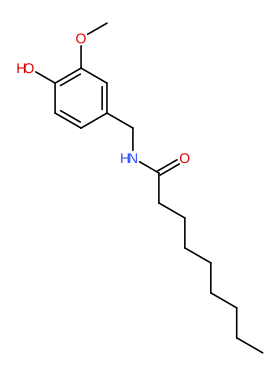 |
| Molecular structure drawn from PubChem coordinates |
| Physical properties [] | |
|---|---|
| Molecular mass | 293.40 g/mol [1] |
| Melting point | 57 [1] |
| Boiling point | 492.7 [1] |
| Solubility | Soluble in water (slightly) [1] |
| Predicted LogP | 4.2 [1] |
| Structural Identifiers [] | |
|---|---|
| Molecular formula | C17H27NO3 |
| IUPAC name | N-[(4-hydroxy-3-methoxyphenyl)methyl]nonanamide |
| SMILES | CCCCCCCCC(=O)NCC1=CC(=C(C=C1)O)OC |
| InChI | InChI=1S/C17H27NO3/c1-3-4-5-6-7-8-9-17(20)18-13-14-10-11-15(19)16(12-14)21-2/h10-12,19H,3-9,13H2,1-2H3,(H,18,20) |
| InChIKey | RGOVYLWUIBMPGK-UHFFFAOYSA-N |
| CAS number | 2444-46-4 |
| UNII | S846B891OR |
| PubChem CID | 2998 |
Nonivamide (also known as N-Vanillylnonanamide, Pseudocapsaicin, Pelargonic acid vanillylamide, N-Vanillylnonamide, N-Vanillylpelargonamide, N-(4-Hydroxy-3-methoxybenzyl)nonanamide, Nonanoic acid vanillylamide, N-Nonanoyl vanillylamide, Vanillyl pelargonic amide or Vanillyl-N-nonylamide) is a substance of the benzylamine class.
Chemistry
Stereochemistry []
Nonivamide is achiral.
Druglikeness
Lipinski's rule of five
Nonivamide matches Lipinski's rule of five.Pharmacology
MeSH Classification
- sensory system agents (M0028003)
Mechanism of action []
Nonivamide is a naturally occurring analog of [DB06774], isolated from peppers, described to produce effects similar to [DB06774]. It is an agonist of the VR1 (vanilloid/TRPV1 receptor). It serves as a transient agonist of these receptors, which are potentiated by pro-inflammatory drugs, a phenomenon that leads to thermal hyperalgesia, or increased heat sensation. Nonivamide has been shown to stimulate afferent neurons with about half the potency of [DB06774]. Agonism of the VR1 (TRPV1) (vanilloid) receptor by Nonivamide was demonstrated to induce the release of Ca2+ from the endoplasmic reticulum (ER) of human lung cells, producing ER stress and cell death [MSDS]. Nonivamide, like other capsaicinoids, acts on the vanilloid receptors located in the peripheral afferent nerve fibers, providing short-acting irritant and algesic properties. Applied dermally, these substances act by stimulating sensitive chemoreceptors of the skin and by reflex, hyperemia and a local elevation in temperature. After repetitive administration, capsaicinoids have been reported to lead to desensitization to nociceptive stimuli possibly by long-acting depletion of peptide neurotransmitters (substance P) from peripheral sensory neurons. Capsaicinoids can modulate muscle tone (in bladder, bronchus etc.). Intravenous injection of nonivamide to rats (10 μg/kg) has been found to lead to bradycardia. The cardiovascular effects are partly explained by substance P release. Nonivamide given to rats subcutaneously (1 mg/kg) was found to cause body temperature decrease, vasodilatation, and increased salivation. Capsaicinoids have shown to illicit bronchospastic effects in guinea pigs. Capsaicin and its analogs were reported to increase barbiturate sleeping time in rats by interacting with hepatic metabolizing enzymes. [1]
See also []
External links []
References []
National Center for Biotechnology Information. PubChem Compound Summary for CID 2998, Nonivamide. Accessed November 20, 2026. https://pubchem.ncbi.nlm.nih.gov/compound/2998
U.S. Food and Drug Administration; National Center for Advancing Translational Sciences. Nonivamide. UNII: S846B891OR. Global Substance Registration System. Accessed November 20, 2026. https://gsrs.ncats.nih.gov/ginas/app/beta/substances/S846B891OR
Data sources []
| Source | Status | Updated (UTC) |
|---|---|---|
| dosing | missing (no dosing statistics) | 2026-11-20 20:02:19 |
| drugspro | missing (no DrugsPRO reagent data) | 2026-11-20 20:02:15 |
| erowid | missing (no Erowid substance of that name) | 2026-11-20 20:02:15 |
| gsrs | ok | 2026-11-20 20:02:15 |
| hmdb | missing (hmdb.ca refused automated access to HMDB0029846) | 2026-11-20 20:02:15 |
| kegg | ok | 2026-11-20 20:02:16 |
| pubchem | ok | 2026-11-20 20:02:14 |
| missing (no r/tripreports posts mention it) | 2026-11-20 20:02:15 | |
| sider | missing (not in SIDER) | 2026-11-20 20:02:15 |
| structure | ok | 2026-11-20 20:02:15 |
| wikipedia | missing (no Wikipedia article with a drug infobox) | 2026-11-20 20:02:15 |