Ondansetron
| Ondansetron | |
|---|---|
 |
| Salts [] | |
|---|---|
| Ondansetron dihydrochloride | |
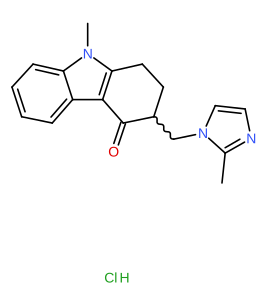 |
| Molecular structure drawn from PubChem coordinates |
| Physical properties [] | |
|---|---|
| Molecular mass | 293.40 g/mol [1] |
| Appearance | Crystals from methanol [1] |
| Melting point | 231-232 °C [1] |
| Solubility | Sparingly soluble in water [1] |
| Predicted LogP | 2.3 [1] |
| Structural Identifiers [] | |
|---|---|
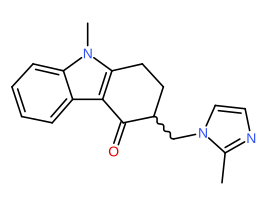
| Molecular formula | C18H19N3O |
| IUPAC name | 9-methyl-3-[(2-methylimidazol-1-yl)methyl]-2,3-dihydro-1H-carbazol-4-one |
| SMILES | CC1=NC=CN1CC2CCC3=C(C2=O)C4=CC=CC=C4N3C |
| InChI | InChI=1S/C18H19N3O/c1-12-19-9-10-21(12)11-13-7-8-16-17(18(13)22)14-5-3-4-6-15(14)20(16)2/h3-6,9-10,13H,7-8,11H2,1-2H3 |
| InChIKey | FELGMEQIXOGIFQ-UHFFFAOYSA-N |
| CAS number | 99614-02-5 |
| UNII | 4AF302ESOS |
| PubChem CID | 4595 |
| Pharmacokinetics[] | |
|---|---|
| Elimination half-life | 5.7 hours |
| Metabolism | Liver (CYP3A4, CYP1A2, CYP2D6) |
| Excretion | Kidney |
| Routes of administration | By mouth, rectal, intravenous, intramuscular, thin film |
| Toxicity [] | |
|---|---|
| LD50 | Mouse: - oral: 10-30 Rat: - oral: 100-150 [1] |
| Dosing[] |
|---|
| Oral [] | |
|---|---|
| Threshold | 1 - 2 |
| Light | ≤ 2 |
| Common | 2 - 4 |
| Strong | 4 |
| Heavy | 4 - 6 |
Statistically derived dosages via DBI-IGS (archived by anodyne.wiki) We do not take any responsibility for medical complications or loss of life sustained by following these dosages blindly. |
Ondansetron (also known as Zudan, Zofran ODT, Zuplenz, ondansetronum, ondasetron, Ondansetron ODT, A04aa01, Eur-1025, Monohydrochloride, Ondansetron or Odansetron (common misspelling of ondansetron)) is a substance of the phenethylamine class.
Chemistry
Salts []
Stereochemistry []
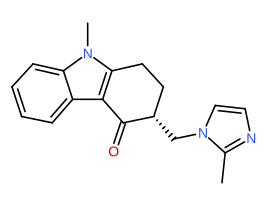
Ondansetron is a racemic mixture of the enantiomers (optical activity ( + / - )).
| Stereoisomerism |
|---|
| Stereoisomers from PubChem |

Druglikeness
Lipinski's rule of five
Ondansetron matches Lipinski's rule of five.Pharmacology
ATC Classification
- alimentary tract and metabolism (A)
- antiemetics and antinauseants (A04)
- antiemetics and antinauseants (A04A)
- serotonin (5ht3) antagonists (A04AA)
- (A04AA01)
- ondansetron (A04AA01)
MeSH Classification
Mechanism of action []
Ondansetron is a selective antagonist of the serotonin receptor subtype, 5-HT3. Cytotoxic chemotherapy and radiotherapy are associated with the release of serotonin (5-HT) from enterochromaffin cells of the small intestine, presumably initiating a vomiting reflex through stimulation of 5-HT3 receptors located on vagal afferents. Ondansetron may block the initiation of this reflex. Activation of vagal afferents may also cause a central release of serotonin from the chemoreceptor trigger zone of the area postrema, located on the floor of the fourth ventricle. Thus, the antiemetic effect of ondansetron is probably due to the selective antagonism of 5-HT3 receptors on neurons located in either the peripheral or central nervous systems, or both. Although the mechanisms of action of ondansetron in treating postoperative nausea and vomiting and cytotoxic induced nausea and vomiting may share similar pathways, the role of ondansetron in opiate-induced emesis has not yet been formally established. [1]
Interactions []
Medical side effects []
121 side effects listed on drug labels in SIDER 4.1 (ondansetron).
- Wound
- Somnolence
- Headache
- Musculoskeletal pain
- Asthenia
- Fatigue
- Malaise
- Discomfort
- Feeling abnormal
- Ill-defined disorder
- Hypoxia
- Body temperature increased
- Genital disorder female
- Constipation
- Anxiety
- Agitation
- Bradycardia
- Dizziness
- Syncope
- Chills
- Urinary retention
- Dry mouth
- Anorectal discomfort
- Feeling hot
- Warmth
- Hypotension
- Pruritus
- Diarrhoea
- Injection site reaction
- Chest pain
- Dysuria
- Paraesthesia
- Feeling cold
- Procedural pain
- Dyskinesia
- Movement disorder
- Orofacial dyskinesia
- Convulsion
- Liver function test abnormal
- Anaphylactic shock
- Anaphylactoid reaction
- Angina pectoris
- Angioedema
- Arrhythmia
- Atrial fibrillation
- Bronchospasm
- Neoplasm malignant
- Cardiovascular disorder
- Dyspnoea
- Toxic epidermal necrolysis
- Eye disorder
- Flushing
- Hiccups
- Hypersensitivity
- Type I hypersensitivity
- Laryngeal oedema
- Laryngospasm
- Mediastinal disorder
- Myocardial infarction
- Acute coronary syndrome
- Nervous system disorder
- Pain
- Palpitations
- Shock
- Erythema multiforme
- Stevens-Johnson syndrome
- Stridor
- Loss of consciousness
- Supraventricular tachycardia
- Torsade de pointes
- Tremor
- Urticaria
- Angiopathy
- Vomiting
- Hepatic failure
- Oculogyric crisis
- Ventricular extrasystoles
- Myocardial ischaemia
- Opisthotonus
- Accommodation disorder
- Blindness transient
- Atrioventricular block second degree
- Hepatobiliary disease
- Erythema
- Vision blurred
- Blindness
- Electrocardiogram ST segment depression
- Procedural nausea
- Injection site pain
- Dystonia
- Visual impairment
- Cardio-respiratory arrest
- Local reaction
- Electrocardiogram QT prolonged
- Lymphocyte transformation test positive
- Toxic skin eruption
- Abdominal pain
- Gastrointestinal pain
- Asthma
- Cough
- Ear disorder
- Dermatitis
- Rash
- Flatulence
- Gastrointestinal disorder
- Cardiac disorder
- Haemorrhage
- Haemoglobin
- Hypokalaemia
- Immune system disorder
- Liver disorder
- Hepatocellular injury
- Foetor hepaticus
- Sleep disorder
- Swelling
- Tachycardia
- Urinary tract infection
- Aspartate aminotransferase increased
- Skin disorder
- Akathisia
- Grand mal convulsion
Indications
- Nausea
- Nausea postoperative
- Neoplasm malignant
- Vomiting
Experience reports
Legal status []
See also []
External links []
- Ondansetron (Wikipedia)
- Ondansetron (PubChem)
- Ondansetron (Wikidata)
- Ondansetron (DrugBank)
- Ondansetron (ChEMBL)
- Ondansetron (ChEBI)
- Ondansetron (Common Chemistry)
- Ondansetron (HMDB)
- Ondansetron (KEGG)
- Ondansetron (EPA DSSTox)
- Ondansetron (Effect Index)
- Ondansetron (UNII)
- Ondansetron (SIDER)
- Ondansetron (Erowid)
References []
National Center for Biotechnology Information. PubChem Compound Summary for CID 4595, Ondansetron. Accessed November 20, 2026. https://pubchem.ncbi.nlm.nih.gov/compound/4595
U.S. Food and Drug Administration; National Center for Advancing Translational Sciences. Ondansetron. UNII: 4AF302ESOS. Global Substance Registration System. Accessed November 20, 2026. https://gsrs.ncats.nih.gov/ginas/app/beta/substances/4AF302ESOS
Zofran Product and Consumer Medicine Information Licence. TGA eBS. http://www.ebs.tga.gov.au/ebs/picmi/picmirepository.nsf/pdf?OpenAgent&id=CP-2013-PI-01055-1
Zofran Product information. Health Canada. 25 April 2012. https://health-products.canada.ca/dpd-bdpp/info.do?lang=en&code=43116
Zofran Tablets 4 mg - Summary of Product Characteristics (SmPC). (emc). 19 January 2022. https://www.medicines.org.uk/emc/product/195/smpc
List of nationally authorised medicinal products: Active substance: ondansetron :Procedure no.: PSUSA/00002217/202102. Ema.europa.eu. https://www.ema.europa.eu/documents/psusa/ondansetron-list-nationally-authorised-medicinal-products-psusa/00002217/202102_en.pdf
Data sources []
| Source | Status | Updated (UTC) |
|---|---|---|
| dosing | ok | 2026-11-20 16:00:42 |
| drugspro | missing (no DrugsPRO reagent data) | 2026-11-20 16:00:38 |
| erowid | ok | 2026-11-20 16:00:40 |
| gsrs | ok | 2026-11-20 16:00:39 |
| hmdb | missing (hmdb.ca refused automated access to HMDB0005035) | 2026-11-20 16:00:38 |
| kegg | ok | 2026-11-20 16:00:40 |
| pubchem | ok | 2026-11-20 16:00:36 |
| ok | 2026-11-20 16:00:38 | |
| sider | ok | 2026-11-20 16:00:38 |
| structure | ok | 2026-11-20 16:00:38 |
| wikipedia | ok | 2026-11-20 16:00:38 |