Oxymorphone
| Oxymorphone | |
|---|---|
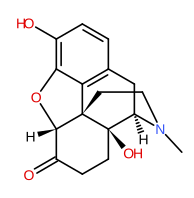 |
| Salts [] | |
|---|---|
| Oxymorphone hydrochloride | |
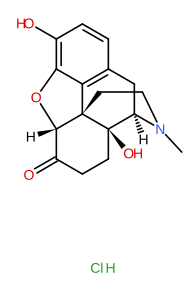 | |
| Oxymorphone hydrobromide | |
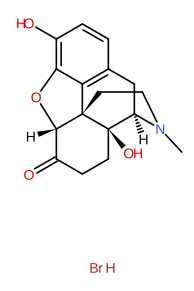 | |
| Oxymorphone hydriodide | |
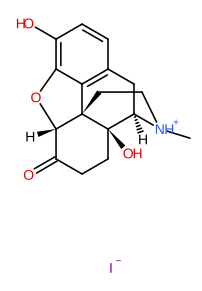 |
| Molecular structure drawn from PubChem coordinates |
| Physical properties [] | |
|---|---|
| Molecular mass | 301.34 g/mol [1] |
| Appearance | Crystals from boiling ethanol, ethyl acetate, or benzene [1] |
| Melting point | 248-249 °C [1] |
| Solubility | 24000 mg/L [1] |
| Predicted LogP | 0.8 [1] |
| Structural Identifiers [] | |
|---|---|
| Molecular formula | C17H19NO4 |
| IUPAC name | (4R,4aS,7aR,12bS)-4a,9-dihydroxy-3-methyl-2,4,5,6,7a,13-hexahydro-1H-4,12-methanobenzofuro[3,2-e]isoquinolin-7-one |
| SMILES | CN1CC[C@]23[C@@H]4C(=O)CC[C@]2([C@H]1CC5=C3C(=C(C=C5)O)O4)O |
| InChI | InChI=1S/C17H19NO4/c1-18-7-6-16-13-9-2-3-10(19)14(13)22-15(16)11(20)4-5-17(16,21)12(18)8-9/h2-3,12,15,19,21H,4-8H2,1H3/t12-,15+,16+,17-/m1/s1 |
| InChIKey | UQCNKQCJZOAFTQ-ISWURRPUSA-N |
| CAS number | 76-41-5 |
| UNII | 9VXA968E0C |
| PubChem CID | 5284604 |
| Pharmacokinetics[] | |
|---|---|
| Elimination half-life | 10–12 hours[3] |
| Duration of action | By mouth: 6–8 hours, Parenteral: 4–6 hours |
| Metabolism | Liver (CYP3A4, glucuronidation) |
| Excretion | Urine, feces |
| Routes of administration | By mouth, buccal, sublingual, intranasal, intravenous, epidural, subcutaneous, intramuscular |
| Dependence liability | High |
| Addiction liability | High |
Oxymorphone (also known as Oximorphonum, 14-Hydroxydihydromorphinone, Dihydrohydroxymorphinone, Dihydroxymorphinone, Oximorfona, (-)-Oxymorphone, 7,8-Dihydro-14-hydroxymorphinone, Oxymorphonum, Oxymorphone cii or Dihydro-14-hydroxymorphinone) is a opioid substance of the 2-benzylpiperidine class.
Chemistry
Salts []
Stereochemistry []
Oxymorphone is a single defined stereoisomer.
Druglikeness
Lipinski's rule of five
Oxymorphone matches Lipinski's rule of five.Reagents
There are currently 4 reagent-interactions on DrugsPRO
| Reagent | Color change | Description |
|---|---|---|
| Marquis | magenta > violet | |
| Mecke | yellow > brown | |
| Mandelin | black | |
| Froehde | blue > violet |
Pharmacology
ATC Classification
- nervous system (N)
- analgesics (N02)
- opioids (N02A)
- natural opium alkaloids (N02AA)
- oxymorphone (N02AA11)
MeSH Classification
Mechanism of action []
Oxymorphone interacts predominantly with the opioid mu-receptor. These mu-binding sites are discretely distributed in the human brain, with high densities in the posterior amygdala, hypothalamus, thalamus, nucleus caudatus, putamen, and certain cortical areas. They are also found on the terminal axons of primary afferents within laminae I and II (substantia gelatinosa) of the spinal cord and in the spinal nucleus of the trigeminal nerve. Also, it has been shown that oxymorphone binds to and inhibits GABA inhibitory interneurons via mu-receptors. These interneurons normally inhibit the descending pain inhibition pathway. So, without the inhibitory signals, pain modulation can proceed downstream. [1]
Interactions []
Medical side effects []
111 side effects listed on drug labels in SIDER 4.1 (oxymorphone).
- Nausea
- Vertigo
- Body temperature increased
- Constipation
- Somnolence
- Headache
- Vomiting
- Hyperhidrosis
- Pruritus
- Dizziness
- Syncope
- Dry mouth
- Diarrhoea
- Asthenia
- Fatigue
- Insomnia
- Abdominal pain
- Gastrointestinal pain
- Confusional state
- Feeling abnormal
- Decreased appetite
- Anorexia
- Amnesia
- Nervous system disorder
- Convulsion
- Memory impairment
- Abdominal distension
- Anxiety
- Apnoea
- Atelectasis
- Pneumothorax
- Mental disorder
- Bronchospasm
- Chest pain
- Dehydration
- Dermatitis
- Dermatitis atopic
- Diplopia
- Drug abuse
- Dyspepsia
- Dyspnoea
- Oedema
- Eye disorder
- Flatulence
- Flushing
- Gastrointestinal disorder
- Hallucination
- Head injury
- Cardiac disorder
- Hypersensitivity
- Hypertension
- Hypotension
- Hypotensive
- Orthostatic hypotension
- Immune system disorder
- Laryngeal oedema
- Laryngospasm
- Lethargy
- Lung disorder
- Mediastinal disorder
- Miosis
- Nervousness
- Feeling jittery
- Tension
- Oliguria
- Palpitations
- Ileus paralytic
- Pneumonia
- Withdrawal syndrome
- Shock
- Loss of consciousness
- Tachycardia
- Urethral disorder
- Urinary tract disorder
- Urticaria
- Angiopathy
- Weight decreased
- Urinary retention
- Agitation
- Pain
- Swelling face
- Injection site reaction
- Intracranial pressure increased
- Biliary colic
- Urinary hesitation
- Malnutrition
- Skin disorder
- Respiratory rate decreased
- Disorientation
- Dysphoria
- Respiratory depression
- Pulmonary function test decreased
- Euphoric mood
- Vision blurred
- Cold sweat
- Sticky skin
- Bradycardia
- Respiratory distress
- Visual impairment
- Altered state of consciousness
- Depressed level of consciousness
- Cancer pain
- Menopausal symptoms
- Hot flush
- Drug interaction
- Oxygen saturation decreased
- Mental status changes
- Ureteral spasm
- Ileus
- Mental retardation
- Mental disability
Indications
- Acute pain
- Anxiety
- Dyspnoea
- Left ventricular dysfunction
- Low back pain
- Opioid naive
- Pain
- Postoperative pain
- Pulmonary oedema
Subjective effects []
Legal status []
- Australia: Oxymorphone is a Schedule 8.
- Brazil: Oxymorphone is a A1.[4]
- Canada: Oxymorphone is a Schedule I.
- United Kingdom: Oxymorphone is a Class A under the "Misuse of Drugs Act 1971".
- United States: Oxymorphone is a Schedule II under the "Controlled Substances Act".[5]
- Germany: Oxymorphone is a Anlage II under the "Betäubungsmittelgesetz (BtMG)".
- Other: Oxymorphone is a SE: Förteckning II, In general: ℞ (Prescription only).[6]
See also []
External links []
References []
National Center for Biotechnology Information. PubChem Compound Summary for CID 5284604, Oxymorphone. Accessed November 20, 2026. https://pubchem.ncbi.nlm.nih.gov/compound/5284604
U.S. Food and Drug Administration; National Center for Advancing Translational Sciences. Oxymorphone. UNII: 9VXA968E0C. Global Substance Registration System. Accessed November 20, 2026. https://gsrs.ncats.nih.gov/ginas/app/beta/substances/9VXA968E0C
Polsten GR, Wallace MS. Kelley and Firestein's Textbook of Rheumatology. Elsevier Health Sciences. 21 June 2016.
Anvisa. RDC Nº 784 – Listas de Substâncias Entorpecentes, Psicotrópicas, Precursoras e Outras sob Controle Especial. Diário Oficial da União. 31 March 2023. https://www.in.gov.br/en/web/dou/-/resolucao-rdc-n-784-de-31-de-marco-de-2023-474904992
Drugs@FDA: FDA Approved Drug Products. www.accessdata.fda.gov. https://www.accessdata.fda.gov/scripts/cder/daf/index.cfm
Läkemedelsverkets föreskrifter (LVFS 2011:10) om förteckningar över narkotika. Läkemedelsverket. https://www.lakemedelsverket.se/globalassets/dokument/lagar-och-regler/lvfs/lvfs-2011-10-konsoliderad.pdf
Data sources []
| Source | Status | Updated (UTC) |
|---|---|---|
| dosing | missing (no dosing statistics) | 2026-11-20 11:13:11 |
| drugspro | ok | 2026-11-20 11:13:07 |
| erowid | missing (no Erowid substance of that name) | 2026-11-20 11:13:07 |
| gsrs | ok | 2026-11-20 11:13:09 |
| hmdb | missing (hmdb.ca refused automated access to HMDB0015323) | 2026-11-20 11:13:07 |
| kegg | ok | 2026-11-20 11:13:09 |
| pubchem | ok | 2026-11-20 11:13:06 |
| missing (no r/tripreports posts mention it) | 2026-11-20 11:13:07 | |
| sider | ok | 2026-11-20 11:13:07 |
| structure | ok | 2026-11-20 11:13:07 |
| wikipedia | ok | 2026-11-20 11:13:07 |