Pargyline
| Pargyline | |
|---|---|
 |
| Salts [] | |
|---|---|
| Pargyline hydrochloride | |
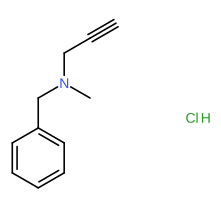 |
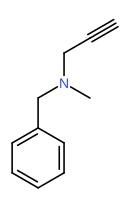
| Molecular structure drawn from PubChem coordinates |
| Physical properties [] | |
|---|---|
| Molecular mass | 159.23 g/mol [1] |
| Solubility | 9.98e-02 g/L [1] |
| Predicted LogP | 2.1 [1] |
| Structural Identifiers [] | |
|---|---|
| Molecular formula | C11H13N |
| IUPAC name | N-benzyl-N-methylprop-2-yn-1-amine |
| SMILES | CN(CC#C)CC1=CC=CC=C1 |
| InChI | InChI=1S/C11H13N/c1-3-9-12(2)10-11-7-5-4-6-8-11/h1,4-8H,9-10H2,2H3 |
| InChIKey | DPWPWRLQFGFJFI-UHFFFAOYSA-N |
| CAS number | 555-57-7 |
| UNII | 9MV14S8G3E |
| PubChem CID | 4688 |
| Pharmacokinetics[] | |
|---|---|
| Routes of administration | Oral[3] |
Pargyline (also known as N-Methyl-N-propargylbenzylamine, Pargylamine, Eudatin, Paragyline, Supirdyl, N-Methyl-N-2-propynylbenzylamine, Pargilina, Pargylinum, Benzenemethanamine, N-methyl-N-2-propynyl- or benzyl(methyl)(prop-2-yn-1-yl)amine) is a monoamine oxidase inhibitor substance of the benzylamine class.
Chemistry
Salts []
Stereochemistry []
Pargyline is achiral.
Druglikeness
Lipinski's rule of five
Pargyline matches Lipinski's rule of five.Pharmacology
ATC Classification
- cardiovascular system (C)
- antihypertensives (C02)
- other antihypertensives (C02K)
- mao inhibitors (C02KC)
- pargyline (C02KC01)
MeSH Classification
Mechanism of action []
MAOIs act by inhibiting the activity of monoamine oxidase, thus preventing the breakdown of monoamine neurotransmitters and thereby increasing their availability. There are two isoforms of monoamine oxidase, MAO-A and MAO-B. MAO-A preferentially deaminates serotonin, melatonin, epinephrine and norepinephrine. MAO-B preferentially deaminates phenylethylamine and trace amines. Pargyline functions by inhibiting the metabolism of catecholamines and tyramine within presynaptic nerve terminals. Catecholamines cause general physiological changes that prepare the body for physical activity (fight-or-flight response). Some typical effects are increases in heart rate, blood pressure, blood glucose levels, and a general reaction of the sympathetic nervous system. [1]
Interactions []
External links []
References []
National Center for Biotechnology Information. PubChem Compound Summary for CID 4688, Pargyline. Accessed November 20, 2026. https://pubchem.ncbi.nlm.nih.gov/compound/4688
U.S. Food and Drug Administration; National Center for Advancing Translational Sciences. Pargyline. UNII: 9MV14S8G3E. Global Substance Registration System. Accessed November 20, 2026. https://gsrs.ncats.nih.gov/ginas/app/beta/substances/9MV14S8G3E
Hayes AH, Schneck DW. Antihypertensive pharmacotherapy. Postgraduate Medicine. May 1976; 59(5):155–162. PMID 57611. https://doi.org/10.1080/00325481.1976.11714363
Data sources []
| Source | Status | Updated (UTC) |
|---|---|---|
| dosing | missing (no dosing statistics) | 2026-11-20 10:00:57 |
| drugspro | missing (no DrugsPRO reagent data) | 2026-11-20 10:00:53 |
| erowid | missing (no Erowid substance of that name) | 2026-11-20 10:00:53 |
| gsrs | ok | 2026-11-20 10:00:54 |
| hmdb | missing (hmdb.ca refused automated access to HMDB0015563) | 2026-11-20 10:00:53 |
| kegg | ok | 2026-11-20 10:00:55 |
| pubchem | ok | 2026-11-20 10:00:53 |
| missing (no r/tripreports posts mention it) | 2026-11-20 10:00:53 | |
| sider | missing (not in SIDER) | 2026-11-20 10:00:53 |
| structure | ok | 2026-11-20 10:00:53 |
| wikipedia | ok | 2026-11-20 10:00:53 |