Pethidine
| Pethidine | |
|---|---|
 |
| Salts [] | |
|---|---|
| Pethidine hydrochloride | |
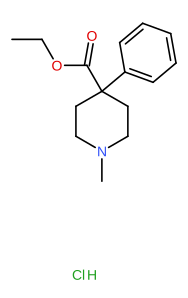 |
| Molecular structure drawn from PubChem coordinates |
| Physical properties [] | |
|---|---|
| Molecular mass | 247.33 g/mol [1] |
| Appearance | Solid [1] |
| Melting point | 270 °C [1] |
| Decomposition | When heated to decomposition it emits toxic fumes of /nitrogen oxides/. [1] |
| Solubility | 3220 mg/L (at 30 °C) [1] |
| Predicted LogP | 2.5 [1] |
| Structural Identifiers [] | |
|---|---|
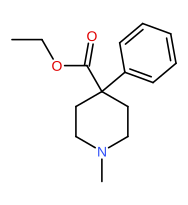
| Molecular formula | C15H21NO2 |
| IUPAC name | ethyl 1-methyl-4-phenylpiperidine-4-carboxylate |
| SMILES | CCOC(=O)C1(CCN(CC1)C)C2=CC=CC=C2 |
| InChI | InChI=1S/C15H21NO2/c1-3-18-14(17)15(9-11-16(2)12-10-15)13-7-5-4-6-8-13/h4-8H,3,9-12H2,1-2H3 |
| InChIKey | XADCESSVHJOZHK-UHFFFAOYSA-N |
| CAS number | 57-42-1 |
| UNII | 9E338QE28F |
| PubChem CID | 4058 |
| Pharmacokinetics[] | |
|---|---|
| Elimination half-life | 2.5–4 hours, 7–11 hours (liver disease) |
| Metabolism | Liver: CYP2B6, CYP3A4, CYP2C19, Carboxylesterase 1 |
| Excretion | Renal |
| Routes of administration | By mouth, intravenous, intramuscular, intrathecal, subcutaneous, epidural[3][4] |
| Dependence liability | High |
| Addiction liability | High[5] |
| Toxicity [] | |
|---|---|
| LD50 | Rat: - oral: 170 mg/kg /Meperidine - oral: 162 mg/kg - ip: 87 mg/kg - sc: 113 mg/kg [1] |
Pethidine (also known as Isonipecaine, Pethidineter, Meperidol, Pethanol, Pethidin, Phetidine, Nemerol, Pipersal, Petydyna or Petidina) is a opioid substance of the phenylpropylamine and phenylpiperidine class.
Chemistry
Salts []
Stereochemistry []
Pethidine is achiral.
Druglikeness
Lipinski's rule of five
Pethidine matches Lipinski's rule of five.Reagents
There are currently 1 reagent-interactions on DrugsPRO
| Reagent | Color change | Description |
|---|---|---|
| Froehde | grey |
Pharmacology
ATC Classification
- nervous system (N)
- analgesics (N02)
- opioids (N02A)
- phenylpiperidine derivatives (N02AB)
- pethidine (N02AB02)
MeSH Classification
Mechanism of action []
Meperidine is primarily a kappa-opiate receptor agonist and also has local anesthetic effects. Meperidine has more affinity for the kappa-receptor than morphine. Opiate receptors are coupled with G-protein receptors and function as both positive and negative regulators of synaptic transmission via G-proteins that activate effector proteins. Binding of the opiate stimulates the exchange of GTP for GDP on the G-protein complex. As the effector system is adenylate cyclase and cAMP located at the inner surface of the plasma membrane, opioids decrease intracellular cAMP by inhibiting adenylate cyclase. Subsequently, the release of nociceptive neurotransmitters such as substance P, GABA, dopamine, acetylcholine and noradrenaline is inhibited. Opioids also inhibit the release of vasopressin, somatostatin, insulin and glucagon. Opioids close N-type voltage-operated calcium channels (OP2-receptor agonist) and open calcium-dependent inwardly rectifying potassium channels (OP3 and OP1 receptor agonist). This results in hyperpolarization and reduced neuronal excitability. [1]
Interactions []
Medical side effects []
82 side effects listed on drug labels in SIDER 4.1 (meperidine).
- Anaphylactic shock
- Decreased appetite
- Anuria
- Anxiety
- Asthenia
- Coma
- Confusional state
- Feeling abnormal
- Constipation
- Libido decreased
- Disturbance in sexual arousal
- Delirium
- Dizziness
- Syncope
- Lightheadedness
- Somnolence
- Oedema
- Dermatitis
- Rash
- Fibrosis
- Flushing
- Gangrene
- Hallucination
- Headache
- Cardiac arrest
- Hypersensitivity
- Hypertension
- Hypotension
- Orthostatic hypotension
- Irritability
- Miosis
- Mydriasis
- Myoclonus
- Nausea
- Pallor
- Palpitations
- Phlebitis
- Pruritus
- Psychotic disorder
- Paranoia
- Convulsion
- Shock
- Muscle spasms
- Withdrawal syndrome
- Hyperhidrosis
- Loss of consciousness
- Tachycardia
- Tremor
- Erythema
- Urticaria
- Welts
- Vasodilation procedure
- Vertigo
- Vomiting
- Dry mouth
- Urinary retention
- Agitation
- Hyperkinesia
- Mood swings
- Affect lability
- Complex partial seizures
- Depressed level of consciousness
- Injection site pain
- Respiratory arrest
- Dyskinesia
- Muscle twitching
- Disorientation
- Dysphoria
- Neurotoxicity
- Respiratory depression
- Pulmonary function test decreased
- Euphoric mood
- Cold sweat
- Hypomania
- Induration
- Bradycardia
- Coordination abnormal
- Paralysis
- Visual impairment
- Hallucinations, mixed
- Insomnia
- Cardiovascular insufficiency
Indications
- Acute pain
- Analgesic effect
- Biliary colic
- Chronic pain
- Cough
- Diarrhoea
- Narcosis
- Pain
- Pancreatitis
- Pancreatitis acute
- Renal colic
- Renal impairment
Subjective effects []
Legal status []
- Australia: Pethidine is a Schedule 8.
- Brazil: Pethidine is a A1.[6]
- Canada: Pethidine is a Schedule I.
- Germany: Pethidine is a Anlage III under the "Betäubungsmittelgesetz (BtMG)".
- New Zealand: Pethidine is a Class B.
- United Kingdom: Pethidine is a Class A under the "Misuse of Drugs Act 1971".
- United States: Pethidine is a Schedule II under the "Controlled Substances Act".
- United Nations: Pethidine is a Schedule I narcotic under the "Single Convention on Narcotic Drugs 1961".
- Other: Pethidine is a SE: Förteckning II, In general: ℞ (Prescription only).[7]
External links []
References []
National Center for Biotechnology Information. PubChem Compound Summary for CID 4058, Pethidine. Accessed November 20, 2026. https://pubchem.ncbi.nlm.nih.gov/compound/4058
U.S. Food and Drug Administration; National Center for Advancing Translational Sciences. Pethidine. UNII: 9E338QE28F. Global Substance Registration System. Accessed November 20, 2026. https://gsrs.ncats.nih.gov/ginas/app/beta/substances/9E338QE28F
Ngan Kee WD. Intrathecal pethidine: pharmacology and clinical applications. Anaesthesia and Intensive Care. April 1998; 26(2):137–146. PMID 9564390. https://doi.org/10.1177/0310057X9802600202
Ngan Kee WD. Epidural pethidine: pharmacology and clinical experience. Anaesthesia and Intensive Care. June 1998; 26(3):247–255. PMID 9619217. https://doi.org/10.1177/0310057X9802600303
Bonewit-West K, Hunt SA, Applegate E. Today's Medical Assistant: Clinical and Administrative Procedures. Elsevier Health Sciences. 2012. https://books.google.com/books?id=YalYPI1KqTQC&pg=PA571
RDC Nº 784 - Listas de Substâncias Entorpecentes, Psicotrópicas, Precursoras e Outras sob Controle Especial. Diário Oficial da União. 2023-03-31. https://www.in.gov.br/en/web/dou/-/resolucao-rdc-n-784-de-31-de-marco-de-2023-474904992
Petidin Viatris, Injektionsvätska, lösning 50 mg/ml. FASS.se. 16 July 2026. https://fass.se/health/product/19741206000040/fass-text
Data sources []
| Source | Status | Updated (UTC) |
|---|---|---|
| dosing | missing (no dosing statistics) | 2026-11-20 04:07:33 |
| drugspro | ok | 2026-11-20 04:07:29 |
| erowid | missing (no Erowid substance of that name) | 2026-11-20 04:07:29 |
| gsrs | ok | 2026-11-20 04:07:30 |
| hmdb | missing (hmdb.ca refused automated access to HMDB0014597) | 2026-11-20 04:07:29 |
| kegg | ok | 2026-11-20 04:07:32 |
| pubchem | ok | 2026-11-20 04:07:29 |
| missing (no r/tripreports posts mention it) | 2026-11-20 04:07:29 | |
| sider | ok | 2026-11-20 04:07:29 |
| structure | ok | 2026-11-20 04:07:29 |
| wikipedia | ok | 2026-11-20 04:07:29 |