Phencyclidine
| PCP | |
|---|---|
 |
| Salts [] | |
|---|---|
| Phencyclidine hydrochloride | |
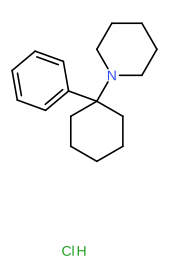 |
| Molecular structure drawn from PubChem coordinates |
| Physical properties [] | |
|---|---|
| Molecular mass | 243.40 g/mol [1] |
| Appearance | White, crystalline powder [1] |
| Odor | Oily, slightly ammoniac [1] |
| Melting point | 46.5 °C [1] |
| Boiling point | 136 °C at 1.00E+00 mm Hg [1] |
| Decomposition | When heated to decomposition it emits toxic fumes of /nitrogen oxides/. [1] |
| Solubility | Soluble in ethanol [1] |
| Predicted LogP | 3.6 [1] |
| Structural Identifiers [] | |
|---|---|
| Molecular formula | C17H25N |
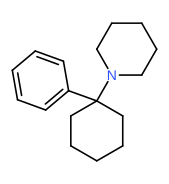
| IUPAC name | 1-(1-phenylcyclohexyl)piperidine |
| SMILES | C1CCC(CC1)(C2=CC=CC=C2)N3CCCCC3 |
| InChI | InChI=1S/C17H25N/c1-4-10-16(11-5-1)17(12-6-2-7-13-17)18-14-8-3-9-15-18/h1,4-5,10-11H,2-3,6-9,12-15H2 |
| InChIKey | JTJMJGYZQZDUJJ-UHFFFAOYSA-N |
| CAS number | 77-10-1 |
| UNII | J1DOI7UV76 |
| PubChem CID | 6468 |
| Pharmacokinetics[] | |
|---|---|
| Onset | 2–60 min[3] |
| Elimination half-life | 7–46 hours |
| Duration of action | 6–48 hours |
| Metabolism | Oxidative hydroxylation in liver by CYP450 enzymes, glucuronidation |
| Excretion | Urine |
| Routes of administration | Smoking, injection, snorted, by mouth[4] |
| Dependence liability | Physical: Low Psychological: Moderate[5] |
| Addiction liability | Variable, reported from low to high |
| Toxicity [] | |
|---|---|
| LD50 | Mouse: - oral: 76.5 mg/kg - ip: 2800 μg/kg [1] |
Phencyclidine (also known as Angel dust, Fenciclidina, Piperidine, 1-(1-phenylcyclohexyl)-, Phencyclidinum, Phencycline, Cl-395, Phenylcyclidine, J4.441e, Cl 395 or Gp 121) is a anaesthetic and dissociative substance of the arylcyclohexylpiperidine class.
Chemistry
Salts []
Stereochemistry []
Phencyclidine is achiral.
Druglikeness
Lipinski's rule of five
Phencyclidine matches Lipinski's rule of five.Reagents
There are currently 12 reagent-interactions on DrugsPRO
| Reagent | Color change | Description |
|---|---|---|
| Marquis | red-orange > brown | |
| Mecke | yellow | |
| Mandelin | slow (dark) green | |
| Liebermann | orange reddish | |
| Froehde | clear or red | |
| Robadope | no pink color change | |
| Simon's | instant dark blue | |
| Ehrlich | no color change | |
| Hofmann | no color change | |
| Scott | no color change | |
| Morris | pale green | |
| Folin | orange or pink |
Pharmacology
MeSH Classification
Mechanism of action []
The N-methyl-D-Aspartate (NMDA) receptor, a type of ionotropic receptor, is found on the dendrites of neurons and receives signals in the form of neurotransmitters. It is a major excitatory receptor in the brain. Normal physiological function requires that the activated receptor fluxes positive ions through the channel part of the receptor. PCP enters the ion channel from the outside of the neuron and binds, reversibly, to a site in the channel pore, blocking the flux of positive ions into the cell. PCP therefore inhibits depolarization of neurons and interferes with cognitive and other functions of the nervous system. [1]
Interactions []
Medical side effects []
36 side effects listed on drug labels in SIDER 4.1 (phencyclidine).
- Abdominal pain
- Anaphylactic shock
- Angioedema
- Asthma
- Conjunctivitis
- Cough
- Cyanosis
- Diarrhoea
- Dyspnoea
- Flushing
- Hypotension
- Laryngeal oedema
- Nausea
- Pain
- Pallor
- Pruritus
- Rhinitis
- Shock
- Syncope
- Sneezing
- Swelling
- Dizziness
- Loss of consciousness
- Tachycardia
- Erythema
- Urticaria
- Urticaria recurrent
- Uterine contractions during pregnancy
- Vomiting
- Wheezing
- Oedema peripheral
- Tenderness
- Lacrimation increased
- Gastrointestinal disorder
- Bradycardia
- Local reaction
Indications
- Hypersensitivity
- Type I hypersensitivity
Subjective effects []
Experience reports
Erowid
There are currently 30 experience reports involving phencyclidine on Erowid: []- "The PCP Trilogy" by nervewing
- "Hey, I Was Curious" by The Monkey Mantra
- "Disassembled Into Atoms" by Tela
- "The World Shrank" by Jen
- "New Years Nystagmus" by Soma Sava
- "Bits of Metal and Boiled Chicken" by sparkle kitty
- "Antidepressants and Hallucinogenic Drugs" by K
- "I Smoked It by Accident" by SkipScramble
- "Welcome To Waterworld" by dgaf420
- "I Can't Imagine How It Feels to Be a Dust Bunny" by Haha Sasha
- "Something Extra" by D
- "A Most Unusual Experience" by Seezee-Three
- "A Visual Trip" by Tyger
- "Pink T & Pop Rocks" by Anoldguy
- "Boom" by Sauceman
- "What the Hell!?" by L
- "Not As Horrific As It's Reputation Suggests" by Kbomb
- "I Am God!" by ReDragon
- "Intensely Stoned" by Chronique
- "Moral: Leave it in the Baggy" by Hakushon
- "Systematically Dull" by JFL
- "The Edge of the Room" by UncleHorneyToad
- "The Good and the Bad" by Ryan7
- "I Feel Like I'm in a Video Game" by Kaliescope Eyes
- "My Favorite Indulgence" by DustBunny
- "A Lesson in Karma" by Young Hippy Teenager
- "Accidently smoked PCP" by Bobalouie
- "What the Hell Happened?" by Beth Marley
- "Rolling Through Old Film Footage" by Sophia
- "''It�s Called a Peace Pill. It�s Really Groovy''" by gepay
- "I Have Tried Every Single Drug and Steroid" by Hangeth_Thy_Dong (51 upvotes)
- "My full drug career to this point. (Feel free to skim )" by Solid-Ambition-6635 (28 upvotes)
- "How dropping acid changed me..." by strangegeneration94 (27 upvotes)
- "dancing with my demons on DOC" by oilstims (26 upvotes)
- "DMXE (70 mg intranasal)" by Nervewing (21 upvotes)
- "Insane 3 ho pcp Trip . The Ultimate Spiritual Experience ." by Parking-Title (18 upvotes)
- "It's time to tell you all about my very special bathtub trip - (O-PCE, 4-aco-dmt, 4-ho-met, 3-ho-pcp, 2c-c, DMT, cannabis)" by coolbreeze1990 (14 upvotes)
- "Pcp trip/ afterglow experience" by Caterpillar203 (12 upvotes)
- "Pcp" by jayyyskek (10 upvotes)
- "16M I vaped what was supposed to be a THC vape, but now i have doubts because i broke my own reality and had what felt like a psychotic episode - anyone can explain what happened to me?" by CasualInsanity3840 (10 upvotes)
- "Strange drug i tried" by Fast_Emu_6669 (9 upvotes)
- "Accidentally took 900ug" by bodyloadhater69 (9 upvotes)
- "LSD/ACID/LUCY First time!!! BEST EVER!!!!" by [deleted] (9 upvotes)
- "PCP 4mg- A Very odd Night" by neonking24 (9 upvotes)
- "Smoked a Cart almost died" by Yolaflare (8 upvotes)
- "LSD+3-HO-PCP trip report" by lowkey_add1ct (7 upvotes)
- "Need help from you guys 🙏" by Muttznutz04 (7 upvotes)
- "3-ho-pcp and Skyrim trip report" by lowkey_add1ct (7 upvotes)
- "My 3000mg (4 bottles) DXM Trip" by constantwhitenoise_ (6 upvotes)
- "28mg of 25i-NBOMe Administered Nasally (x-post from /r/drugs)" by [deleted] (6 upvotes)
- "Is My Dab Cart Laced" by Atlantic_lotion (6 upvotes)
- "950ug acid trip" by Cyenesence (5 upvotes)
- "A Galaxy Far Far Away [No Spoilers](100mg+ 3-meo-pcp,3g mushrooms, weed) (x/post Drugs)" by BringBackMXE (5 upvotes)
- "mild serotonin syndrome caused by mdma+pcp/angel dust?" by putmydeckintheowl (3 upvotes)
- "There are 45 psychedelic and dissociative trip reports in the Drug Users Bible: Download a free copy from here. Whether psychedelics are used for recreation, you need to look after yourself. Stay safe." by DMTrott (3 upvotes)
- "30mg mxipr+9mg 3-ho-pcp+weed trip report" by lowkey_add1ct (3 upvotes)
- "3 meo pcp and ptsd? Life changing" by wizardslashmagi (2 upvotes)
- "3-Meo-PCP 5mg test run" by willieboosie (2 upvotes)
- "3-me-pcp + Shroom afterglow" by santanabroder (2 upvotes)
- "50mg 4-ho-met trip report" by lowkey_add1ct (2 upvotes)
- "Fxe nasal spray trip report/first time" by lowkey_add1ct (2 upvotes)
- ""Meeting God" A Dxm Trip Report" by sewerpig42 (1 upvotes)
- "First time was 1110mg last night " by OkImShaggy (1 upvotes)
- "O-PCP from PsyKSous1" by Forsaken-Damage-3845 (1 upvotes)
- "Still don't know what it was laced with" by Btroi99 (1 upvotes)
- "Best Combo Ever! 2mg CLAM+23mg 3-HO-PCP+ 2-5 Chronic Indica Dabs" by PsychonauticSavant (1 upvotes)
- "Trippy thursday" by Caterpillar203 (1 upvotes)
- "Tryptamines + deschloroketamine" by SwiC_RC (1 upvotes)
- "laced weed" by tristanmarchand1 (0 upvotes)
- "VAPED DCK and DMT (+oral DCK and 2C-B)" by coolbreeze1990 (0 upvotes)
Legal status []
- Australia: Phencyclidine is a Schedule 8.
- Brazil: Phencyclidine is a A3.
- Canada: Phencyclidine is a Schedule I.
- Germany: Phencyclidine is a Anlage I under the "Betäubungsmittelgesetz (BtMG)".
- New Zealand: Phencyclidine is a Class A.
- United Kingdom: Phencyclidine is a Class A under the "Misuse of Drugs Act 1971".
- United States: Phencyclidine is a Schedule II under the "Controlled Substances Act".
- United Nations: Phencyclidine is a Schedule II psychotropic under the "Convention on Psychotropic Substances 1971".
- Other: Phencyclidine is a Tabella I in Italy.
External links []
- Phencyclidine (Wikipedia)
- Phencyclidine (PubChem)
- Phencyclidine (Wikidata)
- Phencyclidine (DrugBank)
- Phencyclidine (ChEMBL)
- Phencyclidine (ChEBI)
- Phencyclidine (Common Chemistry)
- Phencyclidine (HMDB)
- Phencyclidine (KEGG)
- Phencyclidine (EPA DSSTox)
- Phencyclidine (Effect Index)
- Phencyclidine (UNII)
- Phencyclidine (SIDER)
- Phencyclidine (Erowid)
References []
National Center for Biotechnology Information. PubChem Compound Summary for CID 6468, Phencyclidine. Accessed November 20, 2026. https://pubchem.ncbi.nlm.nih.gov/compound/6468
U.S. Food and Drug Administration; National Center for Advancing Translational Sciences. Phencyclidine. UNII: J1DOI7UV76. Global Substance Registration System. Accessed November 20, 2026. https://gsrs.ncats.nih.gov/ginas/app/beta/substances/J1DOI7UV76
Riviello RJ. Manual of forensic emergency medicine: a guide for clinicians. Jones and Bartlett Publishers. 2010. https://books.google.com/books?id=keng9ELAE2IC&pg=PA41
Giannini AJ. Handbook of Substance Abuse: Neurobehavioral Pharmacology. Plenum Publishing Corporation. 1998.
Stobo JD, Traill TA, Hellmann DB, Ladenson PW, Petty BG. The Principles and Practice of Medicine. McGraw Hill Professional. 1996. https://books.google.com/books?id=aA9mMB3lDh4C
Data sources []
| Source | Status | Updated (UTC) |
|---|---|---|
| dosing | missing (no dosing statistics) | 2026-11-20 04:36:53 |
| drugspro | ok | 2026-11-20 04:36:49 |
| erowid | ok | 2026-11-20 04:36:55 |
| gsrs | ok | 2026-11-20 04:36:50 |
| hmdb | missing (hmdb.ca refused automated access to HMDB0256399) | 2026-11-20 04:36:49 |
| kegg | ok | 2026-11-20 04:36:51 |
| pubchem | ok | 2026-11-20 04:36:48 |
| ok | 2026-11-20 04:36:49 | |
| sider | ok | 2026-11-20 04:36:49 |
| structure | ok | 2026-11-20 04:36:49 |
| wikipedia | ok | 2026-11-20 04:36:49 |