Phenylpropanolamine
| PPA | |
|---|---|
 |
| Salts [] | |
|---|---|
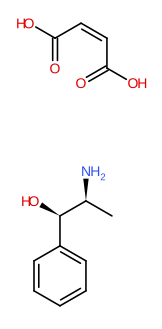
| Phenylpropanolamine maleate | |
 | |
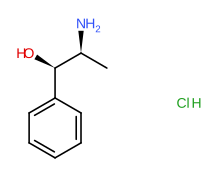
| Phenylpropanolamine hydrochloride | |
 | |
| Phenylpropanolamine bitartrate | |
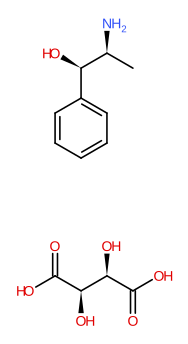 | |
| Phenylpropanolamine hemisulfate | |
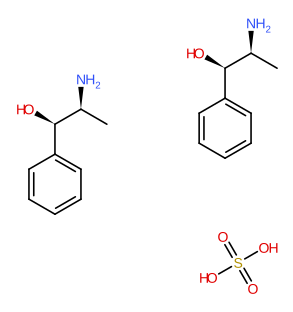 |
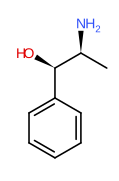
| Molecular structure drawn from PubChem coordinates |
| Physical properties [] | |
|---|---|
| Molecular mass | 151.21 g/mol [1] |
| Appearance | White, crystalline powder [1] |
| Odor | Slight aromatic odor [1] |
| Melting point | 190-194 °C [1] |
| Decomposition | When heated to decomposition it emits very toxic fumes of nitroxides. [1] |
| Solubility | Freely soluble [1] |
| Predicted LogP | 0.8 [1] |
| Structural Identifiers [] | |
|---|---|
| Molecular formula | C9H13NO |
| IUPAC name | (1R,2S)-2-amino-1-phenylpropan-1-ol |
| SMILES | C[C@@H]([C@@H](C1=CC=CC=C1)O)N |
| InChI | InChI=1S/C9H13NO/c1-7(10)9(11)8-5-3-2-4-6-8/h2-7,9,11H,10H2,1H3/t7-,9-/m0/s1 |
| InChIKey | DLNKOYKMWOXYQA-CBAPKCEASA-N |
| CAS number | 14838-15-4 |
| UNII | 33RU150WUN |
| PubChem CID | 10297 |
| Pharmacokinetics[] | |
|---|---|
| Onset | Oral: 15–30 minutes |
| Elimination half-life | 4 hours (range 3.7–4.9 hours)[3] |
| Duration of action | Oral: 3 hours |
| Metabolism | Minimal (3–4%) |
| Excretion | Urine: 90% (unchanged) |
| Routes of administration | By mouth |
| Toxicity [] | |
|---|---|
| LD50 | Rat: - oral: 1490 mg/kg /Phenylpropanolamine - sc: 850 mg/kg [1] |
Phenylpropanolamine (also known as Propadrine, Fenilpropanolamina, erythro-2-Amino-1-phenyl-1-propanol, Phenylpropanolaminum, Phenylfenesin, Rinexin, Fansia, Benzenemethanol, α-(1-aminoethyl)-, (R*,S*)-(+-)-, Phenylpropanolamine 1534 or R01ba01) is a sympathomimetic substance of the amphetamine and phenylethanolamine class.
Chemistry
Salts []
Stereochemistry []
Phenylpropanolamine is a single defined stereoisomer (optical activity ( + / - )).
Druglikeness
Lipinski's rule of five
Phenylpropanolamine matches Lipinski's rule of five.Reagents
There are currently 2 reagent-interactions on DrugsPRO
| Reagent | Color change | Description |
|---|---|---|
| Robadope | pink | |
| Simon's | no blue color change |
Pharmacology
ATC Classification
- respiratory system (R)
- nasal preparations (R01)
- nasal decongestants for systemic use (R01B)
- sympathomimetics (R01BA)
- phenylpropanolamine (R01BA01)
MeSH Classification
- adrenergic alpha-agonists (M0000492)
- appetite depressants (M0001614)
- sympathomimetics (M0020947)
- nasal decongestants (M0022552)
Mechanism of action []
Phenylpropanolamine acts directly on alpha- and, to a lesser degree, beta-adrenergic receptors in the mucosa of the respiratory tract. Stimulation of alpha-adrenergic receptors produces vasoconstriction, reduces tissue hyperemia, edema, and nasal congestion, and increases nasal airway patency. PPA indirectly stimulates beta-receptors, producing tachycardia and a positive inotropic effect. [1]
Prodrugs of phenylpropanolamine: Cafedrine.
Interactions []
Interaction mechanisms documented in KEGG DRUG (number of interacting drugs):
| CYP1A2 | inhibition | 19 (2 contraindicated) |
|---|---|---|
| ADRB1 | shared target | 7 (1 contraindicated) |
| ADRB2 | shared target | 5 (1 contraindicated) |
| ADRA1A | shared target | 3 (1 contraindicated) |
| ADRA1B | shared target | 3 (1 contraindicated) |
| ADRA1D | shared target | 3 (1 contraindicated) |
| ADRA2A | shared target | 2 (2 contraindicated) |
| ADRA2B | shared target | 2 (2 contraindicated) |
| ADRA2C | shared target | 2 (2 contraindicated) |
| ADRB3 | shared target | 2 (1 contraindicated) |
Medical side effects []
40 side effects listed on drug labels in SIDER 4.1 (phenylpropanolamine).
- Anxiety
- Arrhythmia
- Ataxia
- Confusional state
- Feeling abnormal
- Constipation
- Dizziness
- Somnolence
- Dyskinesia
- Dyspnoea
- Dermatitis
- Rash
- Flushing
- Hallucination
- Hypersensitivity
- Hypotension
- Irritability
- Renal tubular necrosis
- Nausea
- Nervousness
- Tension
- Psychotic disorder
- Tachycardia
- Tremor
- Vomiting
- Urinary retention
- Agitation
- Hepatocellular injury
- Liver injury
- Urinary hesitation
- Dysphoria
- Respiratory depression
- Pulmonary function test decreased
- Euphoric mood
- Vision blurred
- Blood pressure increased
- Coordination abnormal
- Antitussive therapy
- Serotonin syndrome
- Insomnia
Indications
- Ache
- Body temperature increased
- Common cold
- Cough
- Discomfort
- Headache
- Hypersensitivity
- Nasal congestion
- Pain
- Rhinorrhoea
- Seasonal allergy
- Sinusitis
- Sneezing
Subjective effects []
Legal status []
- Australia: Phenylpropanolamine is a Schedule 4.
- Brazil: Phenylpropanolamine is a F3.[4]
- Canada: Phenylpropanolamine is a Schedule VI.
- United States: Phenylpropanolamine is Prescription only.
External links []
- Phenylpropanolamine (Wikipedia)
- Phenylpropanolamine (PubChem)
- Phenylpropanolamine (Wikidata)
- Phenylpropanolamine (DrugBank)
- Phenylpropanolamine (ChEMBL)
- Phenylpropanolamine (ChEBI)
- Phenylpropanolamine (Common Chemistry)
- Phenylpropanolamine (KEGG)
- Phenylpropanolamine (EPA DSSTox)
- Phenylpropanolamine (Effect Index)
- Phenylpropanolamine (UNII)
- Phenylpropanolamine (SIDER)
References []
National Center for Biotechnology Information. PubChem Compound Summary for CID 10297, Phenylpropanolamine. Accessed November 20, 2026. https://pubchem.ncbi.nlm.nih.gov/compound/10297
U.S. Food and Drug Administration; National Center for Advancing Translational Sciences. Phenylpropanolamine. UNII: 33RU150WUN. Global Substance Registration System. Accessed November 20, 2026. https://gsrs.ncats.nih.gov/ginas/app/beta/substances/33RU150WUN
Phenylpropanolamine: Uses, Interactions, Mechanism of Action. DrugBank Online. 29 June 2018. https://go.drugbank.com/drugs/DB00397
RDC Nº 804 - Listas de Substâncias Entorpecentes, Psicotrópicas, Precursoras e Outras sob Controle Especial. Diário Oficial da União. 2023-07-24. https://www.in.gov.br/en/web/dou/-/resolucao-rdc-n-804-de-24-de-julho-de-2023-498447451
Data sources []
| Source | Status | Updated (UTC) |
|---|---|---|
| dosing | missing (no dosing statistics) | 2026-11-20 09:00:24 |
| drugspro | ok | 2026-11-20 09:00:20 |
| erowid | missing (no Erowid substance of that name) | 2026-11-20 09:00:20 |
| gsrs | ok | 2026-11-20 09:00:23 |
| hmdb | missing (no HMDB id) | 2026-11-20 09:00:20 |
| kegg | ok | 2026-11-20 09:00:21 |
| pubchem | ok | 2026-11-20 09:00:20 |
| missing (no r/tripreports posts mention it) | 2026-11-20 09:00:20 | |
| sider | ok | 2026-11-20 09:00:20 |
| structure | ok | 2026-11-20 09:00:20 |
| wikipedia | ok | 2026-11-20 09:00:20 |