Procaterol
| Procaterol | |
|---|---|
 |
| Salts [] | |
|---|---|
| Procaterol hydrochloride | |
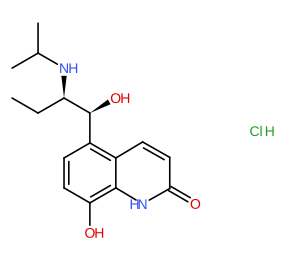 |
| Molecular structure drawn from PubChem coordinates |
| Physical properties [] | |
|---|---|
| Molecular mass | 290.36 g/mol [1] |
| Predicted LogP | 1.5 [1] |
| Structural Identifiers [] | |
|---|---|
| Molecular formula | C16H22N2O3 |
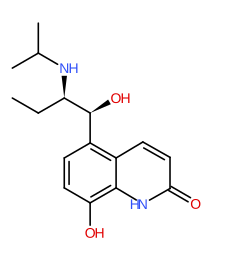
| IUPAC name | 8-hydroxy-5-[(1S,2R)-1-hydroxy-2-(propan-2-ylamino)butyl]-1H-quinolin-2-one |
| SMILES | CC[C@H]([C@H](C1=C2C=CC(=O)NC2=C(C=C1)O)O)NC(C)C |
| InChI | InChI=1S/C16H22N2O3/c1-4-12(17-9(2)3)16(21)11-5-7-13(19)15-10(11)6-8-14(20)18-15/h5-9,12,16-17,19,21H,4H2,1-3H3,(H,18,20)/t12-,16+/m1/s1 |
| InChIKey | FKNXQNWAXFXVNW-WBMJQRKESA-N |
| CAS number | 72332-33-3 |
| UNII | X7I3EMM5K0 |
| PubChem CID | 688563 |
| Pharmacokinetics[] | |
|---|---|
| Elimination half-life | 3.8–4.3 hours[3] |
| Duration of action | 4–12 hours[4][5] |
| Metabolism | Hepatic (extensive) |
| Excretion | Urine: 70% (20% unchanged), Feces: 24% (21% unchanged) |
| Routes of administration | Oral (tablets, syrup), inhalation (dry-powder inhaler) |
Procaterol (also known as Procaterolo, Procaterolum, Meptin, Opc2009, R03ac16, R03cc08, 276-590-0, 8-hydroxy-5-(1-hydroxy-2-(propan-2-ylamino)butyl)-1H-quinolin-2-one, (R,S)-Procaterol or Procaterolum [Latin]) is a substance of the amphetamine and phenylethanolamine class.
Chemistry
Salts []
Procaterol is typically found in the form of its hydrochloride salt.
Stereochemistry []
Procaterol is a single defined stereoisomer (optical activity ( + / - )).
Druglikeness
Lipinski's rule of five
Procaterol matches Lipinski's rule of five.Pharmacology
ATC Classification
- respiratory system (R)
- drugs for obstructive airway diseases (R03)
- adrenergics, inhalants (R03A)
- selective beta-2-adrenoreceptor agonists (R03AC)
- procaterol (R03AC16)
- adrenergics for systemic use (R03C)
- selective beta-2-adrenoreceptor agonists (R03CC)
- procaterol (R03CC08)
MeSH Classification
- bronchodilator agents (M0002975)
- sympathomimetics (M0020947)
- adrenergic beta-2 receptor agonists (M0543982)
Mechanism of action []
Beta(2)-receptor stimulation in the lung causes relaxation of bronchial smooth muscle, bronchodilation, and increased bronchial airflow. [1]
Interactions []
External links []
References []
National Center for Biotechnology Information. PubChem Compound Summary for CID 688563, Procaterol. Accessed November 20, 2026. https://pubchem.ncbi.nlm.nih.gov/compound/688563
U.S. Food and Drug Administration; National Center for Advancing Translational Sciences. Procaterol. UNII: X7I3EMM5K0. Global Substance Registration System. Accessed November 20, 2026. https://gsrs.ncats.nih.gov/ginas/app/beta/substances/X7I3EMM5K0
Kobayashi H, Masuda M, Kashiyama E, Koga N, Yasuda Y, Shibutani T, Endo K, Funaki T, Miyamoto T. Pharmacokinetic study of the oral administration of procaterol hydrochloride hydrate 50 µg in healthy adult Japanese men. International Journal of Clinical Pharmacology and Therapeutics. November 2010; 48(11):744–750. PMID 20979933.
Gern JE, Lemanske RF. β-Adrenergic Agonist Therapy. Immunology and Allergy Clinics of North America. 1993; 13(4):839–860. https://doi.org/10.1016/S0889-8561(22)00663-4
Kemp JP. Adrenergic bronchodilators, old and new. The Journal of Asthma. 1983; 20(6):445–453. PMID 6243013.
Data sources []
| Source | Status | Updated (UTC) |
|---|---|---|
| dosing | missing (no dosing statistics) | 2026-11-20 09:01:46 |
| drugspro | missing (no DrugsPRO reagent data) | 2026-11-20 09:01:42 |
| erowid | missing (no Erowid substance of that name) | 2026-11-20 09:01:42 |
| gsrs | ok | 2026-11-20 09:01:44 |
| hmdb | missing (no HMDB id) | 2026-11-20 09:01:42 |
| kegg | ok | 2026-11-20 09:01:45 |
| pubchem | ok | 2026-11-20 09:01:42 |
| missing (no r/tripreports posts mention it) | 2026-11-20 09:01:42 | |
| sider | missing (not in SIDER) | 2026-11-20 09:01:42 |
| structure | ok | 2026-11-20 09:01:42 |
| wikipedia | ok | 2026-11-20 09:01:43 |