Procyclidine
| Procyclidine | |
|---|---|
 |
| Salts [] | |
|---|---|
| Procyclidine hydrochloride | |
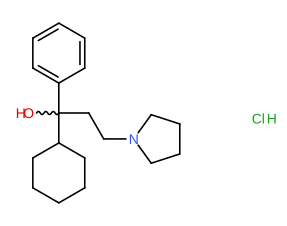 |
| Molecular structure drawn from PubChem coordinates |
| Physical properties [] | |
|---|---|
| Molecular mass | 287.40 g/mol [1] |
| Appearance | Crystals from petroleum ether [1] |
| Melting point | 86 °C [1] |
| Decomposition | When heated to decomposition it emits toxic fumes of NOx. [1] |
| Solubility | Moderately soluble in water, ~ 30 mg/ml [1] |
| Predicted LogP | 4.1 [1] |
| Structural Identifiers [] | |
|---|---|
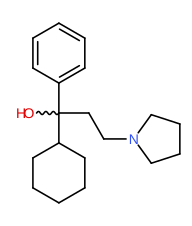
| Molecular formula | C19H29NO |
| IUPAC name | 1-cyclohexyl-1-phenyl-3-pyrrolidin-1-ylpropan-1-ol |
| SMILES | C1CCC(CC1)C(CCN2CCCC2)(C3=CC=CC=C3)O |
| InChI | InChI=1S/C19H29NO/c21-19(17-9-3-1-4-10-17,18-11-5-2-6-12-18)13-16-20-14-7-8-15-20/h1,3-4,9-10,18,21H,2,5-8,11-16H2 |
| InChIKey | WYDUSKDSKCASEF-UHFFFAOYSA-N |
| CAS number | 77-37-2 |
| UNII | C6QE1Q1TKR |
| PubChem CID | 4919 |
| Pharmacokinetics[] | |
|---|---|
| Elimination half-life | ~12 h |
| Routes of administration | By mouth, im, iv |
| Toxicity [] | |
|---|---|
| LD50 | Mouse: - intraperitoneal: 131 mg/kg - intravenous: 60 mg/kg [1] |
Procyclidine (also known as Kemadrine, Tricoloid, Elorine, Lergine, Vagosin, Arpicolin, Spamol, Procyklidin, Triciclidina or Metanin) is a anticholinergic substance of the phenylpropylamine class.
Chemistry
Salts []
Procyclidine is typically found in the form of its hydrochloride salt.
Stereochemistry []
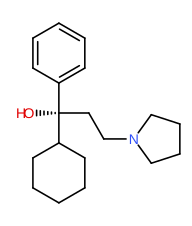
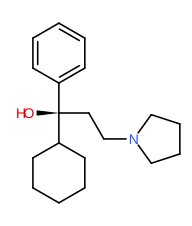
Procyclidine is a racemic mixture of the enantiomers (optical activity ( + / - )).
| Stereoisomerism |
|---|
| Stereoisomers from PubChem |
Druglikeness
Lipinski's rule of five
Procyclidine matches Lipinski's rule of five.Pharmacology
ATC Classification
- nervous system (N)
- anti-parkinson drugs (N04)
- anticholinergic agents (N04A)
- tertiary amines (N04AA)
- (N04AA04)
- procyclidine (N04AA04)
MeSH Classification
Mechanism of action []
The mechanism of action is unknown. It is thought that Procyclidine acts by blocking central cholinergic receptors, and thus balancing cholinergic and dopaminergic activity in the basal ganglia. Many of its effects are due to its pharmacologic similarities with atropine. Procyclidine exerts an antispasmodic effect on smooth muscle, and may produce mydriasis and reduction in salivation. [1]
Interactions []
See also []
External links []
References []
National Center for Biotechnology Information. PubChem Compound Summary for CID 4919, Procyclidine. Accessed November 20, 2026. https://pubchem.ncbi.nlm.nih.gov/compound/4919
U.S. Food and Drug Administration; National Center for Advancing Translational Sciences. Procyclidine. UNII: C6QE1Q1TKR. Global Substance Registration System. Accessed November 20, 2026. https://gsrs.ncats.nih.gov/ginas/app/beta/substances/C6QE1Q1TKR
Data sources []
| Source | Status | Updated (UTC) |
|---|---|---|
| dosing | missing (no dosing statistics) | 2026-11-20 07:07:05 |
| drugspro | missing (no DrugsPRO reagent data) | 2026-11-20 07:07:01 |
| erowid | missing (no Erowid substance of that name) | 2026-11-20 07:07:01 |
| gsrs | ok | 2026-11-20 07:07:02 |
| hmdb | missing (hmdb.ca refused automated access to HMDB0014531) | 2026-11-20 07:07:01 |
| kegg | ok | 2026-11-20 07:07:02 |
| pubchem | ok | 2026-11-20 07:06:59 |
| missing (no r/tripreports posts mention it) | 2026-11-20 07:07:01 | |
| sider | missing (not in SIDER) | 2026-11-20 07:07:01 |
| structure | ok | 2026-11-20 07:07:01 |
| wikipedia | ok | 2026-11-20 07:07:01 |