Promethazine
| Promethazine | |
|---|---|
 |
| Salts [] | |
|---|---|
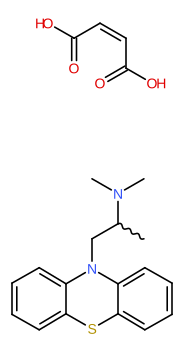
| Promethazine maleate | |
 | |
| Promethazine hydrochloride | |
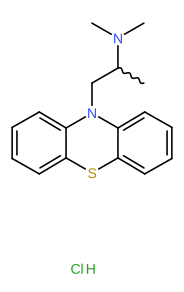 |
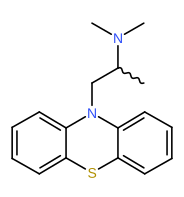
| Molecular structure drawn from PubChem coordinates |
| Physical properties [] | |
|---|---|
| Molecular mass | 284.40 g/mol [1] |
| Appearance | Crystals [1] |
| Melting point | 140 °F (NTP, 1992) [1] |
| Boiling point | 374 to 379 °F at 3 mmHg (NTP, 1992) [1] |
| Decomposition | When heated to decomposition it emits very toxic fumes of /nitrogen oxides and sulfur oxides/. [1] |
| Solubility | 15.6 mg/L (at 24 °C) [1] |
| Predicted LogP | 4.8 [1] |
| Structural Identifiers [] | |
|---|---|
| Molecular formula | C17H20N2S |
| IUPAC name | N,N-dimethyl-1-phenothiazin-10-ylpropan-2-amine |
| SMILES | CC(CN1C2=CC=CC=C2SC3=CC=CC=C31)N(C)C |
| InChI | InChI=1S/C17H20N2S/c1-13(18(2)3)12-19-14-8-4-6-10-16(14)20-17-11-7-5-9-15(17)19/h4-11,13H,12H2,1-3H3 |
| InChIKey | PWWVAXIEGOYWEE-UHFFFAOYSA-N |
| CAS number | 60-87-7 |
| UNII | FF28EJQ494 |
| PubChem CID | 4927 |
| Pharmacokinetics[] | |
|---|---|
| Elimination half-life | 10–19 hours[3] |
| Duration of action | 4–6 hours (sometimes up–12 hours) |
| Metabolism | Liver glucuronidation and sulfoxidation |
| Excretion | Kidney and Bile duct |
| Routes of administration | By mouth, rectal, intravenous, intramuscular, topical |
| Dependence liability | Low[4] |
| Addiction liability | None-Very low[5] |
| Toxicity [] | |
|---|---|
| LD50 | Mouse: - im: 175 mg/kg - iv: 40 mg/kg Rabbit: - iv: 19 mg/kg - oral: 580 mg/kg [1] |
Promethazine (also known as Proazamine, Diphergan, Protazine, Vallergine, Dimapp, Promethazin, Fargan, Procit, Promazinamide or Promezathine) is a anaesthetic substance of the aniline class.
Chemistry
Salts []
Stereochemistry []
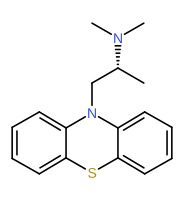
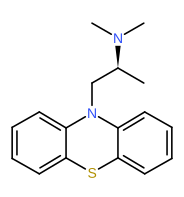
Promethazine is a racemic mixture of the enantiomers (optical activity ( + / - )).
| Stereoisomerism |
|---|
| Stereoisomers from PubChem |
Druglikeness
Lipinski's rule of five
Promethazine matches Lipinski's rule of five.Reagents
There are currently 1 reagent-interactions on DrugsPRO
| Reagent | Color change | Description |
|---|---|---|
| Froehde | purple red |
Pharmacology
ATC Classification
- dermatologicals (D)
- antipruritics, incl. antihistamines, anesthetics, etc. (D04)
- antipruritics, incl. antihistamines, anesthetics, etc. (D04A)
- antihistamines for topical use (D04AA)
- promethazine (D04AA10)
- respiratory system (R)
- antihistamines for systemic use (R06)
- antihistamines for systemic use (R06A)
- phenothiazine derivatives (R06AD)
- promethazine (R06AD02)
MeSH Classification
Mechanism of action []
Promethazine is a an antagonist of histamine H1, post-synaptic mesolimbic dopamine, alpha adrenergic, muscarinic, and NMDA receptors. The antihistamine action is used to treat allergic reactions. Antagonism of muscarinic and NMDA receptors contribute to its use as a sleep aid, as well as for anxiety and tension. Antagonism of histamine H1, muscarinic, and dopamine receptors in the medullary vomiting center make promethazine useful in the treatment of nausea and vomiting. [1]
Interactions []
Medical side effects []
89 side effects listed on drug labels in SIDER 4.1 (promethazine).
- Abscess
- Agranulocytosis
- Anaphylactic shock
- Aplastic anaemia
- Anxiety
- Apnoea
- Arrhythmia
- Asthma
- Catatonia
- Coma
- Confusional state
- Feeling abnormal
- Constipation
- Delirium
- Depression
- Dermatitis
- Rash
- Dermatitis contact
- Diarrhoea
- Diplopia
- Dizziness
- Syncope
- Somnolence
- Dyskinesia
- Oedema
- Extravasation
- Asthenia
- Fatigue
- Lassitude
- Gangrene
- Hallucination
- Headache
- Hypotension
- Conversion disorder
- Irritability
- Jaundice
- Jaundice cholestatic
- Leukopenia
- Nasal congestion
- Necrosis
- Nervousness
- Tension
- Neuroleptic malignant syndrome
- Nightmare
- Pain
- Palpitations
- Phlebitis
- Pruritus
- Convulsion
- Convulsive seizure
- Muscle spasms
- Swelling
- Shock
- Loss of consciousness
- Tachycardia
- Thrombocytopenia
- Thrombophlebitis
- Tinnitus
- Torticollis
- Tremor
- Erythema
- Venous thrombosis
- Dry mouth
- Urinary retention
- Agitation
- Oculogyric crisis
- Injection site reaction
- Urinary hesitation
- Nerve injury
- Dyspepsia
- Disorientation
- Extrapyramidal disorder
- Respiratory depression
- Pulmonary function test decreased
- Euphoric mood
- Protrusion tongue
- Sensory loss
- Vision blurred
- Photosensitivity reaction
- Respiratory disorder
- Bradycardia
- Coordination abnormal
- Paralysis
- Injection site phlebitis
- Surgery
- Tardive dyskinesia
- Thrombocytopenic purpura
- Insomnia
- Decreased appetite
Indications
- Allergic conditions
- Allergic contact dermatitis
- Anaphylactic shock
- Angioedema
- Apprehension
- Conjunctivitis allergic
- Hypersensitivity
- Insect bite NOS
- Light sleep
- Measles
- Motion sickness
- Nausea
- Pain
- Postoperative pain
- Postoperative vomiting
- Pruritus
- Rhinitis allergic
- Seasonal allergy
- Sting
- Urticaria
- Urticaria physical
- Varicella
- Vasomotor rhinitis
- Vomiting
- Wakefulness
Subjective effects []
| 0xea / Promethazine [] | |
|---|---|
Routes:
| |
| alina / Promethazine [] | |
|---|---|
Routes:
| |
| bonzi / Promethazine [] | |
|---|---|
Routes:
| |
| emily / Promethazine [] | |
|---|---|
Routes:
| |
| nervewing / Promethazine [] | |
|---|---|
| Pilz / Promethazine [] | |
|---|---|
Routes:
| |
Experience reports
- ""first time blacking out" datura, promethazine, brugmansia" by Key_Wasabi_7227 (12 upvotes)
- "Weed + DPH + DXM + Codeine + Benzedrex + Hydroxyzine" by AdministrationMany53 (11 upvotes)
- "i didn't know cannabis could do this" by protectyourmice (5 upvotes)
- "Ket and promethazine" by toasted170 (3 upvotes)
- "Promethazine+lorazepam= a fun little mixture" by FajitaCheetah (1 upvotes)
Legal status []
- Australia: Promethazine is a Schedule 3.
- Canada: Promethazine is a OTC.
- New Zealand: Promethazine is a OTC -Pharmacist only.[6]
- United Kingdom: Promethazine is a P (Prescription only when injection).
- United States: Promethazine is Prescription only.
- Other: Promethazine is a South Africa: S5 IV, S2 oral; Sweden: Rx-only.
See also []
External links []
References []
National Center for Biotechnology Information. PubChem Compound Summary for CID 4927, Promethazine. Accessed November 20, 2026. https://pubchem.ncbi.nlm.nih.gov/compound/4927
U.S. Food and Drug Administration; National Center for Advancing Translational Sciences. Promethazine. UNII: FF28EJQ494. Global Substance Registration System. Accessed November 20, 2026. https://gsrs.ncats.nih.gov/ginas/app/beta/substances/FF28EJQ494
Paton DM, Webster DR. Clinical pharmacokinetics of H1-receptor antagonists (the antihistamines). Clinical Pharmacokinetics. 1985; 10(6):477–497. PMID 2866055. https://doi.org/10.2165/00003088-198510060-00002
What Is Promethazine? | Promethazine Effects & Abuse. Lagunatreatment.com. https://lagunatreatment.com/drug-abuse/promethazine/
Gomez S. Promethazine Addiction And Abuse. Addictioncenter.com. 2020-11-24. https://www.addictioncenter.com/drugs/promethazine-addiction-abuse/
Phenergan Tablets/Elixir Datasheet. Medsafe NZ. https://www.medsafe.govt.nz/profs/datasheet/p/Phenergantabelixir.pdf
Data sources []
| Source | Status | Updated (UTC) |
|---|---|---|
| dosing | missing (no dosing statistics) | 2026-11-20 11:40:14 |
| drugspro | ok | 2026-11-20 11:40:10 |
| erowid | missing (no Erowid substance of that name) | 2026-11-20 11:40:10 |
| gsrs | ok | 2026-11-20 11:40:12 |
| hmdb | missing (hmdb.ca refused automated access to HMDB0015202) | 2026-11-20 11:40:10 |
| kegg | ok | 2026-11-20 11:40:16 |
| pubchem | ok | 2026-11-20 11:40:08 |
| ok | 2026-11-20 11:40:10 | |
| sider | ok | 2026-11-20 11:40:10 |
| structure | ok | 2026-11-20 11:40:10 |
| wikipedia | ok | 2026-11-20 11:40:10 |