Quinuclidinyl Benzilate
| QNB | |
|---|---|
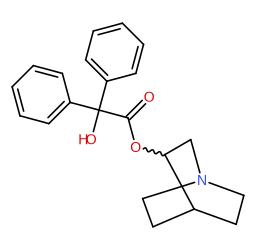 |
| Molecular structure drawn from PubChem coordinates |
| Physical properties [] | |
|---|---|
| Molecular mass | 337.40 g/mol [1] |
| Appearance | Crystalline solid [1] |
| Odor | Slight benzene smell [1] |
| Density | Decomposition point begins at 170 °C. Complete in 2 hours at 200 °C. Rate of hydrolysis: 25 °C at pH 7.0, about 4 weeks; at pH 9, 16 days, 16 hours; at pH 13, 1.8 minutes. Solid bulk density: 0.51 g/cu cm [1] |
| Melting point | 164 °C [1] |
| Decomposition | Hazardous Decomposition: Pyrolysis occurs at 170 °C after prolonged periods yielding CO, CO2 , benzophenone and benzhydrol; appreciable hydrolysis in 2 acidic or basic solutions occurs yielding 3-quinuclidinol and benzilic acid; BZ is oxidized by hypochlorite at a pH of 1-13. [1] |
| Solubility | Stable in most solvents ... soluble in propylene glycol, DMSO, and other solvents. [1] |
| Predicted LogP | 3.3 [1] |
| Structural Identifiers [] | |
|---|---|
| Molecular formula | C21H23NO3 |
| IUPAC name | 1-azabicyclo[2.2.2]octan-3-yl 2-hydroxy-2,2-diphenylacetate |
| SMILES | C1CN2CCC1C(C2)OC(=O)C(C3=CC=CC=C3)(C4=CC=CC=C4)O |
| InChI | InChI=1S/C21H23NO3/c23-20(25-19-15-22-13-11-16(19)12-14-22)21(24,17-7-3-1-4-8-17)18-9-5-2-6-10-18/h1-10,16,19,24H,11-15H2 |
| InChIKey | HGMITUYOCPPQLE-UHFFFAOYSA-N |
| CAS number | 6581-06-2 |
| PubChem CID | 23056 |
Quinuclidinyl Benzilate (also known as Benzilate, Quinuclidinyl, Ro-2-3308, 3-Quinuclidyl benzilate, 3-quinuclidinyl-benzilate, [3h]qnb, Ro 2-3308, (+-)-3-Quinuclidyl benzilate, (+-)-Oxyquinuclidine benzilate, Niosh/dd4639000 or (+-)-3-Quinuclidinol benzilate) is a deliriant substance.
Chemistry
Stereochemistry []
Quinuclidinyl Benzilate is a racemic mixture of the enantiomers.
Druglikeness
Lipinski's rule of five
Quinuclidinyl Benzilate matches Lipinski's rule of five.Pharmacology
MeSH Classification
- muscarinic antagonists (M0028057)
Mechanism of action []
BZ is a glycolate anticholinergic compound related to atropine, scopolamine, and hyoscyamine (others). ... Acting as a competitive inhibitor of acetylcholine at postsynaptic and postjunctional muscarinic receptor sites in smooth muscle, exocrine glands, autonomic ganglia, and the brain, BZ decreases the effective concentration of acetylcholine seen by receptors at these sites. Thus, BZ causes peripheral nervous system (PNS) effects that in general are the opposite of those seen in nerve agent poisoning. [1]
See also []
External links []
References []
National Center for Biotechnology Information. PubChem Compound Summary for CID 23056, Quinuclidinyl Benzilate. Accessed November 23, 2026. https://pubchem.ncbi.nlm.nih.gov/compound/23056
Data sources []
| Source | Status | Updated (UTC) |
|---|---|---|
| dosing | missing (no dosing statistics) | 2026-11-20 21:00:38 |
| drugspro | missing (no DrugsPRO reagent data) | 2026-11-20 21:00:34 |
| erowid | missing (no Erowid substance of that name) | 2026-11-20 21:00:34 |
| gsrs | missing (no UNII) | 2026-11-20 21:00:34 |
| hmdb | missing (hmdb.ca refused automated access to HMDB0245982) | 2026-11-20 21:00:34 |
| kegg | missing (no KEGG DRUG entry) | 2026-11-20 21:00:39 |
| pubchem | ok | 2026-11-20 21:00:33 |
| missing (no r/tripreports posts mention it) | 2026-11-20 21:00:34 | |
| sider | missing (not in SIDER) | 2026-11-20 21:00:34 |
| structure | ok | 2026-11-20 21:00:34 |
| wikipedia | missing (no Wikipedia article with a drug infobox) | 2026-11-20 21:00:35 |