Rimiterol
| Rimiterol | |
|---|---|
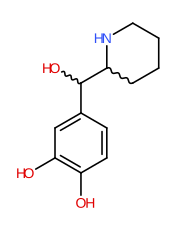 |
| Molecular structure drawn from PubChem coordinates |
| Physical properties [] | |
|---|---|
| Molecular mass | 223.27 g/mol [1] |
| Predicted LogP | 0.8 [1] |
| Structural Identifiers [] | |
|---|---|
| Molecular formula | C12H17NO3 |
| IUPAC name | 4-[hydroxy(piperidin-2-yl)methyl]benzene-1,2-diol |
| SMILES | C1CCNC(C1)C(C2=CC(=C(C=C2)O)O)O |
| InChI | InChI=1S/C12H17NO3/c14-10-5-4-8(7-11(10)15)12(16)9-3-1-2-6-13-9/h4-5,7,9,12-16H,1-3,6H2 |
| InChIKey | IYMMESGOJVNCKV-UHFFFAOYSA-N |
| PubChem CID | 431097 |
Rimiterol (also known as erythro-3,4-Dihydroxyphenyl-2-piperidylcarbinol, Nci60_002370, 4-(hydroxy(2-piperidinyl)methyl)-1,2-benzenediol or (3,4-Dihydroxyphenyl)(piperid-2-yl)methanol) is a sympathomimetic substance of the 2-benzylpiperidine class.
Chemistry
Stereochemistry []
Rimiterol is a racemic mixture of the diastereomers.
Druglikeness
Lipinski's rule of five
Rimiterol matches Lipinski's rule of five.Subjective effects []
Legal status []
- Australia: Rimiterol is a Schedule 4.
See also []
External links []
References []
National Center for Biotechnology Information. PubChem Compound Summary for CID 431097, Rimiterol. Accessed November 22, 2026. https://pubchem.ncbi.nlm.nih.gov/compound/431097
Data sources []
| Source | Status | Updated (UTC) |
|---|---|---|
| dosing | missing (no dosing statistics) | 2026-11-20 10:57:10 |
| drugspro | missing (no DrugsPRO reagent data) | 2026-11-20 10:57:06 |
| erowid | missing (no Erowid substance of that name) | 2026-11-20 10:57:06 |
| gsrs | missing (no UNII) | 2026-11-20 10:57:06 |
| hmdb | missing (hmdb.ca refused automated access to HMDB0257235) | 2026-11-20 10:57:06 |
| kegg | missing (no KEGG DRUG entry) | 2026-11-20 10:57:10 |
| pubchem | ok | 2026-11-20 10:57:05 |
| missing (no r/tripreports posts mention it) | 2026-11-20 10:57:06 | |
| sider | missing (not in SIDER) | 2026-11-20 10:57:06 |
| structure | ok | 2026-11-20 10:57:06 |
| wikipedia | ok | 2026-11-20 10:57:06 |