Ritodrine
| Ritodrine | |
|---|---|
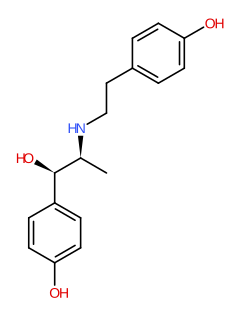 |
| Molecular structure drawn from PubChem coordinates |
| Physical properties [] | |
|---|---|
| Molecular mass | 287.35 g/mol [1] |
| Melting point | 88-90 °C [1] |
| Solubility | Complete [1] |
| Predicted LogP | 2.3 [1] |
| Structural Identifiers [] | |
|---|---|
| Molecular formula | C17H21NO3 |
| IUPAC name | 4-[2-[[(1R,2S)-1-hydroxy-1-(4-hydroxyphenyl)propan-2-yl]amino]ethyl]phenol |
| SMILES | C[C@@H]([C@@H](C1=CC=C(C=C1)O)O)NCCC2=CC=C(C=C2)O |
| InChI | InChI=1S/C17H21NO3/c1-12(17(21)14-4-8-16(20)9-5-14)18-11-10-13-2-6-15(19)7-3-13/h2-9,12,17-21H,10-11H2,1H3/t12-,17-/m0/s1 |
| InChIKey | IOVGROKTTNBUGK-SJCJKPOMSA-N |
| CAS number | 26652-09-5 |
| PubChem CID | 33572 |
| Pharmacokinetics[] | |
|---|---|
| Elimination half-life | 1.7–2.6 hours |
| Metabolism | Hepatic, metabolites are inactive[2] |
| Routes of administration | By mouth, parenteral |
Ritodrine (also known as Ritodrina, p-Hydroxy-α-(1-((p-hydroxyphenethyl)amino)ethyl)benzyl alcohol, 4-[(1R,2S)-1-hydroxy-2-{[2-(4-hydroxyphenyl)ethyl]amino}propyl]phenol, Du-21220, 4-(2-{[(1R,2S)-1-hydroxy-1-(4-hydroxyphenyl)propan-2-yl]amino}ethyl)phenol, 4-(2-(((1R,2S)-1-hydroxy-1-(4-hydroxyphenyl)propan-2-yl)amino)ethyl)phenol, ritodrinum, 4-((1R,2S)-1-hydroxy-2-((2-(4-hydroxyphenyl)ethyl)amino)propyl)phenol, Du21220 or G02ca01) is a sympathomimetic and tocolytic substance of the amphetamine and phenylethanolamine class.
Chemistry
Stereochemistry []
Ritodrine is a single defined stereoisomer.
Druglikeness
Lipinski's rule of five
Ritodrine matches Lipinski's rule of five.Pharmacology
ATC Classification
- genito urinary system and sex hormones (G)
- other gynecologicals (G02)
- other gynecologicals (G02C)
- sympathomimetics, labour repressants (G02CA)
- ritodrine (G02CA01)
MeSH Classification
- sympathomimetics (M0020947)
- tocolytic agents (M0023285)
- adrenergic beta-2 receptor agonists (M0543982)
Mechanism of action []
Ritodrine is beta-2 adrenergic agonist. It binds to beta-2 adrenergic receptors on outer membrane of myometrial cell, activates adenyl cyclase to increase the level of cAMP which decreases intracellular calcium and leads to a decrease of uterine contractions. [1]
Interactions []
Subjective effects []
External links []
References []
National Center for Biotechnology Information. PubChem Compound Summary for CID 33572, Ritodrine. Accessed November 21, 2026. https://pubchem.ncbi.nlm.nih.gov/compound/33572
Finkelstein BW. Ritodrine (Yutopar, Merrell Dow Pharmaceuticals Inc.). Drug Intelligence & Clinical Pharmacy. 1981; 15(6):425–33. https://doi.org/10.1177/106002808101500601
Data sources []
| Source | Status | Updated (UTC) |
|---|---|---|
| dosing | missing (no dosing statistics) | 2026-11-20 09:01:14 |
| drugspro | missing (no DrugsPRO reagent data) | 2026-11-20 09:01:10 |
| erowid | missing (no Erowid substance of that name) | 2026-11-20 09:01:10 |
| gsrs | missing (no UNII) | 2026-11-20 09:01:10 |
| hmdb | missing (hmdb.ca refused automated access to HMDB0015005) | 2026-11-20 09:01:10 |
| kegg | ok | 2026-11-20 09:01:11 |
| pubchem | ok | 2026-11-20 09:01:09 |
| missing (no r/tripreports posts mention it) | 2026-11-20 09:01:10 | |
| sider | missing (not in SIDER) | 2026-11-20 09:01:10 |
| structure | ok | 2026-11-20 09:01:10 |
| wikipedia | ok | 2026-11-20 09:01:10 |