Salbutamol
| Salbutamol | |
|---|---|
 |
| Salts [] | |
|---|---|
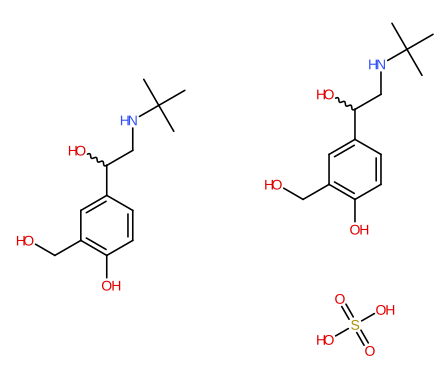
| Salbutamol hemisulfate | |
 | |
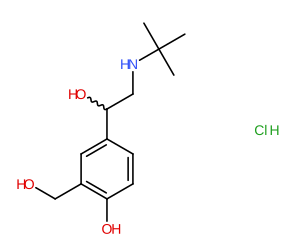
| Salbutamol hydrochloride | |
 |
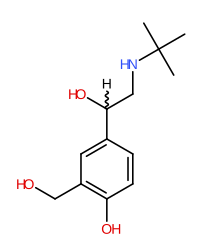
| Molecular structure drawn from PubChem coordinates |
| Physical properties [] | |
|---|---|
| Molecular mass | 239.31 g/mol [1] |
| Appearance | White to off-white crystalline solid [1] |
| Melting point | 147-149 [1] |
| Solubility | 14100 mg/L [1] |
| Predicted LogP | 0.3 [1] |
| Structural Identifiers [] | |
|---|---|
| Molecular formula | C13H21NO3 |
| IUPAC name | 4-[2-(tert-butylamino)-1-hydroxyethyl]-2-(hydroxymethyl)phenol |
| SMILES | CC(C)(C)NCC(C1=CC(=C(C=C1)O)CO)O |
| InChI | InChI=1S/C13H21NO3/c1-13(2,3)14-7-12(17)9-4-5-11(16)10(6-9)8-15/h4-6,12,14-17H,7-8H2,1-3H3 |
| InChIKey | NDAUXUAQIAJITI-UHFFFAOYSA-N |
| CAS number | 18559-94-9 |
| UNII | QF8SVZ843E |
| PubChem CID | 2083 |
| Pharmacokinetics[] | |
|---|---|
| Onset | < 15 min (inhalation), < 30 min (by mouth) |
| Elimination half-life | 3.8–6 hours (inhalation); 5–7.2 hours (by mouth) |
| Duration of action | 3–6 hours (inhalation); ≤ 8 hours (by mouth) |
| Metabolism | Liver |
| Excretion | Kidney |
| Routes of administration | By mouth, inhalation, intravenous |
Salbutamol (also known as albuterol, Ventoline, Proventil HFA, Cobutolin, Salbutamolum, Salbuvent, Asmaven, Asthalin, Aerolin or Salamol) is a sympathomimetic substance of the phenylethanolamine class.
Chemistry
Salts []
Stereochemistry []
Salbutamol is a racemic mixture of the enantiomers (optical activity ( + / - )).
Druglikeness
Lipinski's rule of five
Salbutamol matches Lipinski's rule of five.Pharmacology
ATC Classification
- respiratory system (R)
- drugs for obstructive airway diseases (R03)
- adrenergics, inhalants (R03A)
- selective beta-2-adrenoreceptor agonists (R03AC)
- (R03AC02)
- salbutamol (R03AC02)
- adrenergics for systemic use (R03C)
- selective beta-2-adrenoreceptor agonists (R03CC)
- salbutamol (R03CC02)
MeSH Classification
- bronchodilator agents (M0002975)
- tocolytic agents (M0023285)
- adrenergic beta-2 receptor agonists (M0543982)
Mechanism of action []
In vitro studies and in vivo pharmacologic studies have shown that salbutamol has a preferential effect on beta2-adrenergic receptors compared with isoproterenol. Although beta2 adrenoceptors are the predominant adrenergic receptors in bronchial smooth muscle and beta1 adrenoceptors are the predominant receptors in the heart, there are also beta2-adrenoceptors in the human heart comprising 10% to 50% of the total beta-adrenoceptors. The precise function of these receptors has not been established, but their presence raises the possibility that even selective beta2-agonists may have cardiac effects. Activation of beta2-adrenergic receptors on airway smooth muscle leads to the activation of adenyl cyclase and to an increase in the intracellular concentration of cyclic-3′,5′-adenosine monophosphate (cyclic AMP). This increase of cyclic AMP leads to the activation of protein kinase A, which inhibits the phosphorylation of myosin and lowers intracellular ionic calcium concentrations, resulting in relaxation. Salbutamol relaxes the smooth muscles of all airways, from the trachea to the terminal bronchioles. Salbutamol acts as a functional antagonist to relax the airway irrespective of the spasmogen involved, thus protecting against all bronchoconstrictor challenges. Increased cyclic AMP concentrations are also associated with the inhibition of release of mediators from mast cells in the airway. Salbutamol has been shown in most controlled clinical trials to have more effect on the respiratory tract, in the form of bronchial smooth muscle relaxation, than isoproterenol at comparable doses while producing fewer cardiovascular effects. Controlled clinical studies and other clinical experience have shown that inhaled albuterol, like other beta-adrenergic agonist drugs, can produce a significant cardiovascular effect in some patients, as measured by pulse rate, blood pressure, symptoms, and/or electrocardiographic changes. A measurable decrease in airway resistance is typically observed within 5 to 15 minutes after inhalation of salbutamol. The maximum improvement in pulmonary function usually occurs 60 to 90 minutes after salbutamol treatment, and significant bronchodilator activity has been observed to persist for 3 to 6 hours. [1]
Interactions []
Medical side effects []
200 side effects listed on drug labels in SIDER 4.1 (salbutamol).
- Tremor
- Shakiness
- Tremor muscle
- Tremor of hands
- Asthma
- Agitation
- Hyperkinesia
- Viral infection
- Bronchospasm
- Bronchospasm aggravated
- Respiratory tract infection
- Rhinitis
- Throat irritation
- Vomiting
- Inflammation
- Musculoskeletal pain
- Bronchitis
- Cough
- Cough increased
- Nervousness
- Tension
- Feeling tense
- Nausea
- Injury
- Body temperature increased
- Headache
- Increased appetite
- Pain
- Dizziness
- Lightheadedness
- Syncope
- Sinusitis
- Influenza
- Dyspepsia
- Epigastric distress
- Blood pressure increased
- Gastroenteritis
- Flatulence
- Abdominal bloating
- Tachycardia
- Gastrointestinal disorder
- Asthenia
- Fatigue
- Nasopharyngitis
- Abdominal pain
- Stomach ache
- Gastrointestinal pain
- Diarrhoea
- Dyspnoea
- Wheezing
- Myalgia
- Musculoskeletal discomfort
- Arthralgia
- Oedema
- Muscle spasms
- Cramp muscle
- Lymphadenopathy
- Aggression
- Conjunctivitis
- Epistaxis
- Hypertension
- Nasal congestion
- Pallor
- Mood swings
- Affect lability
- Insomnia
- Decreased appetite
- Anorexia
- Somnolence
- Drowsiness
- Migraine
- Palpitations
- Nightmare
- Chest pain
- Chest discomfort
- Flushing
- Irritability
- Mydriasis
- Pharyngitis
- Hyperhidrosis
- Sweating increased
- Abdominal pain upper
- Epigastric pain
- Dysuria
- Strangury
- Anaphylactic shock
- Angina pectoris
- Angioedema
- Arrhythmia
- Atrial fibrillation
- Mental disorder
- Coagulopathy
- Infection
- Dysgeusia
- Taste altered
- Dermatitis
- Rash
- Retching
- Gastrooesophageal reflux disease
- Glossitis
- Haemorrhage
- Haemoglobin
- Dysphonia
- Hyperglycaemia
- Hypersensitivity
- Hypokalaemia
- Hypotension
- Breast pain
- Musculoskeletal disorder
- Paraesthesia
- Neuropathy peripheral
- Pruritus
- Skin disorder
- Stomatitis
- Supraventricular tachycardia
- Tracheitis
- Upper respiratory tract infection
- Urticaria
- Vertigo
- Dry mouth
- Application site reaction
- Tongue discolouration
- Metabolic acidosis
- Malaise
- Discomfort
- Feeling abnormal
- Ill-defined disorder
- Thinking abnormal
- Mental disability
- Euphoric mood
- Tongue ulceration
- Saliva altered
- Bronchospasm paradoxical
- Extrasystoles
- Oropharyngeal swelling
- Autonomic neuropathy
- Vasodilatation
- Lactic acidosis
- Anxiety
- Ataxia
- Back pain
- Vulvovaginal candidiasis
- Vulvovaginal mycotic infection
- Connective tissue disorder
- Constipation
- Diabetes mellitus
- Dysmenorrhoea
- Ear disorder
- Ear pain
- Eczema
- Eructation
- Glycosuria
- Cardiac disorder
- Cardiac murmur
- Haematuria
- Herpes simplex
- Hyperaesthesia
- Type I hypersensitivity
- Hyperventilation
- Hypoaesthesia
- Hypoglycaemia
- Immune system disorder
- Eye pruritus
- Jaundice
- Ketosis
- Laryngitis
- Lung disorder
- Mediastinal disorder
- Hypertonia
- Nervous system disorder
- Otitis media
- Pre-eclampsia
- Multiple pregnancy
- Pulmonary oedema
- Shock
- Loss of consciousness
- Tinnitus
- Urinary tract infection
- Urethral disorder
- Urinary tract disorder
- Angiopathy
- Vasodilation procedure
- Cardiac output increased
- Cardiac failure high output
- Chills
- Rigors
- Myocardial ischaemia
- Malnutrition
- Cardiac fibrillation
- Dry throat
- Tachycardia foetal
- Electrocardiogram ST segment depression
- Electrocardiogram abnormal
- Fluid overload
- Feeling hot
- Emotional distress
- Electrocardiogram change
- Vascular resistance systemic
- Ileus
- Abdominal distension
Indications
- Asthma
- Asthma exercise induced
- Bronchitis chronic
- Bronchospasm
- Chronic obstructive pulmonary disease
- Coordination abnormal
- Emphysema
- Exacerbation of asthma
- Exercise-induced bronchospasm
- Inflammation
- Obstructive airways disorder
- Status asthmaticus
Subjective effects []
| 0xea / Salbutamol [] | |
|---|---|
Routes:
| |
Legal status []
See also []
External links []
References []
National Center for Biotechnology Information. PubChem Compound Summary for CID 2083, Salbutamol. Accessed November 20, 2026. https://pubchem.ncbi.nlm.nih.gov/compound/2083
U.S. Food and Drug Administration; National Center for Advancing Translational Sciences. Salbutamol. UNII: QF8SVZ843E. Global Substance Registration System. Accessed November 20, 2026. https://gsrs.ncats.nih.gov/ginas/app/beta/substances/QF8SVZ843E
Poisons Standard October 2017. Australian Government. https://www.legislation.gov.au/Details/F2017L01285/Html/Text#_Toc471222305
Prescription Drug List. Government of Canada. 23 October 2014. https://www.canada.ca/en/health-canada/services/drugs-health-products/drug-products/prescription-drug-list/list.html
Respiratory health. Health Canada. 9 May 2018. https://www.canada.ca/en/services/health/drug-health-products/drug-medical-device-highlights-2017/approved-drugs/respiratory-health.html
Data sources []
| Source | Status | Updated (UTC) |
|---|---|---|
| dosing | missing (no dosing statistics) | 2026-11-20 06:06:08 |
| drugspro | missing (no DrugsPRO reagent data) | 2026-11-20 06:06:04 |
| erowid | missing (no Erowid substance of that name) | 2026-11-20 06:06:04 |
| gsrs | ok | 2026-11-20 06:06:06 |
| hmdb | missing (hmdb.ca refused automated access to HMDB0001937) | 2026-11-20 06:06:04 |
| kegg | ok | 2026-11-20 06:06:07 |
| pubchem | ok | 2026-11-20 06:06:02 |
| missing (no r/tripreports posts mention it) | 2026-11-20 06:06:04 | |
| sider | ok | 2026-11-20 06:06:04 |
| structure | ok | 2026-11-20 06:06:04 |
| wikipedia | ok | 2026-11-20 06:06:04 |