Scopolamine
| Scopolamine | |
|---|---|
 |
| Salts [] | |
|---|---|
| Scopolamine hemisulfate | |
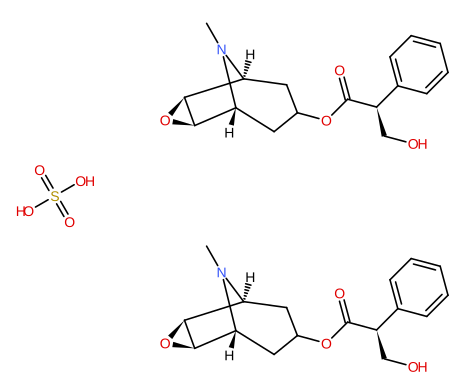 |
| Molecular structure drawn from PubChem coordinates |
| Physical properties [] | |
|---|---|
| Molecular mass | 303.35 g/mol [1] |
| Melting point | 59 °C [1] |
| Solubility | 1.0X10+5 mg/L [1] |
| Predicted LogP | 0.9 [1] |
| Structural Identifiers [] | |
|---|---|
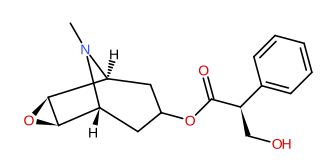
| Molecular formula | C17H21NO4 |
| IUPAC name | [(1S,2S,4R,5R)-9-methyl-3-oxa-9-azatricyclo[3.3.1.02,4]nonan-7-yl] (2S)-3-hydroxy-2-phenylpropanoate |
| SMILES | CN1[C@@H]2CC(C[C@H]1[C@H]3[C@@H]2O3)OC(=O)[C@H](CO)C4=CC=CC=C4 |
| InChI | InChI=1S/C17H21NO4/c1-18-13-7-11(8-14(18)16-15(13)22-16)21-17(20)12(9-19)10-5-3-2-4-6-10/h2-6,11-16,19H,7-9H2,1H3/t11?,12-,13-,14+,15-,16+/m1/s1 |
| InChIKey | STECJAGHUSJQJN-USLFZFAMSA-N |
| CAS number | 51-34-3 |
| UNII | DL48G20X8X |
| PubChem CID | 3000322 |
| Pharmacokinetics[] | |
|---|---|
| Elimination half-life | 5 hours |
| Metabolism | Liver (CYP3A4)[3] |
| Excretion | Kidney |
| Routes of administration | By mouth, transdermal, ophthalmic, subcutaneous, intravenous, sublingual, rectal, buccal, transmucosal, intramuscular |
Scopolamine (also known as Scopace, Hyoscine, (-)-Hyoscine, Scopine tropate, Transderm-Scop, (-)-Scopolamine, Scopine (-)-tropate, Atrochin, Hyosol or l-Scopolamine) is a substance of the tropane class.
Chemistry
Salts []
Stereochemistry []
Scopolamine is a single defined stereoisomer.
Druglikeness
Lipinski's rule of five
Scopolamine matches Lipinski's rule of five.Reagents
There are currently 4 reagent-interactions on DrugsPRO
| Reagent | Color change | Description |
|---|---|---|
| Marquis | yellow | |
| Mecke | yellow | |
| Mandelin | light green | |
| Ehrlich | no color change |
Pharmacology
ATC Classification
- (A04AD01)
MeSH Classification
- adjuvants, anesthesia (M0001144)
- antiemetics (M0001391)
- mydriatics (M0014317)
- cholinergic antagonists (M0027991)
- muscarinic antagonists (M0028057)
Mechanism of action []
[Acetylcholine] (ACh) is a neurotransmitter that can signal through ligand-gated cation channels (nicotinic receptors) and G-protein-coupled muscarinic receptors (mAChRs). ACh signalling via mAChRs located in the central nervous system (CNS) and periphery can regulate smooth muscle contraction, glandular secretions, heart rate, and various neurological phenomena such as learning and memory. mAChRs can be divided into five subtypes, M1-M5, expressed at various levels throughout the brain. Also, M2 receptors are found in the heart and M3 receptors in smooth muscles, mediating effects apart from the direct modulation of the parasympathetic nervous system. While M1, M3, and M5 mAChRs primarily couple to G<sub>q</sub> proteins to activate phospholipase C, M2 and M4 mainly couple to G<sub>i/o</sub> proteins to inhibit adenylyl cyclase and modulate cellular ion flow. This system, in part, helps to control physiological responses such as nausea and vomiting. Scopolamine acts as a non-selective competitive inhibitor of M1-M5 mAChRs, albeit with weaker M5 inhibition; as such, scopolamine is an anticholinergic with various dose-dependent therapeutic and adverse effects. The exact mechanism(s) of action of scopolamine remains poorly understood. Recent evidence suggests that M1 (and possibly M2) mAChR antagonism at interneurons acts through inhibition of downstream neurotransmitter release and subsequent pyramidal neuron activation to mediate neurological responses associated with stress and depression. Similar antagonism of M4 and M5 receptors is associated with potential therapeutic benefits in neurological conditions such as schizophrenia and substance abuse disorders. The significance of these observations to scopolamine's current therapeutic indications of preventing nausea and vomiting is unclear but is linked to its anticholinergic effect and ability to alter signalling through the CNS associated with vomiting. [1]
Interactions []
Medical side effects []
78 side effects listed on drug labels in SIDER 4.1 (scopolamine).
- Abdominal pain
- Amblyopia
- Amnesia
- Mental disorder
- Confusional state
- Feeling abnormal
- Dizziness
- Dysuria
- Strangury
- Eye disorder
- Angle closure glaucoma
- Hallucination
- Headache
- Hypotension
- Nausea
- Nervous system disorder
- Pruritus
- Speech disorder
- Hyperhidrosis
- Erythema
- Redness
- Urethral disorder
- Urinary tract disorder
- Vertigo
- Vomiting
- Agitation
- Excitement
- Muscular weakness
- Skin irritation
- Skin disorder
- Disorientation
- Disturbance in attention
- Acute psychosis
- Dry eye
- Bradycardia
- Rash generalised
- Application site pain
- Application site burn
- Eyelid irritation
- Psychotic disorder
- Paranoia
- Arrhythmia
- Constipation
- Dysphagia
- Dental caries
- Somnolence
- Eczema
- Oedema
- Dermatitis
- Rash
- Asthenia
- Fatigue
- Body temperature increased
- Flushing
- Heat exhaustion
- Heat stroke
- Irritability
- Mydriasis
- Pain
- Pharyngitis
- Tachycardia
- Thirst
- Tremor
- Dry mouth
- Urinary retention
- Photophobia
- Depressed level of consciousness
- Dry skin
- Drug withdrawal syndrome
- Conjunctivitis
- Temperature intolerance
- Hallucination, visual
- Accommodation disorder
- Cycloplegia
- Vision blurred
- Procedural nausea
- Poisoning
- Visual impairment
Indications
- Amnesia
- Cycloplegia
- Delirium tremens
- Iridocyclitis
- Motion sickness
- Mydriasis
- Nausea
- Salivation
- Vomiting
Experience reports
Erowid
There are currently 22 experience reports involving scopolamine on Erowid: []- "No Craving Whatsoever" by Scruff
- "Scopohuasca" by Neil
- "Strange but Effective" by Sinnlos
- "Like LSD and PCP Mixed with Insanity" by J. Moore
- "Slightly Delirious" by TBjorn
- "An Easy and Comfortable Trip" by Woody
- "Unexpected Intensity" by drug infatuated kid
- "Pediatrically Prescribed" by jezebel laguz
- "The Zombie-Drug" by K
- "So This Is What Dementia Feels Like!" by mr.scoobs
- "26 Mile Swimer?" by Pieter
- "Interesting but Intangible" by Sinnlos
- "Three Tries and Still Working on Quitting" by Wonderama
- "Barbies with Baggage" by SomeonElse
- "Scop eye" by Prolixity
- "Ghostly!" by Oompaloompa
- "Permanent Vision and Brain Damage" by Roy
- "Nothing at All" by keifer reefer
- "Dreamy Confusion" by n/a
- "Taken as Prescribed" by Name-Pseudonym
- "Sleepful Fantasies" by ke6ydo
- "Worth the $50" by Brdrline
Legal status []
See also []
External links []
References []
National Center for Biotechnology Information. PubChem Compound Summary for CID 3000322, Scopolamine. Accessed November 21, 2026. https://pubchem.ncbi.nlm.nih.gov/compound/3000322
U.S. Food and Drug Administration; National Center for Advancing Translational Sciences. Scopolamine. UNII: DL48G20X8X. Global Substance Registration System. Accessed November 21, 2026. https://gsrs.ncats.nih.gov/ginas/app/beta/substances/DL48G20X8X
Renner UD, Oertel R, Kirch W. Pharmacokinetics and pharmacodynamics in clinical use of scopolamine. Therapeutic Drug Monitoring. October 2005; 27(5):655–665. PMID 16175141. https://doi.org/10.1097/01.ftd.0000168293.48226.57
Poisons Standard October 2020. Federal Register of Legislation. 30 September 2020. https://www.legislation.gov.au/Details/F2020L01255
Hyoscine 400 micrograms/ml Solution for Injection. (emc). 18 September 2017. https://www.medicines.org.uk/emc/product/3581/smpc
Kwells 300 microgram tablets Summary of Product Characteristics (SmPC). (emc). 2 September 2020. https://www.medicines.org.uk/emc/product/11746/smpc
Transderm Scop - scopolamine patch, extended-release. DailyMed. 14 March 2024. https://dailymed.nlm.nih.gov/dailymed/drugInfo.cfm?setid=b877a694-a1d0-4280-937a-a06820b12a88
Data sources []
| Source | Status | Updated (UTC) |
|---|---|---|
| dosing | missing (no dosing statistics) | 2026-11-20 12:52:30 |
| drugspro | ok | 2026-11-20 12:52:26 |
| erowid | ok | 2026-11-20 12:52:28 |
| gsrs | ok | 2026-11-20 12:52:27 |
| hmdb | missing (no HMDB id) | 2026-11-20 12:52:26 |
| kegg | ok | 2026-11-20 12:52:29 |
| pubchem | ok | 2026-11-20 12:52:25 |
| ok | 2026-11-20 12:52:26 | |
| sider | ok | 2026-11-20 12:52:26 |
| structure | ok | 2026-11-20 12:52:26 |
| wikipedia | ok | 2026-11-20 12:52:26 |