Theobromine
| Theobromine | |
|---|---|
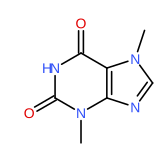 |
| Molecular structure drawn from PubChem coordinates |
| Physical properties [] | |
|---|---|
| Molecular mass | 180.16 g/mol [1] |
| Appearance | Monoclinic needles (/crystalline structure is/ lamellar twining on 001 /axis/) from water [1] |
| Taste | Bitter tasting alkaloid [1] |
| Density | 1.522 g/cu cm at 20 °C; relative density: 1.522 at 20 °C [1] |
| Melting point | 675 °F (NTP, 1992) [1] |
| Boiling point | Sublimes at 554-563 °F (NTP, 1992) [1] |
| Decomposition | Hazardous decomposition products formed under fire conditions - Carbon oxides, nitrogen oxides (NOx). [1] |
| Solubility | less than 1 mg/mL at 64 °F (NTP, 1992) [1] |
| Predicted LogP | -0.8 [1] |
| Structural Identifiers [] | |
|---|---|
| Molecular formula | C7H8N4O2 |
| IUPAC name | 3,7-dimethylpurine-2,6-dione |
| SMILES | CN1C=NC2=C1C(=O)NC(=O)N2C |
| InChI | InChI=1S/C7H8N4O2/c1-10-3-8-5-4(10)6(12)9-7(13)11(5)2/h3H,1-2H3,(H,9,12,13) |
| InChIKey | YAPQBXQYLJRXSA-UHFFFAOYSA-N |
| CAS number | 83-67-0 |
| UNII | OBD445WZ5P |
| PubChem CID | 5429 |
| Pharmacokinetics[] | |
|---|---|
| Elimination half-life | 6–8 hours[3][4] |
| Metabolism | Hepatic demethylation and oxidation |
| Excretion | Renal (10% unchanged, rest as metabolites) |
| Routes of administration | Oral |
| Dependence liability | None |
| Toxicity [] | |
|---|---|
| LD50 | Dog: - oral: 300 mg/kg [1] |
Theobromine (also known as 3,7-Dimethylxanthine, Diurobromine, Santheose, Teobromin, Theosalvose, Theostene, Thesal, 3,7-Dimethyl-3,7-dihydro-1H-purine-2,6-dione, Xantheose or FEMA No. 3591) is a substance of the xanthine class.
Chemistry
Stereochemistry []
Theobromine is achiral.
Druglikeness
Lipinski's rule of five
Theobromine matches Lipinski's rule of five.Pharmacology
ATC Classification
- cardiovascular system (C)
- diuretics (C03)
- low-ceiling diuretics, excl. thiazides (C03B)
- xanthine derivatives (C03BD)
- theobromine (C03BD01)
- respiratory system (R)
- drugs for obstructive airway diseases (R03)
- other systemic drugs for obstructive airway diseases (R03D)
- xanthines (R03DA)
- theobromine (R03DA07)
MeSH Classification
Mechanism of action []
Theobromine stimulates medullary, vagal, vasomotor, and respiratory centers, promoting bradycardia, vasoconstriction, and increased respiratory rate. This action was previously believed to be due primarily to increased intracellular cyclic 3′,5′-adenosine monophosphate (cyclic AMP) following inhibition of phosphodiesterase, the enzyme that degrades cyclic AMP. It is now thought that xanthines such as caffeine and theobromine act as antagonist at adenosine-receptors within the plasma membrane of virtually every cell. As adenosine acts as an autocoid, inhibiting the release of neurotransmitters from presynaptic sites but augmenting the actions of norepinephrine or angiotensin, antagonism of adenosine receptors promotes neurotransmitter release. This explains the stimulatory effects of xanthine derivatives such as theobromine and caffeine. Blockade of the adenosine A1 receptor in the heart leads to the accelerated, pronounced "pounding" of the heart upon caffeine intake. [1]
Legal status []
- Other: Theobromine is a In general: Unscheduled..
See also []
External links []
References []
National Center for Biotechnology Information. PubChem Compound Summary for CID 5429, Theobromine. Accessed November 21, 2026. https://pubchem.ncbi.nlm.nih.gov/compound/5429
U.S. Food and Drug Administration; National Center for Advancing Translational Sciences. Theobromine. UNII: OBD445WZ5P. Global Substance Registration System. Accessed November 21, 2026. https://gsrs.ncats.nih.gov/ginas/app/beta/substances/OBD445WZ5P
Drouillard DD, Vesell ES, Dvorchik BH. Studies on theobromine disposition in normal subjects. Alterations induced by dietary abstention from or exposure to methylxanthines. Clinical Pharmacology and Therapeutics. March 1978; 23(3):296–302. PMID 627135. https://doi.org/10.1002/cpt1978233296
Lelo A, Birkett DJ, Robson RA, Miners JO. Comparative pharmacokinetics of caffeine and its primary demethylated metabolites paraxanthine, theobromine and theophylline in man. British Journal of Clinical Pharmacology. August 1986; 22(2):177–182. PMID 3756065. https://doi.org/10.1111/j.1365-2125.1986.tb05246.x
Data sources []
| Source | Status | Updated (UTC) |
|---|---|---|
| dosing | missing (no dosing statistics) | 2026-11-20 19:41:49 |
| drugspro | missing (no DrugsPRO reagent data) | 2026-11-20 19:41:45 |
| erowid | missing (no Erowid substance of that name) | 2026-11-20 19:41:45 |
| gsrs | ok | 2026-11-20 19:41:46 |
| hmdb | missing (hmdb.ca refused automated access to HMDB0002825) | 2026-11-20 19:41:45 |
| kegg | missing (no KEGG DRUG entry) | 2026-11-20 19:41:49 |
| pubchem | ok | 2026-11-20 19:41:45 |
| missing (no r/tripreports posts mention it) | 2026-11-20 19:41:45 | |
| sider | missing (not in SIDER) | 2026-11-20 19:41:45 |
| structure | ok | 2026-11-20 19:41:45 |
| wikipedia | ok | 2026-11-20 19:41:45 |