Theophylline
| Theophylline | |
|---|---|
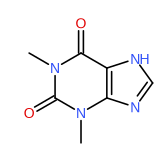 |
| Molecular structure drawn from PubChem coordinates |
| Physical properties [] | |
|---|---|
| Molecular mass | 180.16 g/mol [1] |
| Appearance | White, crystalline alkaloid [1] |
| Odor | Odorless [1] |
| Taste | Bitter [1] |
| Density | g/cm³ [1] |
| Melting point | 522 to 525 °F (NTP, 1992) [1] |
| Decomposition | When heated to decomposition it emits toxic fumes of /nitrogen oxides/. [1] |
| Solubility | 1 to 5 mg/mL at 70.7 °F (NTP, 1992) [1] |
| Predicted LogP | 0 [1] |
| Structural Identifiers [] | |
|---|---|
| Molecular formula | C7H8N4O2 |
| IUPAC name | 1,3-dimethyl-7H-purine-2,6-dione |
| SMILES | CN1C2=C(C(=O)N(C1=O)C)NC=N2 |
| InChI | InChI=1S/C7H8N4O2/c1-10-5-4(8-3-9-5)6(12)11(2)7(10)13/h3H,1-2H3,(H,8,9) |
| InChIKey | ZFXYFBGIUFBOJW-UHFFFAOYSA-N |
| CAS number | 58-55-9 |
| UNII | 0I55128JYK |
| PubChem CID | 2153 |
| Pharmacokinetics[] | |
|---|---|
| Elimination half-life | 5–8 hours |
| Metabolism | Hepatic: CYP1A2, CYP2E1, CYP3A4 |
| Routes of administration | By mouth, intravenous, rectal |
| Toxicity [] | |
|---|---|
| LD50 | Mouse: - oral: 332 mg/kg - im: 271 mg/kg - iv: 136 mg/kg - sc: 180 mg/kg [1] |
Theophylline (also known as 1,3-Dimethylxanthine, Elixophyllin, Theophyllin, Theolair, Elixophylline, Lanophyllin, Nuelin, Theophylline anhydrous, Respbid or Pseudotheophylline) is a substance of the xanthine class.
Chemistry
Stereochemistry []
Theophylline is achiral.
Druglikeness
Lipinski's rule of five
Theophylline matches Lipinski's rule of five.Pharmacology
ATC Classification
- respiratory system (R)
- drugs for obstructive airway diseases (R03)
- other systemic drugs for obstructive airway diseases (R03D)
- xanthines (R03DA)
- (R03DA04)
- theophylline (R03DA04)
MeSH Classification
- bronchodilator agents (M0002975)
- phosphodiesterase inhibitors (M0016659)
- vasodilator agents (M0022559)
- purinergic p1 receptor antagonists (M0545362)
Mechanism of action []
Theophylline relaxes the smooth muscle of the bronchial airways and pulmonary blood vessels and reduces airway responsiveness to histamine, methacholine, adenosine, and allergen. Theophylline competitively inhibits type III and type IV phosphodiesterase (PDE), the enzyme responsible for breaking down cyclic AMP in smooth muscle cells, possibly resulting in bronchodilation. Theophylline also binds to the adenosine A2B receptor and blocks adenosine mediated bronchoconstriction. In inflammatory states, theophylline activates histone deacetylase to prevent transcription of inflammatory genes that require the acetylation of histones for transcription to begin. [1]
Prodrugs of theophylline: Cafedrine, Fenethylline, ZDCM-04.
Interactions []
Interaction mechanisms documented in KEGG DRUG (number of interacting drugs):
| CYP1A2 | inhibition / metabolism / induction | 62 |
|---|---|---|
| ADORA1 | shared target | 29 (6 contraindicated) |
| PDE4A | shared target | 23 |
| PDE4B | shared target | 21 |
| PDE4C | shared target | 21 |
| PDE4D | shared target | 21 |
| ADORA2B | shared target | 19 (6 contraindicated) |
| PDE2A | shared target | 19 |
| PDE1B | shared target | 18 |
| PDE3A | shared target | 18 |
| PDE3B | shared target | 18 |
| PDE10A | shared target | 13 |
| PDE11A | shared target | 13 |
| PDE1A | shared target | 13 |
| PDE1C | shared target | 13 |
| PDE7A | shared target | 13 |
| PDE7B | shared target | 13 |
| PDE8A | shared target | 13 |
| PDE8B | shared target | 13 |
Medical side effects []
79 side effects listed on drug labels in SIDER 4.1 (theophylline).
- Sinus tachycardia
- Vomiting
- Persistent vomiting
- Hypokalaemia
- Hyperglycaemia
- Nervousness
- Tension
- Tremor
- Tremor muscle
- Abdominal pain
- Gastrointestinal pain
- Ventricular extrasystoles
- Hypotension
- Shock
- Tachycardia
- Supraventricular tachycardia
- Ventricular arrhythmia
- Haemodynamic instability
- Disorientation
- Convulsion
- Convulsions generalised
- Diarrhoea
- Atrial fibrillation
- Cardiac flutter
- Rhabdomyolysis
- Haematemesis
- Atrial tachycardia
- Albuminuria
- Alopecia
- Anaphylactic shock
- Anaphylactoid reaction
- Decreased appetite
- Anxiety
- Arrhythmia
- Coma
- Infection
- Dermatitis exfoliative
- Dermatitis contact
- Polyuria
- Dizziness
- Dermatitis
- Rash
- Extravasation
- Body temperature increased
- Flushing
- Gastrooesophageal reflux disease
- Headache
- Haematuria
- Hypercalcaemia
- Hypersensitivity
- Inappropriate antidiuretic hormone secretion
- Irritability
- Nausea
- Nervous system disorder
- Palpitations
- Peptic ulcer
- Phlebitis
- Pruritus
- Status epilepticus
- Urticaria
- Venous thrombosis
- Urinary retention
- Agitation
- Respiratory arrest
- Tachypnoea
- Abdominal pain upper
- Respiratory depression
- Pulmonary function test decreased
- Brain injury
- Hypoxic-ischaemic encephalopathy
- Extrasystoles
- Epigastric discomfort
- Fluid overload
- Cardio-respiratory arrest
- Poisoning
- Blood uric acid increased
- Hyperuricaemia
- Insomnia
- Overdose
Indications
- Asthma
- Asthma chronic
- Bronchitis chronic
- Bronchospasm
- Chronic obstructive pulmonary disease
- Emphysema
- Hyperthyroidism
- Lung disorder
Legal status []
- Australia: Theophylline is a Schedule 4.
- Canada: Theophylline is Prescription only.
- United Kingdom: Theophylline is a P.
- United States: Theophylline is Prescription only.
See also []
External links []
References []
National Center for Biotechnology Information. PubChem Compound Summary for CID 2153, Theophylline. Accessed November 23, 2026. https://pubchem.ncbi.nlm.nih.gov/compound/2153
U.S. Food and Drug Administration; National Center for Advancing Translational Sciences. Theophylline. UNII: 0I55128JYK. Global Substance Registration System. Accessed November 23, 2026. https://gsrs.ncats.nih.gov/ginas/app/beta/substances/0I55128JYK
Data sources []
| Source | Status | Updated (UTC) |
|---|---|---|
| dosing | missing (no dosing statistics) | 2026-11-20 11:44:14 |
| drugspro | missing (no DrugsPRO reagent data) | 2026-11-20 11:44:10 |
| erowid | missing (no Erowid substance of that name) | 2026-11-20 11:44:10 |
| gsrs | ok | 2026-11-20 11:44:10 |
| hmdb | missing (hmdb.ca refused automated access to HMDB0001889) | 2026-11-20 11:44:10 |
| kegg | ok | 2026-11-20 11:44:13 |
| pubchem | ok | 2026-11-20 11:44:09 |
| missing (no r/tripreports posts mention it) | 2026-11-20 11:44:10 | |
| sider | ok | 2026-11-20 11:44:10 |
| structure | ok | 2026-11-20 11:44:10 |
| wikipedia | ok | 2026-11-20 11:44:10 |