Thyroxine
| T4 | |
|---|---|
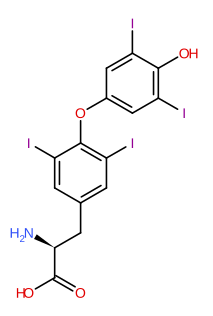 |
| Molecular structure drawn from PubChem coordinates |
| Physical properties [] | |
|---|---|
| Molecular mass | 776.87 g/mol [1] |
| Appearance | Crystals [1] |
| Melting point | 235.5 °C [1] |
| Decomposition | When heated to decomposition it emits toxic fumes. [1] |
| Solubility | 0.105 mg/mL [1] |
| Predicted LogP | 2.4 [1] |
| Structural Identifiers [] | |
|---|---|
| Molecular formula | C15H11I4NO4 |
| IUPAC name | (2S)-2-amino-3-[4-(4-hydroxy-3,5-diiodophenoxy)-3,5-diiodophenyl]propanoic acid |
| SMILES | C1=C(C=C(C(=C1I)OC2=CC(=C(C(=C2)I)O)I)I)C[C@@H](C(=O)O)N |
| InChI | InChI=1S/C15H11I4NO4/c16-8-4-7(5-9(17)13(8)21)24-14-10(18)1-6(2-11(14)19)3-12(20)15(22)23/h1-2,4-5,12,21H,3,20H2,(H,22,23)/t12-/m0/s1 |
| InChIKey | XUIIKFGFIJCVMT-LBPRGKRZSA-N |
| CAS number | 51-48-9 |
| UNII | Q51BO43MG4 |
| PubChem CID | 5819 |
Thyroxine (also known as thyroxin, L Thyroxin β, L Thyrox, L Thyroxine Roche, L Thyroxin Henning, Levothyroxin Delalande, L-3,5,5'-tetraiodothyronine, Tyrosine, O-(4-hydroxy-3,5-diiodophenyl)-3,5-diiodo-, 2-amino-3-(4-(4-hydroxy-3,5-diiodophenoxy)-3,5-diiodophenyl)propanoic acid or L-thyroxine) is a substance of the amphetamine and amino acid class.
Chemistry
Stereochemistry []
Thyroxine is a single defined stereoisomer (optical activity ( - )).
Druglikeness
Lipinski's rule of five
Thyroxine matches Lipinski's rule of five (violations: 1).Pharmacology
ATC Classification
- (H03AA01)
Mechanism of action []
Levothyroxine is a synthetically prepared levo-isomer of the thyroid hormone thyroxine (T<sub>4</sub>, a tetra-iodinated tyrosine derivative) that acts as a replacement in deficiency syndromes such as hypothyroidism. T<sub>4</sub> is the major hormone secreted from the thyroid gland and is chemically identical to the naturally secreted T<sub>4</sub>: it increases metabolic rate, decreases thyroid-stimulating hormone (TSH) production from the anterior lobe of the pituitary gland, and, in peripheral tissues, is converted to T<sub>3</sub>. Thyroxine is released from its precursor protein thyroglobulin through proteolysis and secreted into the blood where is it then peripherally deiodinated to form triiodothyronine (T<sub>3</sub>) which exerts a broad spectrum of stimulatory effects on cell metabolism. T<sub>4</sub> and T<sub>3</sub> have a relative potency of ~1:4. Thyroid hormone increases the metabolic rate of cells of all tissues in the body. In the fetus and newborn, thyroid hormone is important for the growth and development of all tissues including bones and the brain. In adults, thyroid hormone helps to maintain brain function, food metabolism, and body temperature, among other effects. The symptoms of thyroid deficiency relieved by levothyroxine include slow speech, lack of energy, weight gain, hair loss, dry thick skin and unusual sensitivity to cold. The thyroid hormones have been shown to exert both genomic and non-genomic effects. They exert their genomic effects by diffusing into the cell nucleus and binding to thyroid hormone receptors in DNA regions called thyroid hormone response elements (TREs) near genes. This complex of T<sub>4</sub>, T<sub>3</sub>, DNA, and other coregulatory proteins causes a conformational change and a resulting shift in transcriptional regulation of nearby genes, synthesis of messenger RNA, and cytoplasmic protein production. For example, in cardiac tissues T<sub>3</sub> has been shown to regulate the genes for α- and β-myosin heavy chains, production of the sarcoplasmic reticulum proteins calcium-activated ATPase (Ca2+-ATPase) and phospholamban, β-adrenergic receptors, guanine-nucleotide regulatory proteins, and adenylyl cyclase types V and VI as well as several plasma-membrane ion transporters, such as Na+/K+–ATPase, Na+/Ca2+ exchanger, and voltage-gated potassium channels, including Kv1.5, Kv4.2, and Kv4.3. As a result, many cardiac functions including heart rate, cardiac output, and systemic vascular resistance are closely linked to thyroid status. The non-genomic actions of the thyroid hormones have been shown to occur through binding to a plasma membrane receptor integrin aVb3 at the Arg-Gly-Asp recognition site. From the cell-surface, T<sub>4</sub> binding to integrin results in down-stream effects including activation of mitogen-activated protein kinase (MAPK; ERK1/2) and causes subsequent effects on cellular/nuclear events including angiogenesis and tumor cell proliferation. [1]
Medical side effects []
65 side effects listed on drug labels in SIDER 4.1 (thyroxine).
- Abdominal pain
- Gastrointestinal pain
- Alopecia
- Angina pectoris
- Angioedema
- Anxiety
- Arrhythmia
- Arthralgia
- Musculoskeletal discomfort
- Cerebral artery embolism
- Choking
- Coma
- Confusional state
- Feeling abnormal
- Craniosynostosis
- Dysphagia
- Diarrhoea
- Dyspnoea
- Dermatitis
- Rash
- Asthenia
- Fatigue
- Body temperature increased
- Flushing
- Retching
- Basedow's disease
- Headache
- Cardiac arrest
- Cardiac failure
- Cardiac failure congestive
- Hyperthyroidism
- Hypoglycaemia
- Infertility
- Irritability
- Myocardial infarction
- Acute coronary syndrome
- Nausea
- Nervousness
- Tension
- Palpitations
- Pruritus
- Benign intracranial hypertension
- Convulsion
- Serum sickness
- Shock
- Hyperhidrosis
- Sweating increased
- Tachycardia
- Tremor
- Urticaria
- Vomiting
- Weight decreased
- Wheezing
- Mood swings
- Affect lability
- Epiphysiolysis
- Muscular weakness
- Menstruation irregular
- Temperature intolerance
- Increased appetite
- Disorientation
- Dehydration
- Agitation
- Hyperkinesia
- Insomnia
Indications
- Absence congenital
- Atrophy
- Dysfunction thyroid
- Follicular thyroid cancer
- Goitre
- Hashimoto's disease
- Hypothyroidism
- Myxoedema coma
- Neoplasm malignant
- Primary hypothyroidism
- Subclinical hypothyroidism
- Thyroid nodule
- Thyroiditis
- Thyroiditis subacute
See also []
External links []
References []
National Center for Biotechnology Information. PubChem Compound Summary for CID 5819, Thyroxine. Accessed November 20, 2026. https://pubchem.ncbi.nlm.nih.gov/compound/5819
U.S. Food and Drug Administration; National Center for Advancing Translational Sciences. Thyroxine. UNII: Q51BO43MG4. Global Substance Registration System. Accessed November 20, 2026. https://gsrs.ncats.nih.gov/ginas/app/beta/substances/Q51BO43MG4
Data sources []
| Source | Status | Updated (UTC) |
|---|---|---|
| dosing | missing (no dosing statistics) | 2026-11-20 06:38:13 |
| drugspro | missing (no DrugsPRO reagent data) | 2026-11-20 06:38:09 |
| erowid | missing (no Erowid substance of that name) | 2026-11-20 06:38:09 |
| gsrs | ok | 2026-11-20 06:38:09 |
| hmdb | missing (hmdb.ca refused automated access to HMDB0000248) | 2026-11-20 06:38:09 |
| kegg | ok | 2026-11-20 06:38:11 |
| pubchem | ok | 2026-11-20 06:38:09 |
| missing (no r/tripreports posts mention it) | 2026-11-20 06:38:09 | |
| sider | ok | 2026-11-20 06:38:09 |
| structure | ok | 2026-11-20 06:38:09 |
| wikipedia | missing (no Wikipedia article with a drug infobox) | 2026-11-20 06:38:09 |