Tianeptine
| Tianeptine | |
|---|---|
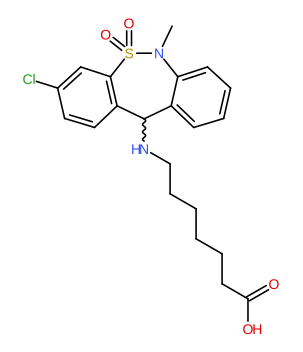 |
| Molecular structure drawn from PubChem coordinates |
| Physical properties [] | |
|---|---|
| Molecular mass | 437.00 g/mol [1] |
| Melting point | 148 [1] |
| Boiling point | 609.2 [1] |
| Predicted LogP | 1.2 [1] |
| Structural Identifiers [] | |
|---|---|
| Molecular formula | C21H25ClN2O4S |
| IUPAC name | 7-[(3-chloro-6-methyl-5,5-dioxo-11H-benzo[c][2,1]benzothiazepin-11-yl)amino]heptanoic acid |
| SMILES | CN1C2=CC=CC=C2C(C3=C(S1(=O)=O)C=C(C=C3)Cl)NCCCCCCC(=O)O |
| InChI | InChI=1S/C21H25ClN2O4S/c1-24-18-9-6-5-8-16(18)21(23-13-7-3-2-4-10-20(25)26)17-12-11-15(22)14-19(17)29(24,27)28/h5-6,8-9,11-12,14,21,23H,2-4,7,10,13H2,1H3,(H,25,26) |
| InChIKey | JICJBGPOMZQUBB-UHFFFAOYSA-N |
| CAS number | 72797-41-2 |
| UNII | XV6773012I |
| PubChem CID | 68870 |
| Pharmacokinetics[] | |
|---|---|
| Elimination half-life | 2.5–3 hours, 4–9 hours (elderly)[3] |
| Metabolism | Hepatic by β-oxidation[4] |
| Excretion | Urine: 65%, Feces: 15% |
| Routes of administration | Oral |
Tianeptine (also known as Stablon, Tianeptina, Tpi-1062, Jnj-39823277, S-1574, Tianeptinum, N06ax14, 276-851-9, Coaxil or Tianeptine Acid) is a antidepressant and depressant substance of the benzylamine class.
Chemistry
Stereochemistry []
Tianeptine is a racemic mixture of the enantiomers (optical activity ( - )).
Druglikeness
Lipinski's rule of five
Tianeptine matches Lipinski's rule of five.Reagents
There are currently 3 reagent-interactions on DrugsPRO
| Reagent | Color change | Description |
|---|---|---|
| Marquis | no color change | |
| Liebermann | no color change | |
| Froehde | no color change |
Pharmacology
ATC Classification
- nervous system (N)
- psychoanaleptics (N06)
- antidepressants (N06A)
- other antidepressants (N06AX)
- (N06AX14)
- tianeptine (N06AX14)
MeSH Classification
- antidepressive agents, tricyclic (M0001387)
Mechanism of action []
Recent studies suggest that tianeptine acts as a full agonist at the mu-type opioid receptor (MOR),. The mu opioid receptors are currently being studied as effective targets for antidepressant therapies. It is believed that the clinical effects of tianeptine are owed to its modulation of these receptors. In addition to its actions on the opioid receptor, previous studies have owed its action to its effect on the serotonin receptor,, dopamine (D2/3) receptors, and glutamate receptors,, as discussed below: Tianeptine has challenged the monoaminergic hypothesis of depression, as well as the widely supported monoaminergic mechanisms whereby the action of most known antidepressants have been explained. Specifically, this drug is thought to persistently alter glutamate receptor bursting of the hippocampal CA3 commissural associational synapse. Current research suggests that tianeptine produces its antidepressant effects through the modulation of glutamate receptor activity (for example, AMPA receptors and NMDA receptors) and affect the release of brain-derived neurotrophic factor (BDNF), which impacts neural plasticity. More recent studies by support the role of tianeptine in the modulation of glutaminergic activity in the amygdala, the emotional region of the brain associated with memories. Tianeptine reduces the hypothalamic-pituitary-adrenal response to stress, and thus prevents stress-related behavioral issues. In rodents, the stress of acute restraint increases extracellular levels of glutamate in the basolateral amygdala an effect that was inhibited by tianeptine. Interestingly, the SSRI fluoxetine increased extracellular glutamate levels in the basolateral amygdala regardless of stress conditions. These data demonstrate that the mechanism of action of tianeptine is distinct from SSRIs and support the hypothesis that the mechanism of action of tianeptine relates to alteration of glutaminergic activity in the amygdala and the hippocampus. In addition to the above mechanisms, tianeptine is a unique antidepressant and anxiolytic medication that stimulates the uptake of serotonin (5-hydroxytryptamine; 5-HT), and 5-hydroxyindoleacetic acid (5-HIAA) in brain tissue. Although the monoaminergic neurotransmitters serotonin (5-HT), noradrenaline (NA) and dopamine (DA) are proven to be related to the occurrence of depressive disorders, it is now recognized that monoamine deficits are not sufficient to explain the mechanism of action of antidepressant medications. [1]
Legal status []
See also []
External links []
References []
National Center for Biotechnology Information. PubChem Compound Summary for CID 68870, Tianeptine. Accessed November 21, 2026. https://pubchem.ncbi.nlm.nih.gov/compound/68870
U.S. Food and Drug Administration; National Center for Advancing Translational Sciences. Tianeptine. UNII: XV6773012I. Global Substance Registration System. Accessed November 21, 2026. https://gsrs.ncats.nih.gov/ginas/app/beta/substances/XV6773012I
Carlhant D, Le Garrec J, Guedes Y, Salvadori C, Mottier D, Riche C. Pharmacokinetics and bioavailability of tianeptine in the elderly. Drug Investigation. September 1990; 2(3):167–172. https://doi.org/10.1007/BF03259191
Fromenty B, Freneaux E, Labbe G, Deschamps D, Larrey D, Letteron P, Pessayre D. Tianeptine, a new tricyclic antidepressant metabolized by beta-oxidation of its heptanoic side chain, inhibits the mitochondrial oxidation of medium and short chain fatty acids in mice. Biochem Pharmacol. 1 Nov 1989; 38(21):3743–3751. PMID 2597170. https://doi.org/10.1016/0006-2952(89)90580-7
RDC Nº 784 - Listas de Substâncias Entorpecentes, Psicotrópicas, Precursoras e Outras sob Controle Especial. Diário Oficial da União. 2023-03-31. https://www.in.gov.br/en/web/dou/-/resolucao-rdc-n-784-de-31-de-marco-de-2023-474904992
Poisons Standard June 2017. 29 May 2017. https://www.legislation.gov.au/Details/F2017L00605
Data sources []
| Source | Status | Updated (UTC) |
|---|---|---|
| dosing | missing (no dosing statistics) | 2026-11-20 17:01:19 |
| drugspro | ok | 2026-11-20 17:01:15 |
| erowid | missing (no Erowid substance of that name) | 2026-11-20 17:01:15 |
| gsrs | ok | 2026-11-20 17:01:15 |
| hmdb | missing (hmdb.ca refused automated access to HMDB0042038) | 2026-11-20 17:01:15 |
| kegg | ok | 2026-11-20 17:01:17 |
| pubchem | ok | 2026-11-20 17:01:13 |
| missing (no r/tripreports posts mention it) | 2026-11-20 17:01:15 | |
| sider | missing (not in SIDER) | 2026-11-20 17:01:15 |
| structure | ok | 2026-11-20 17:01:15 |
| wikipedia | ok | 2026-11-20 17:01:15 |