Tomscaline
| TMPEA | |
|---|---|
 |
| Salts [] | |
|---|---|
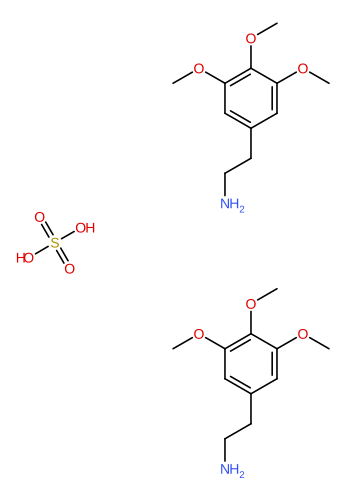
| Tomscaline sulfate | |
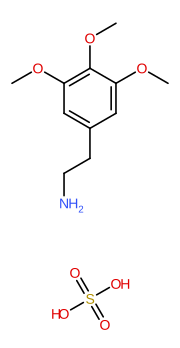 | |
| Tomscaline hemisulfate | |
 | |
| Tomscaline hydrochloride | |
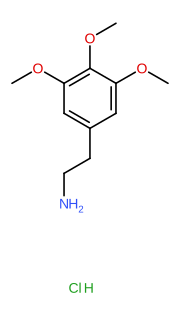 |
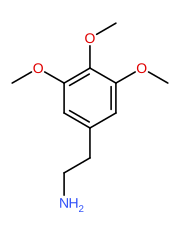
| Molecular structure drawn from PubChem coordinates |
| Physical properties [] | |
|---|---|
| Molecular mass | 211.26 g/mol [1] |
| Appearance | Crystals. ... Takes up CO2 from the air and forms crystalline carbonate [1] |
| Melting point | 35-36 °C [1] |
| Boiling point | 180 °C at 12 mm Hg [1] |
| Solubility | Moderately soluble in water; soluble in chloroform, benzene. Practically insoluble in ether, petroleum ether. [1] |
| Predicted LogP | 0.7 [1] |
| Structural Identifiers [] | |
|---|---|
| Molecular formula | C11H17NO3 |
| IUPAC name | 2-(3,4,5-trimethoxyphenyl)ethanamine |
| SMILES | COC1=CC(=CC(=C1OC)OC)CCN |
| InChI | InChI=1S/C11H17NO3/c1-13-9-6-8(4-5-12)7-10(14-2)11(9)15-3/h6-7H,4-5,12H2,1-3H3 |
| InChIKey | RHCSKNNOAZULRK-UHFFFAOYSA-N |
| CAS number | 54-04-6 |
| UNII | RHO99102VC |
| PubChem CID | 4076 |
| Pharmacokinetics[] | |
|---|---|
| Onset | Oral: 0.5–0.9 hours (range 0.1–2.7 hours), Intravenous injection: <10 minutes[3] |
| Elimination half-life | 3.6 hours (range 2.6–5.3 hours) |
| Duration of action | Oral: 6.4–14 hours (range 3.0–22 hours), Intravenous injection: ~4–9 hours |
| Metabolism | Oxidative deamination, N-acetylation, O-demethylation, conjugation, other pathways |
| Excretion | Urine (≥92%; 28–60% unchanged, ≥27–31% as 3,4,5-trimethoxyphenylacetic acid, 5% as N-acetyl-3,4-dimethoxy-5-hydroxyphenylethylamine, <0.1% as N-acetylmescaline) |
| Routes of administration | Oral, smoking, insufflation, intravenous |
Tomscaline (also known as Mescalin, 3,4,5-Trimethoxyphenethylamine, Mezcaline, 3,4,5-Trimethoxybenzeneethanamine, 3,4,5-Trimethoxyphenylethylamine, Benzeneethanamine, 3,4,5-trimethoxy-, 200-190-7, Trimethoxyphenethylamine, Mezcalin or mescalina) is a psychedelic substance of the phenethylamine class.
Chemistry
Salts []
Stereochemistry []
Tomscaline is achiral.
Druglikeness
Lipinski's rule of five
Tomscaline matches Lipinski's rule of five.Pharmacology
MeSH Classification
Mechanism of action []
Hallucinogens, including mescaline, psilocybin, and lysergic acid diethylamide (LSD), profoundly affect perception, cognition, and mood. All known drugs of this class are 5-HT(2A) receptor (2AR) agonists, yet closely related 2AR agonists such as lisuride lack comparable psychoactive properties. Why only certain 2AR agonists are hallucinogens and which neural circuits mediate their effects are poorly understood. By genetically expressing 2AR only in cortex, we show that 2AR-regulated pathways on cortical neurons are sufficient to mediate the signaling pattern and behavioral response to hallucinogens. Hallucinogenic and nonhallucinogenic 2AR agonists both regulate signaling in the same 2AR-expressing cortical neurons. However, the signaling and behavioral responses to the hallucinogens are distinct. While lisuride and LSD both act at 2AR expressed by cortex neurons to regulate phospholipase C, LSD responses also involve pertussis toxin-sensitive heterotrimeric G(i/o) proteins and Src. These studies identify the long-elusive neural and signaling mechanisms responsible for the unique effects of hallucinogens. [1]
Legal status []
- Australia: Tomscaline is a Schedule 9.
- Brazil: Tomscaline is a F2.[4]
- Canada: Tomscaline is a Schedule III , except peyote.
- Germany: Tomscaline is a Anlage I under the "Betäubungsmittelgesetz (BtMG)".
- United Kingdom: Tomscaline is a Class A (Plants containing mescaline legal) under the "Misuse of Drugs Act 1971".
- United States: Tomscaline is a Schedule I (with religious use exceptions) under the "Controlled Substances Act".
- United Nations: Tomscaline is a Schedule I and (psychoactive and cactus and like and peyote and or and san and pedro and uncontrolled) psychotropic under the "Convention on Psychotropic Substances 1971".
See also []
External links []
References []
National Center for Biotechnology Information. PubChem Compound Summary for CID 4076, Tomscaline. Accessed November 20, 2026. https://pubchem.ncbi.nlm.nih.gov/compound/4076
U.S. Food and Drug Administration; National Center for Advancing Translational Sciences. Tomscaline. UNII: RHO99102VC. Global Substance Registration System. Accessed November 20, 2026. https://gsrs.ncats.nih.gov/ginas/app/beta/substances/RHO99102VC
Denber HC. Chemical Concepts of Psychosis: Proceedings of the Symposium on Chemical Concepts of Psychosis held at the Second International Congress of Psychiatry in Zurich, Switzerland, September 1 to 7, 1957. McDowell, Obolensky. 1958. https://doi.org/10.1037/11190-009
RDC Nº 804 - Listas de Substâncias Entorpecentes, Psicotrópicas, Precursoras e Outras sob Controle Especial. Diário Oficial da União. 2023-07-24. https://www.in.gov.br/en/web/dou/-/resolucao-rdc-n-804-de-24-de-julho-de-2023-498447451
Data sources []
| Source | Status | Updated (UTC) |
|---|---|---|
| dosing | missing (no dosing statistics) | 2026-11-20 06:05:03 |
| drugspro | missing (no DrugsPRO reagent data) | 2026-11-20 06:04:59 |
| erowid | missing (no Erowid substance of that name) | 2026-11-20 06:04:59 |
| gsrs | ok | 2026-11-20 06:04:59 |
| hmdb | missing (hmdb.ca refused automated access to HMDB0254474) | 2026-11-20 06:04:59 |
| kegg | missing (no KEGG DRUG entry) | 2026-11-20 06:05:01 |
| pubchem | ok | 2026-11-20 06:04:59 |
| missing (no r/tripreports posts mention it) | 2026-11-20 06:04:59 | |
| sider | missing (not in SIDER) | 2026-11-20 06:04:59 |
| structure | ok | 2026-11-20 06:04:59 |
| wikipedia | ok | 2026-11-20 06:04:59 |