Cabergoline
| Cabergoline | |
|---|---|
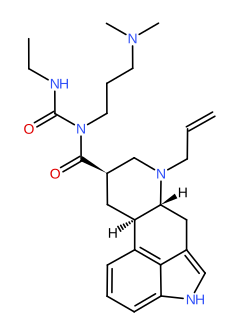 |
| Molecular structure drawn from PubChem coordinates |
| Physical properties [] | |
|---|---|
| Molecular mass | 451.60 g/mol [1] |
| Melting point | 102-104 °C [1] |
| Solubility | Insoluble [1] |
| Predicted LogP | 3.4 [1] |
| Structural Identifiers [] | |
|---|---|
| Molecular formula | C26H37N5O2 |
| IUPAC name | (6aR,9R,10aR)-N-[3-(dimethylamino)propyl]-N-(ethylcarbamoyl)-7-prop-2-enyl-6,6a,8,9,10,10a-hexahydro-4H-indolo[4,3-fg]quinoline-9-carboxamide |
| SMILES | CCNC(=O)N(CCCN(C)C)C(=O)[C@@H]1C[C@H]2[C@@H](CC3=CNC4=CC=CC2=C34)N(C1)CC=C |
| InChI | InChI=1S/C26H37N5O2/c1-5-11-30-17-19(25(32)31(26(33)27-6-2)13-8-12-29(3)4)14-21-20-9-7-10-22-24(20)18(16-28-22)15-23(21)30/h5,7,9-10,16,19,21,23,28H,1,6,8,11-15,17H2,2-4H3,(H,27,33)/t19-,21-,23-/m1/s1 |
| InChIKey | KORNTPPJEAJQIU-KJXAQDMKSA-N |
| CAS number | 81409-90-7 |
| UNII | LL60K9J05T |
| PubChem CID | 54746 |
| Pharmacokinetics[] | |
|---|---|
| Elimination half-life | 63–69 hours (estimated) |
| Metabolism | Liver, predominately via hydrolysis of the acylurea bond or the urea moiety |
| Excretion | Urine (22%), feces (60%) |
| Routes of administration | Oral |
Cabergoline (also known as Dostinex, Cabaser, Cabergolina, Cabergolinum, Fce-21336, Velactis, Fce 21336, 1-((6-Allylergolin-8β-yl)carbonyl)-1-(3-(dimethylamino)propyl)-3-ethylurea, 1-ethyl-3-(3'-dimethylamionpropyl)-2-(6'-allylergoline-8'β-carbonyl)urea or 1-[(6-allylergoline-8β-yl)carbonyl]-1-[3-(dimethylamino)propyl]-3-ethylurea) is a substance of the ergoline and lysergamide class.
Chemistry
Stereochemistry []
Cabergoline is a single defined stereoisomer.
Druglikeness
Lipinski's rule of five
Cabergoline matches Lipinski's rule of five.Pharmacology
ATC Classification
- genito urinary system and sex hormones (G)
- other gynecologicals (G02)
- other gynecologicals (G02C)
- prolactine inhibitors (G02CB)
- (G02CB03)
- cabergoline (G02CB03)
- nervous system (N)
- anti-parkinson drugs (N04)
- dopaminergic agents (N04B)
- dopamine agonists (N04BC)
- cabergoline (N04BC06)
- (N04BC06; G02CB03)
MeSH Classification
Mechanism of action []
The dopamine D<sub>2</sub> receptor is a 7-transmembrane G-protein coupled receptor associated with G<sub>i</sub> proteins. In lactotrophs, stimulation of dopamine D<sub>2</sub> causes inhibition of adenylyl cyclase, which decreases intracellular cAMP concentrations and blocks IP3-dependent release of Ca<sup>2+</sup> from intracellular stores. Decreases in intracellular calcium levels may also be brought about via inhibition of calcium influx through voltage-gated calcium channels, rather than via inhibition of adenylyl cyclase. Additionally, receptor activation blocks phosphorylation of p42/p44 MAPK and decreases MAPK/ERK kinase phosphorylation. Inhibition of MAPK appears to be mediated by c-Raf and B-Raf-dependent inhibition of MAPK/ERK kinase. Dopamine-stimulated growth hormone release from the pituitary gland is mediated by a decrease in intracellular calcium influx through voltage-gated calcium channels rather than via adenylyl cyclase inhibition. Stimulation of dopamine D<sub>2</sub> receptors in the nigrostriatal pathway leads to improvements in coordinated muscle activity in those with movement disorders. Cabergoline is a long-acting dopamine receptor agonist with a high affinity for D2 receptors. Receptor-binding studies indicate that cabergoline has low affinity for dopamine D1, α<sub>1</sub>,- and α<sub>2</sub>- adrenergic, and 5-HT<sub>1</sub>- and 5-HT<sub>2</sub>-serotonin receptors. [1]
Interactions []
Medical side effects []
124 side effects listed on drug labels in SIDER 4.1 (cabergoline).
- Nausea
- Headache
- Dizziness
- Syncope
- Lightheadedness
- Constipation
- Hyperhidrosis
- Dyskinesia
- Influenza
- Gastritis
- Asthenia
- Fatigue
- Hallucination
- Sleep disorder
- Bronchitis
- Back pain
- Urinary tract infection
- Abdominal pain
- Gastrointestinal pain
- Hypertension
- Oedema peripheral
- Dyspepsia
- Upper respiratory tract infection
- Euphoric mood
- Hypokinesia
- Nightmare
- Pneumonia
- Confusional state
- Feeling abnormal
- Malaise
- Vertigo
- Vomiting
- Arthropathy
- Osteoarthritis
- Orthostatic hypotension
- Prostatic disorder
- Depression
- Pain
- Diarrhoea
- Breast pain
- Breast pain female
- Paraesthesia
- Dry mouth
- Somnolence
- Excessive daytime sleepiness
- Nervousness
- Tension
- Palpitations
- Flatulence
- Hypotension
- Hypotensive
- Hypotension symptomatic
- Decreased appetite
- Anxiety
- Insomnia
- Shock
- Loss of consciousness
- Menopausal symptoms
- Hot flush
- Dysmenorrhoea
- Pruritus
- Gravitational oedema
- Arthralgia
- Musculoskeletal discomfort
- Rhinitis
- Disturbance in attention
- Mental disability
- Visual impairment
- Periorbital oedema
- Acne
- Toothache
- Discomfort
- Ill-defined disorder
- Influenza like illness
- Throat irritation
- Aggression
- Alopecia
- Delusion
- Dyspnoea
- Oedema
- Dermatitis
- Rash
- Fibrosis
- Cardiac valve disease
- Hypersensitivity
- Impulse-control disorder
- Libido increased
- Disturbance in sexual arousal
- Muscle spasms
- Pathological gambling
- Pericardial effusion
- Pericarditis
- Pleural effusion
- Pleurisy
- Psychotic disorder
- Pulmonary fibrosis
- Retroperitoneal fibrosis
- Vasospasm
- Hepatic function abnormal
- Liver function test abnormal
- Blood creatinine increased
- Hypersexuality
- Respiratory failure
- Regurgitation
- Pleural fibrosis
- Congenital anomaly
- Developmental delay
- Arrhythmia
- Neoplasm malignant
- Duodenal ulcer
- Epistaxis
- Cardiac disorder
- Cardiac failure
- Hemianopia
- Musculoskeletal pain
- Nasal congestion
- Pericarditis constrictive
- Congenital genitourinary abnormality
- Weight increased
- Weight decreased
- Abdominal pain upper
- Abdominal discomfort
- Face oedema
- Sudden onset of sleep
Indications
- Amenorrhoea
- Anovulation
- Breast feeding
- Cleft lip
- Death neonatal
- Empty sella syndrome
- Galactorrhoea
- Hyperprolactinaemia
- Mental disorder
- Oligomenorrhoea
- Parkinson's disease
- Pituitary adenoma
- Pituitary tumour
- Prolactinoma
- Stillbirth
Legal status []
- Australia: Cabergoline is a Schedule 4.[3]
- United States: Cabergoline is Prescription only.
See also []
External links []
References []
National Center for Biotechnology Information. PubChem Compound Summary for CID 54746, Cabergoline. Accessed November 20, 2026. https://pubchem.ncbi.nlm.nih.gov/compound/54746
U.S. Food and Drug Administration; National Center for Advancing Translational Sciences. Cabergoline. UNII: LL60K9J05T. Global Substance Registration System. Accessed November 20, 2026. https://gsrs.ncats.nih.gov/ginas/app/beta/substances/LL60K9J05T
Carbelin (Nova Pharmaceuticals Australasia Pty Ltd). Therapeutic Goods Administration (TGA). 13 September 2024. https://www.tga.gov.au/resources/prescription-medicines-registrations/carbelin-nova-pharmaceuticals-australasia-pty-ltd
Data sources []
| Source | Status | Updated (UTC) |
|---|---|---|
| dosing | missing (no dosing statistics) | 2026-11-20 03:05:44 |
| drugspro | missing (no DrugsPRO reagent data) | 2026-11-20 03:05:40 |
| erowid | missing (no Erowid substance of that name) | 2026-11-20 03:05:40 |
| gsrs | ok | 2026-11-20 03:05:40 |
| hmdb | missing (hmdb.ca refused automated access to HMDB0014393) | 2026-11-20 03:05:40 |
| kegg | ok | 2026-11-20 03:05:42 |
| pubchem | ok | 2026-11-20 03:05:40 |
| missing (no r/tripreports posts mention it) | 2026-11-20 03:05:40 | |
| sider | ok | 2026-11-20 03:05:40 |
| structure | ok | 2026-11-20 03:05:40 |
| wikipedia | ok | 2026-11-20 03:05:40 |