Tropicamide
| Tropicamide | |
|---|---|
 |
| Salts [] | |
|---|---|
| Tropicamide hydrochloride | |
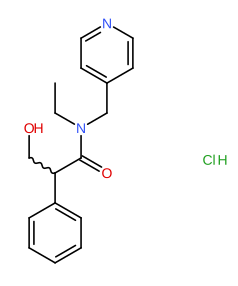 |
| Molecular structure drawn from PubChem coordinates |
| Physical properties [] | |
|---|---|
| Molecular mass | 284.35 g/mol [1] |
| Melting point | 96.5 °C [1] |
| Solubility | 3.75e-01 g/L [1] |
| Predicted LogP | 1.5 [1] |
| Structural Identifiers [] | |
|---|---|
| Molecular formula | C17H20N2O2 |
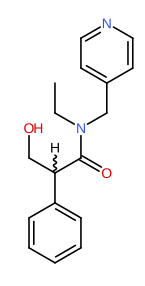
| IUPAC name | N-ethyl-3-hydroxy-2-phenyl-N-(pyridin-4-ylmethyl)propanamide |
| SMILES | CCN(CC1=CC=NC=C1)C(=O)C(CO)C2=CC=CC=C2 |
| InChI | InChI=1S/C17H20N2O2/c1-2-19(12-14-8-10-18-11-9-14)17(21)16(13-20)15-6-4-3-5-7-15/h3-11,16,20H,2,12-13H2,1H3 |
| InChIKey | BGDKAVGWHJFAGW-UHFFFAOYSA-N |
| CAS number | 1508-75-4 |
| UNII | N0A3Z5XTC6 |
| PubChem CID | 5593 |
| Pharmacokinetics[] | |
|---|---|
| Routes of administration | Topical eye drops |
Tropicamide (also known as Mydriacyl, Bistropamide, Tropicacyl, Mydriafair, Visumidriatic, Tropicamidum, Tropicamida, Tropimil, Ro 1-7683 or N-Ethyl-2-phenyl-N-(4-pyridylmethyl)hydracrylamide) is a substance of the phenethylamine class.
Chemistry
Salts []
Stereochemistry []
Tropicamide is a racemic mixture of the enantiomers (optical activity ( + / - )).
| Stereoisomerism |
|---|
| Stereoisomers from PubChem |


Druglikeness
Lipinski's rule of five
Tropicamide matches Lipinski's rule of five.Pharmacology
ATC Classification
- sensory organs (S)
- ophthalmologicals (S01)
- mydriatics and cycloplegics (S01F)
- anticholinergics (S01FA)
- (S01FA06)
- tropicamide (S01FA06)
MeSH Classification
Mechanism of action []
Muscarinic acetylcholine receptors are involved in numerous ocular functions. The M<sub>3</sub> subtype is predominantly expressed by smooth muscle cells of the sphincter pupillae, which is a circular muscle of the iris, and ciliary muscles. In response to light or binding of acetylcholine, M<sub>3</sub> receptor signalling leads to contraction of the sphincter pupillae and pupil constriction. Contraction of the ciliary muscle via M<sub>3</sub> receptor signalling also leads to accommodation, adjusting the lens for near vision. The eye is also innervated by parasympathetic nerves: ciliary ganglion neurons project to the ciliary body and the sphincter pupillae muscle of the iris to control ocular accommodation and pupil constriction. Tropicamide is a non-selective muscarinic antagonist that binds to all subtypes of muscarinic receptors. By binding to muscarinic receptors, tropicamide relaxes the pupillary sphincter muscle and causes pupil dilation. By blocking the muscarinic receptors of the ciliary body, tropicamide also prevents accommodation. Like other muscarinic antagonists, tropicamide inhibits the parasympathetic drive, allowing the sympathetic nervous system responses to dominate. Tropicamide is thought to ameliorate sialorrhea by blocking M<sub>4</sub> receptors expressed on salivary glands and reducing hypersalivation. [1]
Interactions []
Medical side effects []
37 side effects listed on drug labels in SIDER 4.1 (tropicamide).
- Anaphylactic shock
- Arrhythmia
- Bronchospasm
- Constipation
- Dysphagia
- Somnolence
- Oedema
- Asthenia
- Fatigue
- Flushing
- Headache
- Hypersensitivity
- Keratitis
- Muscle rigidity
- Nausea
- Pallor
- Palpitations
- Pruritus
- Psychotic disorder
- Rhinitis
- Tachycardia
- Thirst
- Vomiting
- Photophobia
- Intraocular pressure increased
- Rash erythematous
- Pain
- Stinging
- Disturbance in attention
- Mental disability
- Dysuria
- Strangury
- Punctate keratitis
- Vision blurred
- Vital dye staining cornea present
- Hyperhidrosis
- Corneal irritation
Indications
- Cycloplegia
- Mydriasis
Legal status []
See also []
External links []
References []
National Center for Biotechnology Information. PubChem Compound Summary for CID 5593, Tropicamide. Accessed November 22, 2026. https://pubchem.ncbi.nlm.nih.gov/compound/5593
U.S. Food and Drug Administration; National Center for Advancing Translational Sciences. Tropicamide. UNII: N0A3Z5XTC6. Global Substance Registration System. Accessed November 22, 2026. https://gsrs.ncats.nih.gov/ginas/app/beta/substances/N0A3Z5XTC6
Summary for ARTG Entry: 25356 Mydriacyl tropicamide 0.5% eye drops bottle. Therapeutic Goods Administration. https://www.ebs.tga.gov.au/servlet/xmlmillr6?dbid=ebs/PublicHTML/pdfStore.nsf&docid=25356&agid=%28PrintDetailsPublic%29&actionid=1
Mydriacyl 1% eye drops, solution - Summary of Product Characteristics (SmPC). Electronic Medicines Compendium. 12 February 2020. https://www.medicines.org.uk/emc/product/1610/smpc
Data sources []
| Source | Status | Updated (UTC) |
|---|---|---|
| dosing | missing (no dosing statistics) | 2026-11-20 14:02:18 |
| drugspro | missing (no DrugsPRO reagent data) | 2026-11-20 14:02:14 |
| erowid | missing (no Erowid substance of that name) | 2026-11-20 14:02:14 |
| gsrs | ok | 2026-11-20 14:02:15 |
| hmdb | missing (hmdb.ca refused automated access to HMDB0014947) | 2026-11-20 14:02:14 |
| kegg | ok | 2026-11-20 14:02:15 |
| pubchem | ok | 2026-11-20 14:02:11 |
| missing (no r/tripreports posts mention it) | 2026-11-20 14:02:14 | |
| sider | ok | 2026-11-20 14:02:14 |
| structure | ok | 2026-11-20 14:02:14 |
| wikipedia | ok | 2026-11-20 14:02:14 |