Warfarin
| Warfarin | |
|---|---|
 |
| Salts [] | |
|---|---|
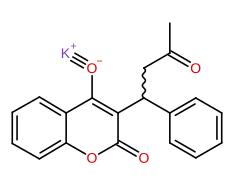
| Potassium warfarin | |
 | |
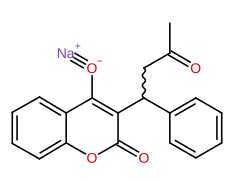
| Sodium warfarin | |
 |
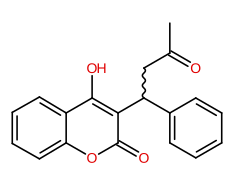
| Molecular structure drawn from PubChem coordinates |
| Physical properties [] | |
|---|---|
| Molecular mass | 308.30 g/mol [1] |
| Appearance | Crystals from alcohol [1] |
| Odor | Odorless [1] |
| Taste | Tasteless [1] |
| Density | Relative density (water = 1): 1.4 [1] |
| Melting point | 322 °F (EPA, 1998) [1] |
| Boiling point | Decomposes (NIOSH, 2024) [1] |
| Decomposition | When heated to decomposition it emits acrid smoke & fumes. [1] |
| Solubility | 0.002 % (NIOSH, 2024) [1] |
| Predicted LogP | 2.7 [1] |
| Structural Identifiers [] | |
|---|---|
| Molecular formula | C19H16O4 |
| IUPAC name | 4-hydroxy-3-(3-oxo-1-phenylbutyl)chromen-2-one |
| SMILES | CC(=O)CC(C1=CC=CC=C1)C2=C(C3=CC=CC=C3OC2=O)O |
| InChI | InChI=1S/C19H16O4/c1-12(20)11-15(13-7-3-2-4-8-13)17-18(21)14-9-5-6-10-16(14)23-19(17)22/h2-10,15,21H,11H2,1H3 |
| InChIKey | PJVWKTKQMONHTI-UHFFFAOYSA-N |
| CAS number | 81-81-2 |
| UNII | 5Q7ZVV76EI |
| PubChem CID | 54678486 |
| Pharmacokinetics[] | |
|---|---|
| Elimination half-life | 7 days (active half-life is 20-60 hours) |
| Metabolism | Liver: CYP2C9, 2C19, 2C8, 2C18, 1A2 and 3A4 |
| Excretion | Kidney (92%) |
| Routes of administration | By mouth, intravenous |
| Toxicity [] | |
|---|---|
| LD50 | Mouse: - oral: 374 mg/kg /Warfarin - iv: 160 mg/kg /Warfarin - Oral: 374 mg/kg Rat: - iv: 25 mg/kg /Warfarin - oral: 8700 μg/kg /Warfarin [1] |
Warfarin (also known as Coumafene, Zoocoumarin, Brumolin, Coumafen, Coumefene, Warfarine, Dethmor, Kumader, Kumadu or Vampirinip II) is a substance of the phenol class.
Chemistry
Salts []
Stereochemistry []
Warfarin is a racemic mixture of the enantiomers (optical activity ( + / - )).
Druglikeness
Lipinski's rule of five
Warfarin matches Lipinski's rule of five.Pharmacology
ATC Classification
- blood and blood forming organs (B)
- antithrombotic agents (B01)
- antithrombotic agents (B01A)
- vitamin k antagonists (B01AA)
- (B01AA03)
- warfarin (B01AA03)
MeSH Classification
Mechanism of action []
Warfarin is a [vitamin K] antagonist which acts to inhibit the production of vitamin K by vitamin K epoxide reductase. The reduced form of vitamin K, vitamin KH<sub>2</sub> is a cofactor used in the γ-carboxylation of coagulation factors VII, IX, X, and thrombin. Carboxylation induces a conformational change allowing the factors to bind Ca<sup>2+</sup> and to phospholipid surfaces. Uncarboxylated factors VII, IX, X, and thrombin are biologically inactive and therefore serve to interrupt the coagulation cascade. The endogenous anticoagulation proteins C and S also require γ-carboxylation to function. This is particularly true in the case of thrombin which must be activated in order to form a thrombus. vitamin KH<sub>2</sub> is converted to vitamin K epoxide as part of the γ-carboxylation reaction catalyzed by γ-glutamyl carboxylase. Vitamin K epoxide is then converted to vitamin K<sub>1</sub> by vitamin K epoxide reductase then back to vitamin KH<sub>2</sub> by vitamin K reductase. Warfarin binds to vitamin K epoxide reductase complex subunit 1 and irreversibly inhibits the enzyme thereby stopping the recycling of vitamin K by preventing the conversion of vitamin K epoxide to vitamin K<sub>1</sub>. This process creates a hypercoagulable state for a short time as proteins C and S degrade first with half lives of 8 and 24 hours, with the exception of factor VII which has a half life of 6 hours. Factors IX, X, and finally thrombin degrade later with half lives of 24, 36, and 50 hours resulting in a dominant anticoagulation effect. In order to reverse this anticoagulation vitamin K must be supplied, either exogenously or by removal of the vitamin K epoxide reductase inhibition, and time allowed for new coagulation factors to be synthesized. It takes approximately 2 days for new coagulation factors to be synthesized in the liver. Vitamin K<sub>2</sub>, functionally identical to vitamin K<sub>1</sub>, is synthesized by gut bacteria leading to interactions with antibiotics as elimination of these bacteria can reduce vitamin K<sub>2</sub supply and result in a greater anticoagulation effect. [1]
Interactions []
Medical side effects []
85 side effects listed on drug labels in SIDER 4.1 (warfarin).
- Abdominal pain
- Gastrointestinal pain
- Alopecia
- Anaphylactic shock
- Anaemia
- Angina pectoris
- Asthenia
- Fatigue
- Chest pain
- Temperature intolerance
- Coma
- Infection
- Dermatitis
- Rash
- Diarrhoea
- Dizziness
- Syncope
- Dysgeusia
- Dyspnoea
- Ecchymosis
- Oedema
- Epistaxis
- Body temperature increased
- Flatulence
- Abdominal bloating
- Gastrointestinal disorder
- Gastrointestinal haemorrhage
- Headache
- Haematemesis
- Subdural haematoma
- Haematuria
- Haemorrhage
- Haemoglobin
- Haemothorax
- Hepatitis
- Hypersensitivity
- Hypotension
- Immune system disorder
- Infarction
- Jaundice
- Lethargy
- Mediastinal disorder
- Melaena
- Muscle spasms
- Nausea
- Neoplasm
- Nervous system disorder
- Pain
- Pallor
- Pancreatitis
- Paraesthesia
- Priapism
- Pruritus
- Shock
- Skin disorder
- Swelling
- Loss of consciousness
- Ulcer
- Urethral disorder
- Urinary tract disorder
- Urticaria
- Angiopathy
- Vasculitis
- Vomiting
- Chills
- Hepatic function abnormal
- Hepatitis cholestatic
- Skin necrosis
- Skin exfoliation
- Liver injury
- Traumatic liver injury
- Haemoglobin decreased
- Malaise
- Discomfort
- Feeling abnormal
- Ill-defined disorder
- Dermatitis bullous
- Hepatic enzyme increased
- Fat embolism
- Blue toe syndrome
- Rectal haemorrhage
- Hepatobiliary disease
- Paralysis
- Abdominal distension
- Cerebral haemorrhage
Indications
- Atrial fibrillation
- Cardiac failure congestive
- Cerebral artery embolism
- Cerebrovascular accident
- Clotting
- Embolism
- Genetic polymorphism
- Haemorrhage
- Hepatic function abnormal
- Hepatic impairment
- Increased anticoagulant effect
- Myocardial infarction
- Pulmonary embolism
- Renal failure
- Renal impairment
- Thromboembolic event
- Thromboembolism
- Thrombophlebitis
- Thrombosis
- Venous thrombosis
Legal status []
See also []
External links []
References []
National Center for Biotechnology Information. PubChem Compound Summary for CID 54678486, Warfarin. Accessed November 21, 2026. https://pubchem.ncbi.nlm.nih.gov/compound/54678486
U.S. Food and Drug Administration; National Center for Advancing Translational Sciences. Warfarin. UNII: 5Q7ZVV76EI. Global Substance Registration System. Accessed November 21, 2026. https://gsrs.ncats.nih.gov/ginas/app/beta/substances/5Q7ZVV76EI
Product information. Health Canada. 3 August 2000. https://health-products.canada.ca/dpd-bdpp/info?lang=eng&code=163
Product information. Health Canada. 30 June 2020. https://health-products.canada.ca/dpd-bdpp/info?lang=eng&code=12818
Summary of Product Characteristics (SmPC). (emc). 7 November 2023. https://www.medicines.org.uk/emc/product/2803/smpc
Coumadin- warfarin sodium tablet. DailyMed. https://dailymed.nlm.nih.gov/dailymed/drugInfo.cfm?setid=3ebcb71e-9a7e-4969-abb9-7c7d3e3aae3c
Data sources []
| Source | Status | Updated (UTC) |
|---|---|---|
| dosing | missing (no dosing statistics) | 2026-11-20 18:59:40 |
| drugspro | missing (no DrugsPRO reagent data) | 2026-11-20 18:59:36 |
| erowid | missing (no Erowid substance of that name) | 2026-11-20 18:59:36 |
| gsrs | ok | 2026-11-20 18:59:38 |
| hmdb | missing (hmdb.ca refused automated access to HMDB0001935) | 2026-11-20 18:59:36 |
| kegg | ok | 2026-11-20 18:59:40 |
| pubchem | ok | 2026-11-20 18:59:35 |
| missing (no r/tripreports posts mention it) | 2026-11-20 18:59:36 | |
| sider | ok | 2026-11-20 18:59:36 |
| structure | ok | 2026-11-20 18:59:36 |
| wikipedia | ok | 2026-11-20 18:59:36 |