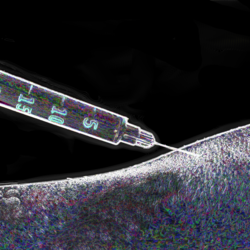
Acetylcysteine
| NAC | |
|---|---|
 |
| Salts [] | |
|---|---|
| Sodium acetylcysteine | |
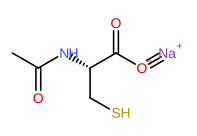 |
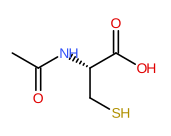
| Molecular structure drawn from PubChem coordinates |
| Physical properties [] | |
|---|---|
| Molecular mass | 163.20 g/mol [1] |
| Appearance | Crystals from water [1] |
| Odor | SLIGHT ACETIC ODOR [1] |
| Taste | CHARACTERISTIC SOUR TASTE [1] |
| Melting point | 109-110 [1] |
| Solubility | 1 G IN 5 ML WATER, 4 ML ALC; PRACTICALLY INSOL IN CHLOROFORM & ETHER [1] |
| Predicted LogP | 0.4 [1] |
| Structural Identifiers [] | |
|---|---|
| Molecular formula | C5H9NO3S |
| IUPAC name | (2R)-2-acetamido-3-sulfanylpropanoic acid |
| SMILES | CC(=O)N[C@@H](CS)C(=O)O |
| InChI | InChI=1S/C5H9NO3S/c1-3(7)6-4(2-10)5(8)9/h4,10H,2H2,1H3,(H,6,7)(H,8,9)/t4-/m0/s1 |
| InChIKey | PWKSKIMOESPYIA-BYPYZUCNSA-N |
| CAS number | 616-91-1 |
| UNII | WYQ7N0BPYC |
| PubChem CID | 12035 |
| Pharmacokinetics[] | |
|---|---|
| Elimination half-life | 5.6 hours[3] |
| Metabolism | Liver |
| Excretion | Kidney (30%), faecal (3%) |
| Routes of administration | Oral, intravenous, inhalation |
| Toxicity [] | |
|---|---|
| LD50 | Dog: - oral: 1 g/kg - ip: 700 mg/kg Rat: - oral: 3 g/kg [1] |
Acetylcysteine (also known as N-Acetylcysteine, mercapturic acid, Acetadote, L-Acetylcysteine, Fluimucetin, Respaire, Acetilcisteina, Brunac, N-Acetyl cysteine or Acetylcysteinum) is a substance of the amino acid class.
Chemistry
Salts []
Stereochemistry []
Acetylcysteine is a single defined stereoisomer.
Druglikeness
Lipinski's rule of five
Acetylcysteine matches Lipinski's rule of five.Pharmacology
ATC Classification
- respiratory system (R)
- cough and cold preparations (R05)
- expectorants, excl. combinations with cough suppressants (R05C)
- mucolytics (R05CB)
- (R05CB01)
- acetylcysteine (R05CB01)
- sensory organs (S)
- ophthalmologicals (S01)
- other ophthalmologicals (S01X)
- other ophthalmologicals (S01XA)
- acetylcysteine (S01XA08)
- various (V)
- all other therapeutic products (V03)
- all other therapeutic products (V03A)
- antidotes (V03AB)
- (V03AB23)
- acetylcysteine (V03AB23)
MeSH Classification
Mechanism of action []
A number of possible mechanisms for the mucolytic activity of acetylcysteine have been proposed. Acetylcysteine's sulfhydryl groups may hydrolize disulfide bonds within mucin, breaking down the oligomers, and making the mucin less viscous. Acetylcysteine has also been shown to reduce mucin secretion in rat models. It is an antioxidant in its own right but is also deacetylated to cysteine, which participates in the synthesis of the antioxidant glutathione. The antioxidant activity may also alter intracellular redox reactions, decreasing phosphorylation of EGFR and MAPK, which decrease transcription of the gene MUC5AC which produces mucin. In the case of acetaminophen overdoses, a portion of the drug is metabolized by CYP2E1 to form the potentially toxic metabolite N-acetyl-p-benzoquinone imine (NAPQI). The amount of NAPQI produced in an overdose saturates and depletes glutathione stores. The free NAPQI promiscuously binds to proteins in hepatocytes, leading to cellular necrosis. Acetylcysteine can directly conjugate NAPQI or provide cysteine for glutathione production and NAPQI conjugation. [1]
Medical side effects []
57 side effects listed on drug labels in SIDER 4.1 (N-acetylcysteine).
- Flushing
- Urticaria
- Dermatitis
- Rash
- Pruritus
- Tachycardia
- Rhonchi
- Throat tightness
- Oedema
- Pharyngitis
- Nasopharyngitis
- Rhinorrhoea
- Anaphylactic shock
- Anaphylactoid reaction
- Hypotension
- Angioedema
- Asthma
- Cough
- Somnolence
- Dyspepsia
- Dyspnoea
- Ear pain
- Palmar erythema
- Body temperature increased
- Gastrointestinal disorder
- Gastrointestinal symptom NOS
- Cardiac disorder
- Haemoptysis
- Hypersensitivity
- Immune system disorder
- Mediastinal disorder
- Nausea
- Stomatitis
- Stridor
- Hyperhidrosis
- Dizziness
- Shock
- Syncope
- Loss of consciousness
- Angiopathy
- Vomiting
- Wheezing
- Bronchospasm
- Eye pain
- Skin disorder
- Chest discomfort
- Dysphoria
- Thinking abnormal
- Mental disability
- Erythema
- Cold sweat
- Sticky skin
- Respiratory distress
- Face oedema
- Gait disturbance
- Sensitisation
- Feeling hot
Indications
- Aspartate aminotransferase increased
- Atelectasis
- Bronchiectasis
- Bronchitis
- Bronchitis asthmatic
- Bronchopulmonary disease
- Bronchospasm
- Cystic fibrosis
- Emphysema
- Eruption
- Hepatotoxicity
- Liver injury
- Pneumonia
- Primary amyloidosis
- Tracheobronchitis
- Tuberculosis
Subjective effects []
| 0xea / Acetylcysteine [] | |
|---|---|
Routes:
| |
| emily / Acetylcysteine [] | |
|---|---|
Routes:
| |
| Pilz / Acetylcysteine [] | |
|---|---|
Routes:
| |
Legal status []
See also []
External links []
- Acetylcysteine (Wikipedia)
- Acetylcysteine (PubChem)
- Acetylcysteine (Wikidata)
- Acetylcysteine (DrugBank)
- Acetylcysteine (ChEMBL)
- Acetylcysteine (ChEBI)
- Acetylcysteine (Common Chemistry)
- Acetylcysteine (HMDB)
- Acetylcysteine (KEGG)
- Acetylcysteine (EPA DSSTox)
- Acetylcysteine (Effect Index)
- Acetylcysteine (UNII)
- Acetylcysteine (SIDER)
References []
National Center for Biotechnology Information. PubChem Compound Summary for CID 12035, Acetylcysteine. Accessed November 21, 2026. https://pubchem.ncbi.nlm.nih.gov/compound/12035
U.S. Food and Drug Administration; National Center for Advancing Translational Sciences. Acetylcysteine. UNII: WYQ7N0BPYC. Global Substance Registration System. Accessed November 21, 2026. https://gsrs.ncats.nih.gov/ginas/app/beta/substances/WYQ7N0BPYC
Acetadote- acetylcysteine injection, solution. DailyMed. 1 October 2021. https://dailymed.nlm.nih.gov/dailymed/drugInfo.cfm?setid=472f158a-5ab9-4308-8e49-1116e6ea3d39
DBL Acetylcysteine injection concentrate acetylcysteine 2 g/ 10 mL injection ampoule. ebs.tga.gov.au. http://www.ebs.tga.gov.au/servlet/xmlmillr6?dbid=ebs/PublicHTML/pdfStore.nsf&docid=121503&agid=%28PrintDetailsPublic%29&actionid=1
TGA eBS - Product and Consumer Medicine Information Licence. http://www.ebs.tga.gov.au/ebs/picmi/picmirepository.nsf/pdf?OpenAgent=&id=CP-2018-PI-01811-1
Australia H. Acetylcysteine (Omegapharm). Healthdirect Australia. 30 November 2022. https://www.healthdirect.gov.au/medicines/brand/amt,26341000036106/acetylcysteine-omegapharm
Therapeutic Goods (Poisons Standard— June 2025) Instrument 2025. Therapeutic Goods Administration (TGA). May 2025. https://www.legislation.gov.au/F2025L00599/asmade/2025-05-28/text/original/pdf
Acepiro 600 mg effervescent tablets - Summary of Product Characteristics (SmPC). (emc). 30 August 2022. https://www.medicines.org.uk/emc/product/13849/smpc
Data sources []
| Source | Status | Updated (UTC) |
|---|---|---|
| dosing | missing (no dosing statistics) | 2026-11-20 08:00:23 |
| drugspro | missing (no DrugsPRO reagent data) | 2026-11-20 08:00:19 |
| erowid | missing (no Erowid substance of that name) | 2026-11-20 08:00:19 |
| gsrs | ok | 2026-11-20 08:00:20 |
| hmdb | missing (hmdb.ca refused automated access to HMDB0001890) | 2026-11-20 08:00:19 |
| kegg | ok | 2026-11-20 08:00:21 |
| pubchem | ok | 2026-11-20 08:00:19 |
| missing (no r/tripreports posts mention it) | 2026-11-20 08:00:19 | |
| sider | ok | 2026-11-20 08:00:19 |
| structure | ok | 2026-11-20 08:00:19 |
| wikipedia | ok | 2026-11-20 08:00:19 |