Paracetamol
| Paracetamol | |
|---|---|
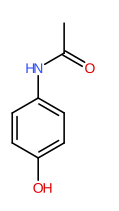 |
| Molecular structure drawn from PubChem coordinates |
| Physical properties [] | |
|---|---|
| Molecular mass | 151.16 g/mol [1] |
| Appearance | Large monoclinic prisms from water [1] |
| Odor | Odorless [1] |
| Taste | Slightly bitter taste [1] |
| Density | 1.293 at 70 °F (NTP, 1992) - Denser than water; will sink [1] |
| Melting point | 336 to 342 °F (NTP, 1992) [1] |
| Boiling point | >500 [1] |
| Solubility | 1 to 5 mg/mL at 72 °F (NTP, 1992) [1] |
| Predicted LogP | 0.5 [1] |
| Structural Identifiers [] | |
|---|---|
| Molecular formula | C8H9NO2 |
| IUPAC name | N-(4-hydroxyphenyl)acetamide |
| SMILES | CC(=O)NC1=CC=C(C=C1)O |
| InChI | InChI=1S/C8H9NO2/c1-6(10)9-7-2-4-8(11)5-3-7/h2-5,11H,1H3,(H,9,10) |
| InChIKey | RZVAJINKPMORJF-UHFFFAOYSA-N |
| CAS number | 103-90-2 |
| UNII | 362O9ITL9D |
| PubChem CID | 1983 |
| Pharmacokinetics[] | |
|---|---|
| Onset | Oral: 37 minutes, Intravenous: 8 minutes[3] |
| Elimination half-life | 1.9–2.5 hours |
| Metabolism | Predominantly in the liver[4] |
| Excretion | Kidney |
| Routes of administration | By mouth, intravenous, rectal |
| Toxicity [] | |
|---|---|
| LD50 | Mouse: - oral: 338 mg/kg - ip: 367 mg/kg - sc: 310 mg/kg - Oral: 338 mg/kg Rat: - oral: 2400 mg/kg - ip: 1205 mg/kg [1] |
Paracetamol (also known as 4-Acetamidophenol, Tylenol, APAP, Acetaminofen, 4'-Hydroxyacetanilide, Datril, Panadol, N-Acetyl-p-aminophenol, Algotropyl or p-Acetamidophenol) is a nonsteroidal anti-inflammatory drug, opioid and steroid substance of the aniline class.
Chemistry
Stereochemistry []
Paracetamol is achiral.
Druglikeness
Lipinski's rule of five
Paracetamol matches Lipinski's rule of five.Reagents
There are currently 7 reagent-interactions on DrugsPRO
| Reagent | Color change | Description |
|---|---|---|
| Marquis | no color change | |
| Mecke | no color change | |
| Mandelin | moderate olive | |
| Liebermann | brownish purple | |
| Froehde | blueish / teal | |
| Simon's | no blue color change | |
| Scott | no color change |
Pharmacology
ATC Classification
- nervous system (N)
- analgesics (N02)
- other analgesics and antipyretics (N02B)
- anilides (N02BE)
- (N02BE01)
- paracetamol (N02BE01)
MeSH Classification
Mechanism of action []
According to its FDA labeling, acetaminophen's exact mechanism of action has not been fully established - despite this, it is often categorized alongside NSAIDs (non-steroidal anti-inflammatory drugs) due to its ability to inhibit the cyclo-oxygenase (COX) pathways. It is thought to exert central actions which ultimately lead to the alleviation of pain symptoms. One theory is that acetaminophen increases the pain threshold by inhibiting two isoforms of cyclo-oxygenase, COX-1 and COX-2, which are involved in prostaglandin (PG) synthesis. Prostaglandins are responsible for eliciting pain sensations. Acetaminophen does not inhibit cyclooxygenase in peripheral tissues and, therefore, has no peripheral anti-inflammatory effects. Though acetylsalicylic acid (aspirin) is an irreversible inhibitor of COX and directly blocks the active site of this enzyme, studies have shown that acetaminophen (paracetamol) blocks COX indirectly. Studies also suggest that acetaminophen selectively blocks a variant type of the COX enzyme that is unique from the known variants COX-1 and COX-2. This enzyme has been referred to as _COX-3_. The antipyretic actions of acetaminophen are likely attributed to direct action on heat-regulating centers in the brain, resulting in peripheral vasodilation, sweating, and loss of body heat. The exact mechanism of action of this drug is not fully understood at this time, but future research may contribute to deeper knowledge. Although further investigation is warranted, the active metabolite of acetaminophen (AM404) was shown to interact with several molecular targets, including the Ca<sub>v</sub>3.2 calcium channel, the cannabinoid CB1 receptors, TRPV1 receptors, and Na<sub>v</sub>1.8 and Na<sub>v</sub>1.7 channels. [1]
Medical side effects []
169 side effects listed on drug labels in SIDER 4.1 (acetaminophen).
- Injection site pain
- Nervous system disorder
- Injection site reaction
- Mental disorder
- Insomnia
- Constipation
- Headache
- Somnolence
- Dry mouth
- Disturbance in attention
- Balance disorder
- Vomiting
- Anaemia
- Dizziness
- Lightheadedness
- Cough
- Post procedural haemorrhage
- Abdominal distension
- Asthenia
- Fatigue
- Chest pain
- Diarrhoea
- Dyspepsia
- Digestion impaired
- Hyperglycaemia
- Hypokalaemia
- Alveolitis
- Body temperature increased
- Hypotonia
- Muscle relaxant therapy
- Nausea
- Gastrointestinal disorder
- Anaphylactic shock
- Bladder neck obstruction
- Dermatitis atopic
- Cutaneous hypersensitivity
- Dysuria
- Strangury
- Oedema
- Dermatitis
- Rash
- Eye disorder
- Flushing
- Angle closure glaucoma
- Acute angle-closure glaucoma
- Cardiac disorder
- Hypersensitivity
- Mydriasis
- Palpitations
- Pruritus
- Tachycardia
- Thrombocytopenia
- Erythema
- Urethral disorder
- Urinary tract disorder
- Urticaria
- Urinary retention
- Hepatic failure
- Hepatic necrosis
- Skin disorder
- Hepatic enzyme increased
- Hepatitis fulminant
- Administration site reaction
- Benign prostatic hyperplasia
- Immune system disorder
- Mediastinal disorder
- Hepatobiliary disease
- Abdominal pain
- Gastrointestinal pain
- Pancreatitis acute
- Agranulocytosis
- Haemolytic anaemia
- Angioedema
- Decreased appetite
- Anxiety
- Asthma
- Atelectasis
- Pneumothorax
- Bronchospasm
- Coma
- Confusional state
- Feeling abnormal
- Malaise
- Connective tissue disorder
- Dermatitis exfoliative
- Dyskinesia
- Dyspnoea
- Toxic epidermal necrolysis
- Eructation
- Hallucination
- Blood disorder
- Haemorrhage
- Haemoglobin
- Hypertension
- Hypotension
- Irritability
- Renal failure acute
- Renal tubular necrosis
- Leukopenia
- Myoclonus
- Nervousness
- Tension
- Neutropenia
- Nightmare
- Oliguria
- Pain in extremity
- Pancytopenia
- Pleural effusion
- Pulmonary oedema
- Convulsion
- Chills
- Shock
- Muscle spasms
- Erythema multiforme
- Stevens-Johnson syndrome
- Stridor
- Hyperhidrosis
- Sweating increased
- Tremor
- Trismus
- Azotaemia
- Angiopathy
- Wheezing
- Agitation
- Rash pustular
- Oedema peripheral
- Hypophosphataemia
- Hepatic function abnormal
- Periorbital oedema
- Hypomagnesaemia
- Hepatocellular injury
- Liver injury
- Muscular weakness
- Hyperreflexia
- Aspartate aminotransferase increased
- Urinary hesitation
- Traumatic liver injury
- Malnutrition
- Acute hepatic failure
- Rash macular
- Drug eruption
- Discomfort
- Ill-defined disorder
- Muscle twitching
- Breath sounds abnormal
- Chest discomfort
- Abdominal discomfort
- Dysphoria
- Respiratory depression
- Pulmonary function test decreased
- Euphoric mood
- Pemphigoid
- Hypoalbuminaemia
- Vision blurred
- Photosensitivity reaction
- Rash maculo-papular
- Energy increased
- Blood pressure increased
- Coordination abnormal
- Dystonia
- Fluid overload
- Drug interaction
- Serotonin syndrome
- Mental status changes
- Acute generalised exanthematous pustulosis
- Anaemia postoperative
- Hepatitis
- Infusion site pain
- Kounis syndrome
Indications
- Ache
- Acute pain
- Arthritis
- Back pain
- Body temperature increased
- Common cold
- Difficulty sleeping
- Discomfort
- Dry cough
- Dyspepsia
- Flu symptoms
- Glucose-6-phosphate dehydrogenase deficiency
- Gout
- Headache
- Migraine
- Myalgia
- Nasal congestion
- Neuralgia
- Osteoarthritis
- Pain
- Renal failure
- Rheumatism
- Rhinorrhoea
- Sinus headache
- Sinus pain
- Sinusitis
- Tension headache
- Throat sore
- Toothache
- Ulcer
Subjective effects []
| 0xea / Paracetamol [] | |
|---|---|
Routes:
| |
| a1ko / Paracetamol [] | |
|---|---|
Routes:
| |
| emily / Paracetamol [] | |
|---|---|
Routes:
| |
| Pilz / Paracetamol [] | |
|---|---|
Routes:
| |
| x86pup / Paracetamol [] | |
|---|---|
Routes:
| |
Legal status []
External links []
References []
National Center for Biotechnology Information. PubChem Compound Summary for CID 1983, Paracetamol. Accessed November 20, 2026. https://pubchem.ncbi.nlm.nih.gov/compound/1983
U.S. Food and Drug Administration; National Center for Advancing Translational Sciences. Paracetamol. UNII: 362O9ITL9D. Global Substance Registration System. Accessed November 20, 2026. https://gsrs.ncats.nih.gov/ginas/app/beta/substances/362O9ITL9D
Pickering G, Macian N, Libert F, Cardot JM, Coissard S, Perovitch P, Maury M, Dubray C. Buccal acetaminophen provides fast analgesia: two randomized clinical trials in healthy volunteers. Drug Design, Development and Therapy. September 2014; 8:1621–1627. PMID 25302017. https://doi.org/10.2147/DDDT.S63476
Codapane Forte Paracetamol and codeine phosphate product information. TGA eBusiness Services. 29 April 2013. https://www.ebs.tga.gov.au/ebs/picmi/picmirepository.nsf/pdf?OpenAgent&id=CP-2010-PI-05623-3
Regulatory Decision Summary – Acetaminophen Injection. Health Canada. 23 October 2014. https://hpr-rps.hres.ca/reg-content/regulatory-decision-summary-detail.php?lang=en&linkID=RDS00565
Tylenol Regular Strength- acetaminophen tablet, film coated. DailyMed. 6 August 2025. https://dailymed.nlm.nih.gov/dailymed/drugInfo.cfm?setid=398d8996-b522-a3cd-e063-6394a90ac2c8
Acetaminophen injection. DailyMed. 18 August 2025. https://dailymed.nlm.nih.gov/dailymed/drugInfo.cfm?setid=88c29438-3648-4b09-bd43-70ad7a35bcb5
Data sources []
| Source | Status | Updated (UTC) |
|---|---|---|
| dosing | missing (no dosing statistics) | 2026-11-20 08:00:58 |
| drugspro | ok | 2026-11-20 08:00:54 |
| erowid | missing (no Erowid substance of that name) | 2026-11-20 08:00:54 |
| gsrs | ok | 2026-11-20 08:00:55 |
| hmdb | missing (hmdb.ca refused automated access to HMDB0001859) | 2026-11-20 08:00:54 |
| kegg | ok | 2026-11-20 08:00:57 |
| pubchem | ok | 2026-11-20 08:00:54 |
| missing (no r/tripreports posts mention it) | 2026-11-20 08:00:54 | |
| sider | ok | 2026-11-20 08:00:55 |
| structure | ok | 2026-11-20 08:00:54 |
| wikipedia | ok | 2026-11-20 08:00:55 |