Amphetamine
| Speed | |
|---|---|
 |
| Salts [] | |
|---|---|
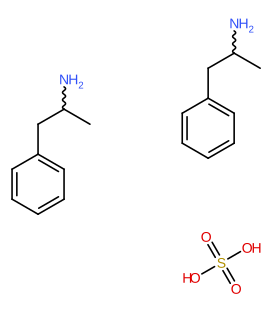
| Amphetamine hemisulfate | |
 | |
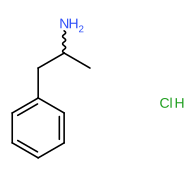
| Amphetamine hydrochloride | |
 | |
| Amphetamine adipate | |
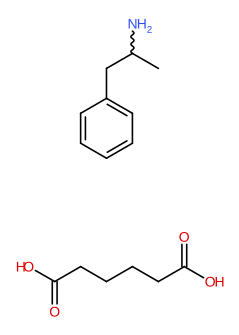 | |
| Amphetamine tartrate | |
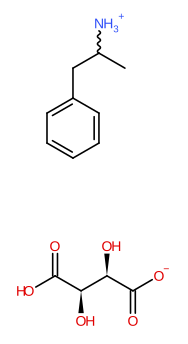 | |
| Amphetamine phosphate | |
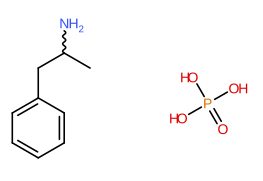 |
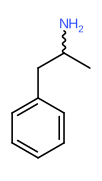
| Molecular structure drawn from PubChem coordinates |
| Physical properties [] | |
|---|---|
| Molecular mass | 135.21 g/mol [1] |
| Appearance | Mobile liquid [1] |
| Odor | Amine odor [1] |
| Taste | Acrid, burning taste [1] |
| Density | 0.913 at 77 °F (EPA, 1998) - Less dense than water; will float [1] |
| Melting point | -98 °C [1] |
| Boiling point | 392 to 397 °F at 760 mmHg (EPA, 1998) [1] |
| Decomposition | When heated to decomposition it emits toxic fumes of nitroxides. [1] |
| Solubility | Moderate solubility [1] |
| Predicted LogP | 1.8 [1] |
| Structural Identifiers [] | |
|---|---|
| Molecular formula | C9H13N |
| IUPAC name | 1-phenylpropan-2-amine |
| SMILES | CC(CC1=CC=CC=C1)N |
| InChI | InChI=1S/C9H13N/c1-8(10)7-9-5-3-2-4-6-9/h2-6,8H,7,10H2,1H3 |
| InChIKey | KWTSXDURSIMDCE-UHFFFAOYSA-N |
| CAS number | 300-62-9 |
| UNII | CK833KGX7E |
| PubChem CID | 3007 |
| Pharmacokinetics[] | |
|---|---|
| Onset | Immediate release dosing: 30-45 minutes, Extended release dosing: 1.5-2 hours[3][4] |
| Elimination half-life | dextroamphetamine: 9-11 hours, levoamphetamine: 11-14 hours, pH-dependent: 7-34 hours[5] |
| Duration of action | Immediate release dosing: 3-6 hours, Extended release dosing: 8-12 hours |
| Metabolism | CYP2D6, DBH, FMO3 |
| Excretion | Primarily renal;, pH-dependent range: 1-75% |
| Routes of administration | Medical: Oral, Recreational: Oral, insufflation, rectal, intramuscular, intravenous |
| Dependence liability | Physical: None, Psychological: Moderate |
| Addiction liability | Moderate |
| Toxicity [] | |
|---|---|
| LD50 | Mouse: - oral: 22 mg/kg - ip: 16 mg/kg Rat: - ip: 125 mg/kg - sc: 39 mg/kg - Subcutaneous: 180 mg/kg [1] |
| Dosing[] |
|---|
| Insufflated [] | |
|---|---|
| Light | ≤ 13.2 mg(518x - 25.4%) |
| Common | 13.2 - 20 mg(635x - 31.2%) |
| Strong | 20 - 30 mg(449x - 22.0%) |
| Heavy | 30 - 44 mg(233x - 11.4%) |
| Extreme | 44 mg +(202x - 9.9%) |
| Intravenous [] | |
|---|---|
| Light | ≤ 25 mg(430x - 46.7%) |
| Common | 25 - 30 mg(178x - 19.3%) |
| Strong | 30 - 35 mg(165x - 17.9%) |
| Heavy | 35 - 40 mg(75x - 8.1%) |
| Extreme | 40 mg +(73x - 7.9%) |
| Sublingual [] | |
|---|---|
| Light | ≤ 13.9 mg(2x - 40.0%) |
| Common | 13.9 - 15 mg(1x - 20.0%) |
| Strong | 15 - 37.5 mg(1x - 20.0%) |
| Heavy | 37.5 - 45 mg |
| Extreme | 45 mg +(1x - 20.0%) |
| Oral [] | |
|---|---|
| Light | ≤ 17 mg(374x - 25.9%) |
| Common | 17 - 30 mg(446x - 30.8%) |
| Strong | 30 - 50 mg(305x - 21.1%) |
| Heavy | 50 - 97 mg(178x - 12.3%) |
| Extreme | 97 mg +(143x - 9.9%) |
| Intrarectal [] | |
|---|---|
| Light | ≤ 40.7 mg(19x - 33.9%) |
| Common | 40.7 - 70 mg(11x - 19.6%) |
| Strong | 70 - 100 mg(15x - 26.8%) |
| Heavy | 100 - 162.5 mg(5x - 8.9%) |
| Extreme | 162.5 mg +(6x - 10.7%) |
Statistically derived dosages via DBI-IGS (archived by anodyne.wiki) We do not take any responsibility for medical complications or loss of life sustained by following these dosages blindly. |
Amphetamine (also known as Amfetamine, dl-Amphetamine, 1-Phenyl-2-aminopropane, Desoxynorephedrine, Norephedrane, Elastonon, Fenopromin, Phenedrine, β-Aminopropylbenzene or Propisamine) is a stimulant substance of the amphetamine class.
Chemistry
Salts []
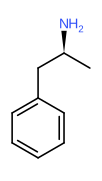
Stereochemistry []
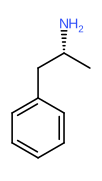
Amphetamine is a racemic mixture of the enantiomers (optical activity ( + / - )).
| Stereoisomerism |
|---|
| Stereoisomers from PubChem |
Druglikeness
Lipinski's rule of five
Amphetamine matches Lipinski's rule of five.Reagents
There are currently 9 reagent-interactions on DrugsPRO
| Reagent | Color change | Description |
|---|---|---|
| Marquis | just orange spots | |
| Mecke | no color change | |
| Mandelin | Neon green / blue | |
| Liebermann | orange > red | |
| Robadope | pink | |
| Simon's | no blue color change | |
| Ehrlich | no color change | |
| Hofmann | no color change | |
| Zimmermann | no change / faint yellow |
Pharmacology
ATC Classification
- nervous system (N)
- psychoanaleptics (N06)
- psychostimulants, agents used for adhd and nootropics (N06B)
- centrally acting sympathomimetics (N06BA)
- amfetamine (N06BA01)
MeSH Classification
- central nervous system stimulants (M0001063)
- sympathomimetics (M0020947)
- dopamine agents (M0023499)
- adrenergic agents (M0027961)
- adrenergic uptake inhibitors (M0028095)
- dopamine uptake inhibitors (M0028098)
Mechanism of action []
Amphetamine's structure closely resembles catecholamine neurotransmitters, characterized primarily by a long planar conformation, an aromatic ring, and nitrogen in the aryl side chain. Like endogenous catecholamines, amphetamine is actively transported into presynaptic nerve terminals via monoamine reuptake transporters, which require association with two sodium ions and one chloride ion. Because amphetamine acts as a competitive substrate, increased concentrations lead to greater internalization of amphetamine. Once in the presynaptic terminal, amphetamine competes for storage in VMAT2 (Vesicular Monoamine Transporter 2), displacing other monoamines. This action induces the release of neurotransmitters into the synapse through a process known as reverse transport. The d-isomer is approximately fourfold more potent than the $l$-isomer in promoting dopamine release via this mechanism. The mechanism of action is further complemented by the inhibition of both monoamine reuptake and monoamine oxidase (MAO), which act synergistically to significantly elevate monoamine concentrations. Amphetamine does not act as a direct inhibitor but rather as a competitive substrate, classifying it as a weak dopamine reuptake inhibitor, a moderate noradrenaline reuptake inhibitor, and a very weak serotonin reuptake inhibitor. Consequently, the l-isomer exhibits significantly lower potency in this specific action. Amphetamine acts as a weak inhibitor of the mitochondrial-bound enzyme MAO, the catalytic enzyme responsible for degrading excess neurotransmitters. Although this mechanism is often considered minor due to its weak inhibitory nature, it remains a component of amphetamine's overall action. Amphetamine is a modulator of glutamatergic neurotransmission, primarily via its action on the dopamine system. The mass release of dopamine caused by amphetamine subsequently signals to the glutamatergic system, leading to long-lasting changes in synaptic plasticity. Amphetamine's entry into dopamine neurons triggers the endocytosis of the excitatory amino acid transporter EAAT3, reducing glutamate clearance and potentiating excitatory synaptic responses mediated by ionotropic receptors. Chronic exposure also alters receptor composition, such as the downregulation of the NMDA receptor NR2B subunit in the striatum, which is a key molecular change underlying behavioral sensitization to the drug. [1]
Prodrugs of amphetamine: Amfetaminil, Amphecloral, Butylamphetamine, Deprenyl, Desmethyldeprenyl, Dimethylamphetamine, Fenethylline, Fenproporex, Mefenorex, Morforex, ZDCM-04.
Medical side effects []
134 side effects listed on drug labels in SIDER 4.1 (amphetamine).
- Cardiac death
- Abdominal pain
- Stomach ache
- Gastrointestinal pain
- Acidosis
- Aggression
- Alopecia
- Anaphylactic shock
- Angina pectoris
- Angioedema
- Decreased appetite
- Anxiety
- Arrhythmia
- Asthenia
- Fatigue
- Ataxia
- Mental disorder
- Breast disorder
- Chest pain
- Coma
- Infection
- Confusional state
- Feeling abnormal
- Connective tissue disorder
- Constipation
- Sudden death
- Libido decreased
- Disturbance in sexual arousal
- Delirium
- Depression
- Diarrhoea
- Polyuria
- Dizziness
- Syncope
- Lightheadedness
- Dysgeusia
- Dyskinesia
- Dysmenorrhoea
- Dyspepsia
- Digestion impaired
- Dyspnoea
- Toxic epidermal necrolysis
- Dermatitis
- Rash
- Eye disorder
- Exhaustion
- Body temperature increased
- Flushing
- Gastrointestinal disorder
- Hallucination
- Headache
- Cardiac disorder
- Hypersensitivity
- Hypertension
- Hypotension
- Irritability
- Lethargy
- Mydriasis
- Myocardial infarction
- Acute coronary syndrome
- Nausea
- Nervous system disorder
- Nervousness
- Tension
- Neuroleptic malignant syndrome
- Pallor
- Palpitations
- Panic reaction
- Psychotic disorder
- Psychotic episode
- Paranoia
- Rhabdomyolysis
- Convulsion
- Shock
- Sleep terror
- Speech disorder
- Erythema multiforme
- Stevens-Johnson syndrome
- Cerebrovascular accident
- Hyperhidrosis
- Loss of consciousness
- Tachycardia
- Tooth disorder
- Tourette's disorder
- Tremor
- Urinary tract infection
- Urethral disorder
- Urinary tract disorder
- Urticaria
- Allergic urticaria
- Angiopathy
- Viral infection
- Vomiting
- Weight decreased
- Dry mouth
- Chills
- Agitation
- Hyperkinesia
- Mood swings
- Affect lability
- Panic attack
- Drug withdrawal syndrome
- Growth retardation
- Haemorrhage intracranial
- Injury
- Hyperreflexia
- Malnutrition
- Colitis ischaemic
- Photosensitivity reaction
- Skin disorder
- Anhedonia
- Abdominal pain upper
- Muscle twitching
- Increased appetite
- Dysphoria
- Choreoathetosis
- Euphoric mood
- Disturbance in attention
- Mental disability
- Vasculitis cerebral
- Erectile dysfunction
- Blood pressure systolic increased
- Extrasystoles
- Hyperpyrexia
- Psychomotor retardation
- Blood pressure increased
- Visual impairment
- Drug dependence
- Compulsions
- Tic
- Cardiomyopathy
- Hypersomnia
- Insomnia
- Somnolence
Indications
- Appetite absent
- Attention deficit disorder
- Attention deficit/hyperactivity disorder
- Distractibility
- Electroencephalogram abnormal
- Forgetfulness
- Hyperkinesia
- Learning disability
- Mental disorder
- Mood swings
- Narcolepsy
- Psychotic disorder
Subjective effects []
| 0xea / Amphetamine [] | |
|---|---|
Routes:
| |
| a1ko / Amphetamine [] | |
|---|---|
Routes:
| |
| alina / Amphetamine [] | |
|---|---|
Routes:
| |
| bonzi / Amphetamine [] | |
|---|---|
| emily / Amphetamine [] | |
|---|---|
Routes:
| |
| magnus / Amphetamine [] | |
|---|---|
Routes:
| |
| Mere / Amphetamine [] | |
|---|---|
| michalina / Amphetamine [] | |
|---|---|
Forms:
| |
| nervewing / Amphetamine [] | |
|---|---|
| ninerik / Amphetamine [] | |
|---|---|
Classes:Source:
| |
| Pilz / Amphetamine [] | |
|---|---|
Routes:
| |
| vivi / Amphetamine [] | |
|---|---|
Routes:
| |
| x86pup / Amphetamine [] | |
|---|---|
Routes:
| |
Experience reports
Erowid
There are currently 30 experience reports involving amphetamine on Erowid: []- "Anything Goes � Dealer�s Choice, and I�m the Dealer" by Anatoli Smorin
- "Sweaty, Jittery, Fun & Productive" by Anatoli Smorin
- "Eight Months of Regimented Substance Use" by Anatoli Smorin
- "How Ironic" by Drew
- "Speed Caused My Stroke?" by Jay See
- "Disastrous Even With a Prescription" by EffedMjr.
- "A Blissful Week and a Half" by AustinRN
- "A Walk With the Universe" by Fairy Princess
- "Our Adventurous Binge Pt. 1" by AddyMan96
- "Addiction Is No Longer an Issue" by J._Nyb
- "Generation Adderall" by Casey Schwartz
- "Good Girl On..." by Anonymous
- "Seven-Hour Trip Cured My HPPD" by Jason
- "Reversible MAOI Interactions" by MB
- "Dabblings With Amphetamines" by CrazyChemist
- "A New Light" by wfan420
- "The Wonders of Stimulants" by Curious George
- "Therapeutic Potential" by Nadja
- "Confidence Enhancing, not Intelligence!" by Average student
- "I Told Myself I'd Never be One of Those..." by Chris
- "Food Issues/Eating Disorders" by Anna
- "Rise and Shine, Crash and Burn" by William Rehnquist
- "Good Mixer Drug" by D-Bag420
- "I'm Not An Addict" by Jane
- "Growing Up High" by Jen
- "Polypharmacy, Sleep, and Addiction" by Az
- "The Story of Tom (Schizophrenia Revealed)" by The Man of Decency
- "Red Blood Cells in Party Hats" by The Elf
- "The Beginning of Self-Knowledge" by The Seeker
- "Adventures in Academics" by Some student
- "An Acid Trip that Only Satan Himself could Imagine || A Detailed Account of the Events that Transcended one Fateful Halloween 5 yrs ago. Resulting in the Admittance of my Best Friend into the ER, Him Stealing a Car, Developing Psychosis, and so so Much More Crazy Shit!!" by GrizzlyAdams123 (74 upvotes)
- "Talking to a Cop on my first Acid Trip" by PotatoSharp6339 (69 upvotes)
- "1 Gram Of Meth And Being Abducted By Aliens From My Jail Cell (Psychosis Story)" by W8_420 (63 upvotes)
- "Smoking DMT and losing it all." by mystic300 (54 upvotes)
- "I Have Tried Every Single Drug and Steroid" by Hangeth_Thy_Dong (51 upvotes)
- "The time I accidentally got dosed 3200mics while hanging out with a friend from playstation (long read)" by MrFuzzySeratonin (50 upvotes)
- "My Heroic Journey on 3.5 grams of Mushrooms" by dadjeans96 (46 upvotes)
- "First Ever Psychedelic (3.5g of Shrooms)" by send-some-help (46 upvotes)
- "Scary breakthrough and entering the afterlife on 250 ug" by KietMaan (44 upvotes)
- "12g A+ Albino mushroom trip ( FUCKING CRAZY)" by chaseyB01 (44 upvotes)
- "Most intense mushroom experience so far" by CrispyBrosine (43 upvotes)
- "My last time taking LSD (it’s a doozy)" by shadowofthedogman (41 upvotes)
- "I was injected with DMT in the name of science" by Samwise2512 (36 upvotes)
- "First DMT breakthrough" by CatharsisPachimwi (36 upvotes)
- "What was I thinking: First trip goes south when taking a stupid amount of shrooms, tab of acid, and smoking weed on top of everything." by bossinbananza (35 upvotes)
- "400 UG tab + Adderall + Nitrous most insane visuals ive ever seen." by bignotcherry (34 upvotes)
- "Accidentally taking too much fake lsd" by stjakey (34 upvotes)
- "How 6 Grams of Shrooms “Released” Me From Nicotine For Good." by PsychedelicWalnuts (31 upvotes)
- ""I am god" on 5-MeO-DMT" by NondualTherapy (30 upvotes)
- "Weed became my nicotine" by stjakey (30 upvotes)
- "Thank you Lucy for changing my life [LSD 150ug]" by AmITrippingHahaYes (30 upvotes)
- "Psychedelia Turned Into Stimulant Psychosis (on a tab of DOC)." by 26LT (30 upvotes)
- "20X Salvia Trip Report" by SicilianTorah (29 upvotes)
- "Life Changing Trip" by Plastic_Job_5705 (29 upvotes)
- "My full drug career to this point. (Feel free to skim )" by Solid-Ambition-6635 (28 upvotes)
- "~900ug LSD Trip: Seeing God, feeling Hell (VERY LONG POST)" by chexsmexy (28 upvotes)
- "What is a trip exactly? I'm new and had difficulty just giving in to my mind" by thisiswhatiwant (27 upvotes)
- "DMT Report" by Ecstatic-Nectarine53 (27 upvotes)
- "Every Drug I've taken so far (AMA)" by Used-Philosopher-408 (26 upvotes)
- "The acid trip that changed my life" by acidchangedyalife (26 upvotes)
- "Insane Life Changing Shroom Trip (4g Penis Envy)" by LordStinkyDinky (26 upvotes)
- "1500 Microgram: A journey to multiverse within" by lsd_lover (25 upvotes)
- "LSD+Shrooms+DMT" by KLWTY (25 upvotes)
- "Accidental 400μg LSD-25 in Silent Darkness, at 16 years old (feb. 2020)" by KronixPC (25 upvotes)
- "Meth psychosis trip report" by 0bscurious (25 upvotes)
- "First Soul Bomb [500ug LSD + 3.5g Amz. Cubes]" by ethnob711 (25 upvotes)
- "2000ug ways LSD changed me." by Interesting-Chance-8 (24 upvotes)
- "100ug 1p-LSD + 3 hits from dab pen." by aaawbtway (24 upvotes)
- "1000 mcg trip report" by SFwandering2day (22 upvotes)
- "Liquid...something." by Joszul (22 upvotes)
- "10 grams fresh Atlantis truffles – 1st trip ever – A Shapeshifting Native American Shaman helped me to expel my demon of alcoholism" by elvisjaggeraj (21 upvotes)
- "[Mushrooms, MAOI, NOS] Meeting Aliens, Getting Possessed, and Talking to the Gnomes" by ethnob711 (21 upvotes)
- ""And..." A Terrifyingly Beautiful LSD Ego Death Trip Report" by acidshlov (20 upvotes)
- "Tripping Alone LSD 300ug" by Zac_bro (19 upvotes)
- "My most intense trip was on 160 ug acid + cannabis(hash)" by seetrough99 (19 upvotes)
- "First time doing DXM. (LONG)" by lolnoscopedtf (19 upvotes)
- "Doing MDMA for my first time, alone." by the_lone_roller (19 upvotes)
- "3.5G albino on Saturday..." by chrismushman (18 upvotes)
- "The 4 Trips That Changed My Life" by Desperate_Loss7783 (18 upvotes)
- "3.5g P. Cubensis (August 2018)" by Doc_George (18 upvotes)
Legal status []
- Australia: Amphetamine is a Schedule 8.
- Brazil: Amphetamine is a A3.
- Canada: Amphetamine is a Schedule I.
- Germany: Amphetamine is a Anlage III under the "Betäubungsmittelgesetz (BtMG)".
- New Zealand: Amphetamine is a Class B.
- United Kingdom: Amphetamine is a Class B under the "Misuse of Drugs Act 1971".
- United States: Amphetamine is a Schedule II under the "Controlled Substances Act".[6]
- United Nations: Amphetamine is a Psychotropic Schedule II.
- Other: Amphetamine is a SE: Förteckning II.[7]
See also []
External links []
- Amphetamine (Wikipedia)
- Amphetamine (PubChem)
- Amphetamine (Wikidata)
- Amphetamine (DrugBank)
- Amphetamine (ChEMBL)
- Amphetamine (ChEBI)
- Amphetamine (Common Chemistry)
- Amphetamine (HMDB)
- Amphetamine (KEGG)
- Amphetamine (EPA DSSTox)
- Amphetamine (Effect Index)
- Amphetamine (UNII)
- Amphetamine (SIDER)
- Amphetamine (Erowid)
References []
National Center for Biotechnology Information. PubChem Compound Summary for CID 3007, Amphetamine. Accessed November 20, 2026. https://pubchem.ncbi.nlm.nih.gov/compound/3007
U.S. Food and Drug Administration; National Center for Advancing Translational Sciences. Amphetamine. UNII: CK833KGX7E. Global Substance Registration System. Accessed November 20, 2026. https://gsrs.ncats.nih.gov/ginas/app/beta/substances/CK833KGX7E
Millichap JG. Attention Deficit Hyperactivity Disorder Handbook: A Physician's Guide to ADHD. Springer. 2010.
Brams M, Mao AR, Doyle RL. Onset of efficacy of long-acting psychostimulants in pediatric attention-deficit/hyperactivity disorder. Postgraduate Medicine. September 2008; 120(3):69–88. PMID 18824827. https://doi.org/10.3810/pgm.2008.09.1909
Adderall- dextroamphetamine saccharate, amphetamine aspartate, dextroamphetamine sulfate, and amphetamine sulfate tablet. DailyMed. 8 November 2019. https://dailymed.nlm.nih.gov/dailymed/drugInfo.cfm?setid=f22635fe-821d-4cde-aa12-419f8b53db81
Ingersoll J. Amphetamine, Methamphetamine, and Optical Isomers. Federal Register. 7 July 1971. https://archives.federalregister.gov/issue_slice/1971/7/7/12730-12734.pdf
Läkemedelsverkets föreskrifter (LVFS 2011:10) om förteckningar över narkotika. Läkemedelsverket. https://www.lakemedelsverket.se/globalassets/dokument/lagar-och-regler/lvfs/lvfs-2011-10-konsoliderad.pdf
Data sources []
| Source | Status | Updated (UTC) |
|---|---|---|
| dosing | ok | 2026-11-20 03:08:03 |
| drugspro | ok | 2026-11-20 03:07:59 |
| erowid | ok | 2026-11-20 03:08:02 |
| gsrs | ok | 2026-11-20 03:08:03 |
| hmdb | missing (hmdb.ca refused automated access to HMDB0014328) | 2026-11-20 03:07:59 |
| kegg | ok | 2026-11-20 03:08:00 |
| pubchem | ok | 2026-11-20 03:07:57 |
| ok | 2026-11-20 03:07:59 | |
| sider | ok | 2026-11-20 03:07:59 |
| structure | ok | 2026-11-20 03:07:59 |
| wikipedia | ok | 2026-11-20 03:07:59 |