Caffeine
| Caffeine | |
|---|---|
 |
| Salts [] | |
|---|---|
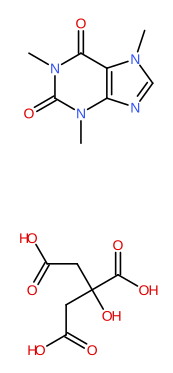
| Caffeine citrate | |
 | |
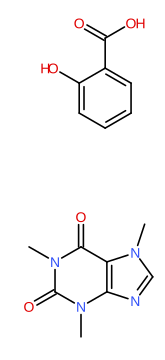
| Caffeine salicylate | |
 | |
| Caffeine monohydrate | |
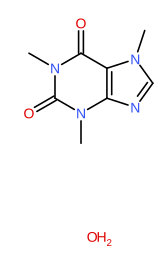 |
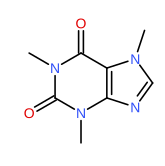
| Molecular structure drawn from PubChem coordinates |
| Rotamer [] | |
|---|---|
| Conformer structure via 3Dmol.js |
| Physical properties [] | |
|---|---|
| Molecular mass | 194.19 g/mol [1] |
| Appearance | White, prismatic crystals [1] |
| Odor | Odorless [1] |
| Taste | Bitter taste [1] |
| Density | 1.23 at 64 °F (NTP, 1992) - Denser than water; will sink [1] |
| Melting point | 460 °F (NTP, 1992) [1] |
| Boiling point | 352 °F at 760 mmHg (sublimes) (NTP, 1992) [1] |
| Decomposition | When heated to decomposition, it emits toxic fumes of /nitrogen oxides/. [1] |
| Solubility | 10 to 50 mg/mL at 73 °F (NTP, 1992) [1] |
| Predicted LogP | -0.1 [1] |
| Structural Identifiers [] | |
|---|---|
| Molecular formula | C8H10N4O2 |
| IUPAC name | 1,3,7-trimethylpurine-2,6-dione |
| SMILES | CN1C=NC2=C1C(=O)N(C(=O)N2C)C |
| InChI | InChI=1S/C8H10N4O2/c1-10-4-9-6-5(10)7(13)12(3)8(14)11(6)2/h4H,1-3H3 |
| InChIKey | RYYVLZVUVIJVGH-UHFFFAOYSA-N |
| CAS number | 58-08-2 |
| UNII | 3G6A5W338E |
| PubChem CID | 2519 |
| Pharmacokinetics[] | |
|---|---|
| Onset | 45 minutes–1 hour[3] |
| Elimination half-life | Adults: 3–7 hours, Infants (full term): 8 hours, Infants (premature): 100 hours[4] |
| Duration of action | 3–4 hours[5] |
| Metabolism | Primary: CYP1A2, Minor: CYP2E1, CYP3A4,, CYP2C8, CYP2C9 |
| Excretion | Urine (100%) |
| Routes of administration | Common: By mouth Medical: Intravenous , Uncommon: Insufflation, rectal, transdermal, topical, buccal, sublingual, inhalation |
| Dependence liability | Physical: Low–moderate (9–30%) , Psychological: Low–moderate[6] |
| Addiction liability | None[7][8] |
| Toxicity [] | |
|---|---|
| LD50 | Mouse: - Oral: 127 mg/kg Rat: - ip: 260 mg/kg - oral: 192 mg/kg - rectal: 300 mg/kg - iv: 105 mg/kg [1] |
Caffeine (also known as Guaranine, 1,3,7-Trimethylxanthine, Methyltheobromine, Theine, Thein, Cafeina, Caffein, Cafipel, Koffein or Mateina) is a depressant substance of the xanthine class.
It is a constituent of coffea.
Chemistry
Salts []
Stereochemistry []
Caffeine is achiral.
Druglikeness
Lipinski's rule of five
Caffeine matches Lipinski's rule of five.Reagents
There are currently 10 reagent-interactions on DrugsPRO
| Reagent | Color change | Description |
|---|---|---|
| Marquis | no color change | |
| Mecke | no color change | |
| Mandelin | no color change | |
| Liebermann | light yellow / yellow | |
| Froehde | no color change | |
| Robadope | no pink color change | |
| Simon's | no blue color change | |
| Ehrlich | no color change | |
| Hofmann | no color change | |
| Scott | no color change |
Pharmacology
ATC Classification
- dermatologicals (D)
- other dermatological preparations (D11)
- other dermatological preparations (D11A)
- other dermatologicals (D11AX)
- caffeine (D11AX26)
- nervous system (N)
- psychoanaleptics (N06)
- psychostimulants, agents used for adhd and nootropics (N06B)
- xanthine derivatives (N06BC)
- (N06BC01)
- caffeine (N06BC01)
MeSH Classification
- central nervous system stimulants (M0001063)
- phosphodiesterase inhibitors (M0016659)
- purinergic p1 receptor antagonists (M0545362)
Mechanism of action []
The mechanism of action of caffeine is complex, as it impacts several body systems, which are listed below. The effects as they relate to various body systems are described as follows: **General and cellular actions** Caffeine exerts several actions on cells, but the clinical relevance is poorly understood. One probable mechanism is the inhibition of nucleotide phosphodiesterase enzymes, adenosine receptors, regulation of calcium handling in cells, and participates in adenosine receptor antagonism. Phosphodiesterase enzymes regulate cell function via actions on second messengers cAMP and cGMP. This causes lipolysis through activation of hormone-sensitive lipases, releasing fatty acids and glycerol. **Respiratory** The exact mechanism of action of caffeine in treating apnea related to prematurity is unknown, however, there are several proposed mechanisms, including respiratory center stimulation in the central nervous system, a reduced threshold to hypercapnia with increased response, and increased consumption of oxygen, among others. The blocking of the adenosine receptors enhances respiratory drive via an increase in brain medullary response to carbon dioxide, stimulating ventilation and respiratory drive, while increasing contractility of the diaphragm. **Central nervous system** Caffeine demonstrates antagonism of all 4 adenosine receptor subtypes (A1, A2a, A2b, A3) in the central nervous system. Caffeine's effects on alertness and combatting drowsiness are specifically related to the antagonism of the A2a receptor. **Renal system** Caffeine has diuretic effects due to is stimulatory effects on renal blood flow, increase in glomerular filtration, and increase in sodium excretion. **Cardiovascular system** Adenosine receptor antagonism at the A1 receptor by caffeine stimulates inotropic effects in the heart. Blocking of adenosine receptors promotes catecholamine release, leading to stimulatory effects occurring in the heart and the rest of the body. In the blood vessels, caffeine exerts direct antagonism of adenosine receptors, causing vasodilation. It stimulates the endothelial cells in the blood vessel wall to release nitric oxide, potentiating blood vessel relaxation. Catecholamine release, however, antagonizes this and exerts inotropic and chronotropic effects on the heart, ultimately leading to vasoconstriction. Finally, caffeine is shown to raise systolic blood pressure measurements by 5 to 10 mmHg when it is not taken regularly, versus no effect in those who consume it regularly. The vasoconstricting effects of caffeine are beneficial in migraines and other types of headache, which are normally caused by vasodilation in the brain. [1]
Interactions []
Interaction mechanisms documented in KEGG DRUG (number of interacting drugs):
| CYP1A2 | inhibition / metabolism | 37 |
|---|---|---|
| ADORA1 | shared target | 8 (1 contraindicated) |
| PDE4A | shared target | 8 |
| PDE1B | shared target | 7 |
| PDE2A | shared target | 7 |
| PDE3A | shared target | 7 |
| PDE3B | shared target | 7 |
| PDE4B | shared target | 7 |
| PDE4C | shared target | 7 |
| PDE4D | shared target | 7 |
| CYP2E1 | metabolism | 4 |
| ADORA2A | shared target | 3 (1 contraindicated) |
| PDE5A | shared target | 2 |
Medical side effects []
51 side effects listed on drug labels in SIDER 4.1 (caffeine).
- Dermatitis
- Rash
- Sepsis
- Necrotising colitis
- Necrotising enterocolitis neonatal
- Acidosis
- Disseminated intravascular coagulation
- Dyspnoea
- Gastritis
- Gastrointestinal haemorrhage
- Haemorrhage
- Haemoglobin
- Pulmonary oedema
- Renal failure
- Retinopathy of prematurity
- Skin disorder
- Impaired healing
- Injury
- Dry skin
- Cerebral haemorrhage
- Immune system disorder
- Infection
- Deafness
- Failure to thrive
- Gastrointestinal disorder
- Cardiac disorder
- Hyperglycaemia
- Hypersensitivity
- Hypertension
- Hypoglycaemia
- Irritability
- Nervous system disorder
- Convulsion
- Tachycardia
- Agitation
- Blood creatinine increased
- Haemoglobin decreased
- Malnutrition
- Brain injury
- Stroke volume increased
- Nervousness
- Feeling jittery
- Hypercalcaemia
- Blood sodium increased
- Infestation
- Infusion site phlebitis
- Infusion site inflammation
- Urine output increased
- Thyroxine decreased
- Brain hypoxia
- Regurgitation
Indications
- Apnoea
- Primary apnea of premature newborns
Subjective effects []
| 0xea / Caffeine [] | |
|---|---|
Routes:
| |
| a1ko / Caffeine [] | |
|---|---|
Routes:
| |
| alina / Caffeine [] | |
|---|---|
Routes:
| |
| bonzi / Caffeine [] | |
|---|---|
Routes:
| |
| emily / Caffeine [] | |
|---|---|
Routes:
| |
| magnus / Caffeine [] | |
|---|---|
Routes:
| |
| nervewing / Caffeine [] | |
|---|---|
| ninerik / Caffeine [] | |
|---|---|
Routes:
| |
| Pilz / Caffeine [] | |
|---|---|
Routes:
| |
| vivi / Caffeine [] | |
|---|---|
Routes:
| |
Experience reports
Erowid
There are currently 30 experience reports involving caffeine on Erowid: []- "Anything Goes � Dealer�s Choice, and I�m the Dealer" by Anatoli Smorin
- "Jittery Pooping" by Anatoli Smorin
- "Eight Months of Regimented Substance Use" by Anatoli Smorin
- "Psychedelic Molly" by Horhe
- "Through the Roof" by Luis A
- "Glorious" by supersonic
- "Unexpected Ego Death" by DrSeuss
- "A Bag Full of Bad Ideas" by LFK
- "Insufflated vs. Oral, Caffeine Comparison" by cowardsCoke
- "Workin' With a Heart Attack-Ack-Ack: Liveblogging a Test Run of AeroShot Caffeine Inhalers" by Drew Grant
- "Happy, Euphoric, Energetic High" by cannadware
- "Affective Catapulting" by Karakal
- "A Stupid Mistake" by Metafractal
- "Kick the Coffee" by Eulachon
- "Supreme Productivity" by Greg
- "24 Hour Adventure" by Deptstoremook
- "Childhood Revisited" by Xherrus
- "My Beloved Partner" by Reene
- "Stimulation, Tension, Concentration Affected" by eveningguru
- "An Experiment" by NoSleepTillSunrise
- "Maximizing the Day's Potential" by Habibi
- "An Evolved Relationship" by Chizzlewit
- "Never Knew That I Truly Was Addicted" by V
- "Not Especially Impressed..." by orlando to miami
- "Intense Psychedelic Dream" by howard
- "Coffee Slave" by hooked
- "Got My Sense of Humor Back, But Doesn't Combine Well" by Anonymous
- "Inspired to Quit" by Taren
- "Always Use A Spoon" by CoffeeDude
- "A Nasty Drug Gurd Yuk...!" by Traven
- "The Soup: 250ug LSD, 22mg 2C-B, Nitrous Oxide, Cannabis, and Nicotine." by postcooked_2 (49 upvotes)
- "I did 3 grams of mushrooms and it changed my life" by weezy-13 (36 upvotes)
- "Player 1 has reconnected" by Kitty-Kittinger (34 upvotes)
- "Weed became my nicotine" by stjakey (30 upvotes)
- "Every Drug I've taken so far (AMA)" by Used-Philosopher-408 (26 upvotes)
- "High dose of caffeine and marijuana, along with ketamine (uncomfortable experience)" by strangegeneration94 (23 upvotes)
- "The first time I dropped acid (overwhelming & scary)" by strangegeneration94 (22 upvotes)
- "4-Ceremony Ayahuasca Report" by spaghetti_okra (20 upvotes)
- ""I think I'm having a stroke" - Don't mix DMT + Cocaine" by Trick_Statement3390 (18 upvotes)
- "Being lowered down several layers of reality on 160mg of ket" by terrymckenna2012 (17 upvotes)
- "First drop experience at age, 37 (approx. 150 ug - Aug. 2020)" by Doc_George (15 upvotes)
- "2-FMA (2-Fluoromethamphetamine) trip report" by dioxycontin (14 upvotes)
- "4F-MPH (4Fluoromethylphenidate) Trip Report [research chemical stimulant]" by dioxycontin (13 upvotes)
- "A bad night of stomach pain" by Peaceful_pothead (12 upvotes)
- "Weed + DPH + DXM + Codeine + Benzedrex + Hydroxyzine" by AdministrationMany53 (11 upvotes)
- "Trippin on DXM for the first time" by HelpEli (11 upvotes)
- "Physically painful nightmare shroom trip" by NoCuello (11 upvotes)
- "A Deal with Ayahuasca - Sober After 8 Years of Alcoholism" by alpha_ray_burst (10 upvotes)
- "My stupid experience" by carspottingNFT (9 upvotes)
- "Diamond Shruumz Gummies" by Narrow-Beginning5761 (9 upvotes)
- "Description, comparison and rating of 14 opioids " by PsychedStrawberry (9 upvotes)
- "Caffeine, Nicotine, Diazepam - A day of opposites" by [deleted] (9 upvotes)
- "Trip report: 15g hollandia truffle" by superzavv (9 upvotes)
- "Tripping on DPH" by fiendingtesticle (9 upvotes)
- "Caffeine effects report" by HerbRat (8 upvotes)
- "Jan. 2nd - 3rd, 2022 - 300mg DXM Report" by ImThatStonerKid (8 upvotes)
- "LSD+3-HO-PCP trip report" by lowkey_add1ct (7 upvotes)
- "does anyone else ever read a trip report and think, “this guy is an insufferable asshole?” here’s an example of one caffeine report I came across" by Nighthoodz1642 (7 upvotes)
- ""the light" a 250ug LSD + 3.5 gram penis envy mushroom + cannabis trip report" by ripkoikio (7 upvotes)
- "trippin on stilnox" by raccatacc (7 upvotes)
- "first time meeting an online friend u already know we got high as hell" by HistoricalNebula5050 (6 upvotes)
- "350mg of caffeine (5 espresso shots) vs 2 melatonin pills (10mg each) made me tweak in lecture yesterday" by Accomplished_Bowl219 (6 upvotes)
- "Found an incomplete trip report from my robo blackout. Read and AMA." by toopsychedforlife (6 upvotes)
- "2 capsules of "Club Mixxx 3.0" (branded herbal supplement) at a festival - a surprisingly intense roll! (300mg total of N,N-DMPEA, caffeine and glaucine)" by fazedncrazed (6 upvotes)
- "My 100% federally legal 4 Day Plateau 1 Tour Guid/Trip Report" by Azzanadra_ (5 upvotes)
- "Caffeine Trip Report (5000mg) - Caffeine " by Embarrassed_Theory28 (5 upvotes)
- "350 mg dxm + dph & nicotine vape 💨" by lorengreen4 (5 upvotes)
- "First trip - 2g + 2g mushroom chocolate bar." by 0x2142 (5 upvotes)
- "What was in that gummy? A "cannabis oil" trip report" by nils_olav_III (4 upvotes)
- "Diamond Shruumz Microdose Gummies" by calbgreenbeane (4 upvotes)
- "Strong dose of DCK, new plateau, unexpected twists, and some overwhelming moments (detailed/analytical)" by throwaway734169 (4 upvotes)
- "DXM Trip report 480mg (I'm an idiot)" by Parsnip-Murky (4 upvotes)
- "Bad trip on Caffeine, Paracetamol and Ibuprofen?" by Red-Boxes (4 upvotes)
- "The Moment Is What Matters: MDMA and Ketamine experience" by 3Alsjeblieft (4 upvotes)
- "There are 45 psychedelic and dissociative trip reports in the Drug Users Bible: Download a free copy from here. Whether psychedelics are used for recreation, you need to look after yourself. Stay safe." by DMTrott (3 upvotes)
- "PEA HORROR STORY" by JinxxCuts (3 upvotes)
- "Doing 40 pills again after 2 years." by Beginning_Camel5122 (3 upvotes)
- "DXM Trip Report - Self experimentation for Depression" by Spiritual_West1540 (3 upvotes)
- "First time blue lotus tea Trip report (aka blue lily of the nile)" by DMANROCKED (3 upvotes)
- "DPH trip 200 mg alone" by Augm3nt_ (3 upvotes)
Legal status []
- Australia: Caffeine is Unscheduled.
- Brazil: Caffeine is Unscheduled.
- Canada: Caffeine is Unscheduled.
- Germany: Caffeine is Unscheduled.
- New Zealand: Caffeine is Unscheduled.
- United Kingdom: Caffeine is a GSL.
- United States: Caffeine is Unscheduled.
- United Nations: Caffeine is Unscheduled.
- Other: Caffeine is a CN: OTC, SE: Unscheduled In general legal for all uses.[9]
See also []
External links []
References []
National Center for Biotechnology Information. PubChem Compound Summary for CID 2519, Caffeine. Accessed November 20, 2026. https://pubchem.ncbi.nlm.nih.gov/compound/2519
U.S. Food and Drug Administration; National Center for Advancing Translational Sciences. Caffeine. UNII: 3G6A5W338E. Global Substance Registration System. Accessed November 20, 2026. https://gsrs.ncats.nih.gov/ginas/app/beta/substances/3G6A5W338E
Institute of Medicine (US) Committee on Military Nutrition Research. Pharmacology of Caffeine. National Academies Press (US). 2001. https://www.ncbi.nlm.nih.gov/books/NBK223808/
Caffeine. DrugBank. 16 September 2013. http://www.drugbank.ca/drugs/DB00201#pharmacology
Poleszak E, Szopa A, Wyska E, Kukuła-Koch W, Serefko A, Wośko S, Bogatko K, Wróbel A, Wlaź P. Caffeine augments the antidepressant-like activity of mianserin and agomelatine in forced swim and tail suspension tests in mice. Pharmacological Reports. February 2016; 68(1):56–61. PMID 26721352. https://ruj.uj.edu.pl/xmlui/handle/item/101035
Griffiths RR, Chausmer AL. Caffeine as a model drug of dependence: Recent developments in understanding caffeine withdrawal, the caffeine dependence syndrome, and caffeine negative reinforcement. Nihon Shinkei Seishin Yakurigaku Zasshi = Japanese Journal of Psychopharmacology. 2000; 20(5):223–231. PMID 11326548.
Quadra GR, Brovini EM, dos Santos JA, Paranaíba JR. Handbook of Substance Misuse and Addictions. Springer International Publishing. 2022. https://doi.org/10.1007/978-3-030-67928-6_78-1
Nestler EJ, Kenny PJ, Russo SJ, Schaefer A. Nestler, Hyman & Malenka's Molecular Neuropharmacology: A Foundation for Clinical Neuroscience. McGraw Hill. 2020.
Koffein Viatris, Tablett 100 mg. Läkemedelsverket. https://www.lakemedelsverket.se/sv/sok-lakemedelsfakta/lakemedel/19730302000030/koffein-viatris-100-mg-tablett#:~:text=Vissa%20f%C3%B6rpackningar%20receptbelagda
Data sources []
| Source | Status | Updated (UTC) |
|---|---|---|
| dosing | missing (no dosing statistics) | 2026-11-20 07:07:42 |
| drugspro | ok | 2026-11-20 07:07:38 |
| erowid | ok | 2026-11-20 07:07:39 |
| gsrs | ok | 2026-11-20 07:07:40 |
| hmdb | missing (hmdb.ca refused automated access to HMDB0001847) | 2026-11-20 07:07:38 |
| kegg | ok | 2026-11-20 07:07:41 |
| pubchem | ok | 2026-11-20 07:07:37 |
| ok | 2026-11-20 07:07:38 | |
| sider | ok | 2026-11-20 07:07:38 |
| structure | ok | 2026-11-20 07:07:38 |
| wikipedia | ok | 2026-11-20 07:07:38 |